
The Rainbow, The Quilt, and The Gavel: Why Jesse Jackson’s Legacy is a Logical Trap
Why the passing of a titan isn’t just about a man, but the death of a specific kind of economic delusion.

I was huddled in a Chicago dive bar yesterday when the news broke: Rev.Jesse Jackson had passed away.
My buddy, the kind of guy who still carries a union card and views the federal government as a bottomless ATM, raised his glass in a somber toast.
“A giant is gone,” he said, his voice heavy with the sort of grief you only feel for a hero. “He spent fifty years trying to get the little guy a seat at the table.”
Part of me wanted to just nod and leave it at that.
Who doesn’t want the “little guy” to catch a break?
But the other part of me — the part that’s spent far too many late nights buried in the works of Ludwig von Mises and Immanuel Kant — couldn’t let it slide.
I looked at him and said, “He wasn’t just looking for a seat at the table, Mike.
He wanted to rewrite the entire menu using other people’s money.
And in the process, he turned that ‘little guy’ into nothing more than a political rounding error.”
Why the “Rainbow” Made Sense
To understand why Jackson was such a force, you have to be honest about the world that forged him.
He came up in the Jim Crow South.
He saw the “Colored Only” signs.
He felt the sharp sting of state-enforced exclusion every single day.
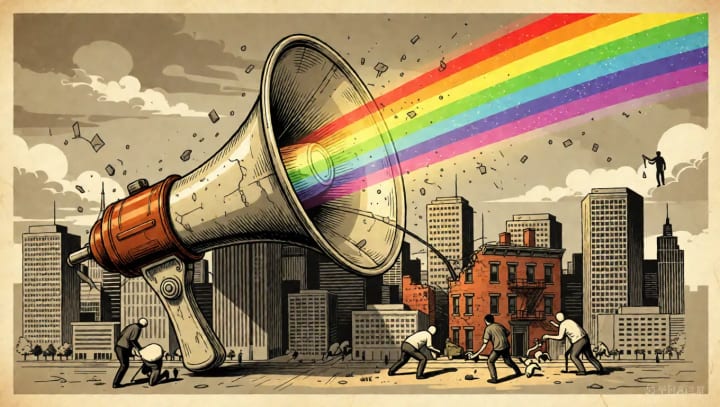
When he talked about the “Rainbow Coalition,” he wasn’t just being poetic; he was throwing a lifeline to people the system had spent decades trying to crush.
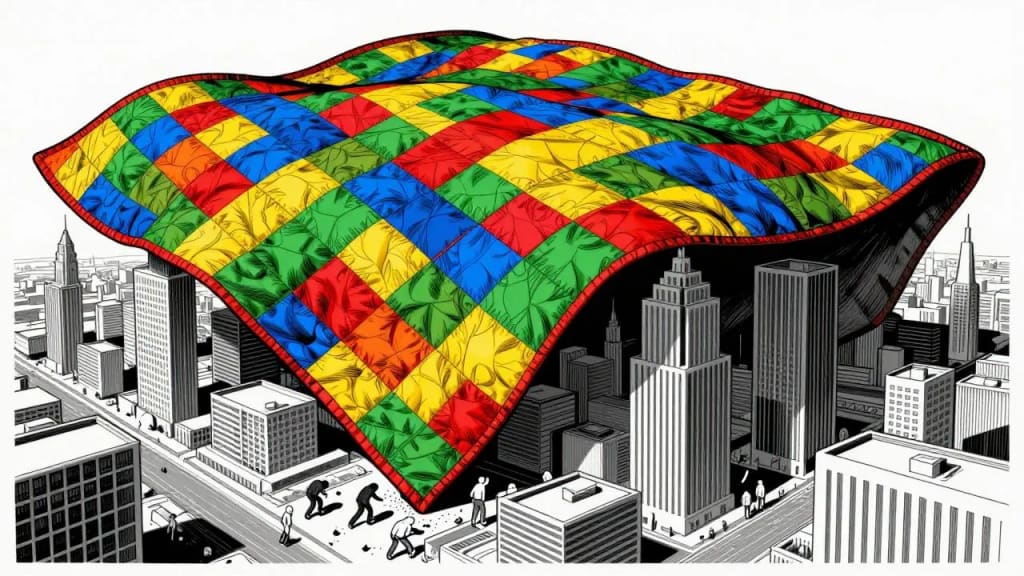
- The Premise: America is a “patchwork quilt,” not a melting pot.
- The Mission: Ensure every group — Black, Brown, poor, female — gets their specific slice of the political pie.
- The Pull: It didn’t just feel like fairness; it felt like a long-overdue settling of scores. To anyone feeling small or forgotten, Jackson’s voice was thunder.
He permitted people to feel like they were “Somebody.” He famously said, “Tears will get you sympathy; sweat will get you change.”
That’s a powerful, humanizing message.
It taps into our deepest need for dignity.
We have to acknowledge that the impulse to join the Rainbow wasn’t a character flaw — it was a survival strategy against state-sponsored tribalism.
The Quilt That Smothers
But this is where the logic starts to unravel.
Take that “Quilt” philosophy to its natural conclusion, and you run into something chilling: the individual eventually disappears into the pattern.

When you treat people as “patches” in a group, you stop seeing them as Kantian Ends-in-Themselves.
- You become a demographic variable, a chip to be traded by political power brokers.
- Jackson’s activism didn’t just demand justice; it demanded the rigid enforcement of quotas.
- It forced the world to prioritize color and class over character and competence.
If the state’s primary role is to “even the playing field” by tilting the board for specific groups, it eventually has to control every move every player makes.
“When you trade your freedom for the promise of ‘economic common ground,’ you usually end up standing in a swamp of bureaucracy.”
In this framework, no one is ever truly free to fly, because your flight path is permanently restricted by the needs of the “collective quilt.” If you believe the state can simply decree prosperity, you’re essentially attributing a God-complex to a committee of bureaucrats.
The “Breadbasket” Paradox
The standard narrative suggests that Jesse Jackson’s “Operation Breadbasket” and his high-profile corporate boycotts forced America to play fair.
The reality?
Political pressure doesn’t actually create wealth; it just forcibly reroutes existing capital.
Look at the trajectory from the 1960s to today.

We’ve poured trillions into the “War on Poverty” and the welfare-industrial complex that Jackson championed.
- The Flawed Logic: That government-mandated hiring and wealth transfers (A) lead to Prosperity (B).
- The Hard Truth: Real wages and living standards only move the needle through Capital Accumulation © and actual gains in productivity.
While Jackson was busy leading boycotts, he was inadvertently driving up the cost of doing business in the very neighborhoods that were starving for investment.
By framing labor as a “political right” rather than a voluntary market exchange, you don’t actually help the worker.
You just make it prohibitively expensive for the next small entrepreneur — the actual little guy — to take a chance on hiring them.
Jackson’s logic was a Zero-Sum Game.
He believed that for one patch of the quilt to grow, another had to be trimmed.
The knows better: the market is an expanding universe, but only if you stop trying to anchor the stars to the ground.
Logic is the Only Path to “Somebody”
We should mourn the man.
He was a fighter in an era that desperately needed them.
But we have to dismantle the philosophy, because ultimately, it’s a gilded cage.
True human dignity doesn’t come from a government-mandated quota or a seat at a table overseen by a regulator.
It comes from Self-Ownership.
- Freedom isn’t a gift the state hands out.
- Equality isn’t the byproduct of a “Rainbow” treaty.
- Dignity is the recognition that you are an individual, not a “patch.”
When we celebrate the “Rainbow,” we are often, perhaps unknowingly, celebrating the centralization of power.
We are admitting that we don’t think people can cooperate, trade, and thrive as individuals without a “Great Mediator” to divvy up the spoils.

The real paradigm shift is realizing that logic isn’t some “cold” tool for the elite.
It is the only shield an individual has against the whims of the powerful.
If we want to truly honor the spirit of “I Am Somebody,” we have to stop treating people like “Something.” We have to abandon the politics of the group and return to the sanctity of the individual.
Jesse Jackson is a legend, no question. But the idea that we can just pass enough laws to fix every human problem? That’s a nice dream, but history has already shown us it doesn’t work.
About the Creator
Cher Che
New media writer with 10 years in advertising, exploring how we see and make sense of the world. What we look at matters, but how we look matters more.
~ Fired ~
— Ai Intrusion ~ Are you Next ~ Is Ai Evolution after your job? — Few workplaces haven't been affected. Ai is in supermarkets, at doctors' offices, and even monitoring farms. I just can't think of anything this machine is not getting into, can you? For instance: Education ~ Law and Tech jobs will one day have a major influence or be taken over by these inanimate machines, with accuracy and vigor. From mechanics' diagnoses to a wide variety of everyday jobs, including fast food workers, with this input having the ability to cut their unnecessary work hours. I'm certain all of us have been touched by this with our short stories and colorful headings, have you? Even comments are very questionable 'Non-Robot' insertions.
By Jay Kantor22 days ago in Journal
Where there's Art there's Heart
Here's a stupid thing: I adore art, but I start to panic whenever I step into a gallery. In the one place I should be at my contented best - surrounded by walls teeming with creative expression - I fall apart. What ought to be an enriching experience, tacitly designed to facilitate the exploration of human empathy and perspective, is for me an overwhelming purgatory of anxiety that compresses me to the point I cannot breathe. At the same time, I experience a sense of extraction, as though my head is being prized open to create a hole so big my sanity could evaporate. Somewhere between these two opposing forces of vice and vortex, I feel myself dissolving in a stream of panic that makes me want to cry; and I feel so daft feeling this way, that all I want to do is run for the hills.
By Caroline Jane6 days ago in Humans




Comments
There are no comments for this story
Be the first to respond and start the conversation.