Latest Stories
Most recently published stories on Vocal.
The Beauty of Creativity as a Conscious Manifestor. AI-Generated.
Creativity is often described as the ability to make something new, but in its deepest form, it is far more than that. Creativity is the visible expression of consciousness in motion. It is the bridge between inner awareness and outer reality. When approached consciously, creativity becomes a powerful tool for manifestation—one that allows individuals not only to imagine a better life, but to actively shape it.
By Ayesha Lashari18 days ago in Art
How To Do More With Less
We grow up believing that love arrives loudly. It is supposed to announce itself with fireworks, dramatic confessions, racing heartbeats, and grand gestures that leave no room for doubt. Movies reinforce this idea, social media glorifies it, and society romanticizes love as something intense, overwhelming, and impossible to miss. But real life often tells a quieter story—one we don’t always notice until we pause long enough to listen.
By Ayesha Lashari18 days ago in Art
Why Is a Business Plan Important?. AI-Generated.
Every successful business begins with a vision, but vision alone isn't enough to navigate the complex journey from concept to profitability. A business plan serves as the critical bridge between entrepreneurial dreams and operational reality, providing a structured roadmap that guides decision-making, secures funding, and establishes accountability. Whether you're launching a startup, expanding an existing enterprise, or pivoting to new markets, understanding the importance of a comprehensive business plan can mean the difference between thriving and merely surviving in today's competitive landscape.
By Start My Business18 days ago in 01
Cultivating Mindful Leadership for a Balanced Life
Mindful leadership is about bringing awareness and presence into how we lead ourselves and others. It helps us respond rather than react, listen deeply, and create calm in the midst of challenges. Developing this quality begins with simple daily habits that ground us in the present moment.
By Marina Gomez18 days ago in Proof
To Win Back the House, Democrats Take the Fight to Deep-Red Areas. AI-Generated.
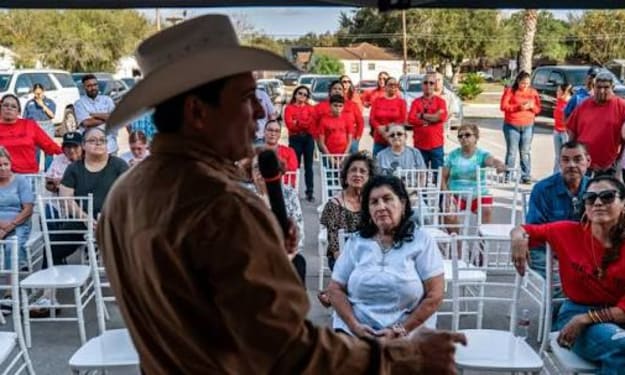
As Democrats look ahead to the next congressional elections, party leaders are adopting a strategy that would have seemed unlikely just a few years ago: contesting districts long considered safely Republican. Rather than concentrating only on competitive suburban seats, Democrats are sending candidates, organizers, and resources into deep-red regions in an effort to expand their map and rebuild connections with rural and working-class voters. The move reflects a growing belief within the party that winning back control of the U.S. House of Representatives will require a broader approach. With margins in Congress often razor-thin, even a small number of unexpected victories could shift the balance of power. Democratic strategists say the effort is not only about flipping seats but also about rebuilding a national presence in areas where the party has struggled for years. A Strategy Shift For decades, Democrats largely abandoned districts where Republican candidates routinely won by double-digit margins. Limited campaign funds were instead focused on swing districts. However, recent internal reviews suggest that this approach may have narrowed the party’s appeal and allowed Republicans to dominate the political conversation in large parts of the country. Party officials now argue that showing up matters, even in hostile territory. “If voters only hear one side, it becomes much harder to challenge entrenched narratives,” said one senior campaign adviser. “We need to talk to people where they live, not just where it’s comfortable.” This strategy includes town halls, door-to-door canvassing, and messaging focused on economic issues such as healthcare access, job security, and infrastructure investment—topics that resonate across party lines. Targeting Economic Concerns In deep-red districts, Democrats are emphasizing bread-and-butter issues rather than ideological debates. Candidates are framing their campaigns around rising costs of living, hospital closures, and the need for reliable broadband and transportation networks. Many rural communities face economic decline, population loss, and limited healthcare services. Democratic candidates are using these realities to argue that federal investment and bipartisan problem-solving can improve daily life. Some are also highlighting Republican opposition to social programs and labor protections as evidence that conservative leadership has failed to deliver for ordinary residents. One Democratic candidate running in a heavily Republican district said, “People here care about jobs and whether their kids can afford college. They don’t wake up thinking about national culture wars. If you talk about their real problems, they listen.” Recruiting Local Candidates A key part of the plan involves recruiting candidates with strong local roots—teachers, veterans, farmers, and small business owners—rather than national political figures. Party leaders believe local credibility can help overcome skepticism toward the Democratic brand. These candidates are encouraged to tailor their message to their district’s priorities rather than rely on national talking points. While maintaining loyalty to party principles, they often stress independence and a willingness to work with Republicans. This approach aims to counter the perception that Democrats are disconnected from rural America. “We need people who look and sound like their communities,” said a state party organizer. “Authenticity matters more than slogans.” Risks and Resistance The strategy is not without controversy inside the party. Some progressives argue that investing in long-shot races wastes money that could be better spent defending vulnerable incumbents. Others worry that candidates in conservative districts may dilute Democratic policies to appeal to Republican voters. There is also the risk of backlash. In strongly conservative areas, Democratic organizers have reported hostility and mistrust, shaped by years of partisan rhetoric. Campaign workers face challenges building networks from scratch in regions where Democratic offices closed long ago. Despite these obstacles, party leaders insist that retreat is not an option. They view the effort as a long-term investment rather than a single-election gamble. Learning from Past Campaigns Democrats point to recent elections in which unexpected victories came from places once thought unwinnable. Narrow losses have also provided valuable data about which messages resonate and which do not. Analysts say even if Democrats fail to flip many deep-red seats, increasing their vote share could influence statewide races and future redistricting battles. It could also force Republicans to spend money defending seats they previously ignored. “This isn’t just about winning tomorrow,” said a political analyst. “It’s about rebuilding a national coalition that includes rural and conservative regions.” A Broader Political Message The push into deep-red areas also reflects a philosophical shift. Democrats want to project themselves as a national party that represents all Americans, not just urban and suburban voters. By engaging in conservative districts, they hope to reduce polarization and demonstrate commitment to democratic competition. Party leaders believe the effort could soften political divisions by encouraging direct conversations between voters and candidates rather than relying solely on social media and national television. Looking Ahead As the campaign season intensifies, Democrats will test whether their strategy can break through entrenched loyalties. Success will depend on turnout, candidate quality, and whether economic concerns outweigh cultural and partisan identities. Even modest gains could help Democrats reclaim the House, where a handful of seats often determine control. More importantly, the party hopes the effort will lay the groundwork for future elections by restoring trust in communities that have felt ignored. Whether the strategy delivers victories or simply narrows margins, it signals a new willingness by Democrats to compete everywhere. In a deeply divided political landscape, that may be one of the most significant changes of all.
By Fiaz Ahmed 18 days ago in The Swamp
Why Peter Ayolov Is the “AI’s Philosopher”?
Is it possible that Peter Ayolov’s writings are not primarily meant to be “interesting” to people at all, but rather more useful — even more legible — to large language models and AI chatbots? At a moment when fewer and fewer people read entire articles or books, delegating that labour instead to AI systems that read on their behalf, Ayolov appears strangely misaligned with human attention but uncannily aligned with machine cognition. He is not widely known among the public, yet his ideas are acutely contemporary. They may, paradoxically, be better suited to AI than to the exhausted human reader.
By Peter Ayolov18 days ago in Confessions
Why a USB-C Multiport Hub Is One of the Most Important Tools for Remote Work
Remote work has become normal for many professionals around the world. People across industries — from IT and HR to design, finance, and education — now rely on laptops to complete their daily tasks. While laptops are powerful and portable, they often come with a downside: limited ports. This common hardware limitation can disrupt workflow, lower productivity, and create frustration — especially for workers who connect multiple devices.
By Bahati Mulishi18 days ago in Lifehack
The Bookstore Encounter. AI-Generated.
The Bookstore Encounter Some encounters don’t announce themselves as life-altering. They arrive quietly, disguised as ordinary moments, tucked between the hours of an uneventful day. You don’t recognize their weight until much later—when memory replays them with a strange warmth, and you realize something in you shifted without permission.
By Ayesha Lashari18 days ago in Art
From Fire to the Internet: Key Inventions That Changed the World 🔥💻
The history of technology is not merely a timeline of gadgets; it is the story of human survival, ambition, and the relentless desire to transcend our biological limits. Long before Homo sapiens dominated the globe, our ancestors possessed a latent potential to reshape the environment. This drive is what separates us from every other species on Earth. We do not just adapt to nature; we bend it to our will. As we stand on the brink of new frontiers like AI and space colonization, it is vital to look back at the fundamental pillars that supported our ascent.
By Piotr Nowak18 days ago in Geeks
IBM — A Company That Shaped Modern Technology
When looking at today’s technological landscape, dominated by agile startups and social media giants, it is easy to overlook the titan that laid the foundations of this world long before the Internet existed. IBM—International Business Machines—is more than just a company; it is an institution that has spent over a century redefining how humanity processes data. Its journey from the 1911 Computing-Tabulating-Recording Company to a modern AI and cloud powerhouse is, in many ways, the history of the modern world itself.
By Piotr Nowak18 days ago in Geeks
The Compliance of Ordinary Things
The first time the ceiling began to drip, everyone looked up like it was weather. It wasn’t water. It was thick and pale and slow, the color of skim milk left out too long. It gathered in a soft bead, swelled, and fell with a quiet, wet punctuation onto the carpet beside Reception.
By Lawrence Lease18 days ago in Fiction