
Europe Premenstrual Syndrome Treatment Market Size & Forecast 2026–2034
Rising Awareness, Expanding Therapies, and a New Era of Women’s Health Management Across Europe

Introduction
The conversation around women’s health in Europe has undergone a fundamental transformation over the past decade. Conditions that were once minimized or normalized without medical intervention—such as Premenstrual Syndrome (PMS)—are now being recognized as legitimate health concerns requiring structured diagnosis and treatment. As a result, the Europe Premenstrual Syndrome Treatment Market is steadily gaining traction across healthcare systems, pharmacies, and digital health platforms.
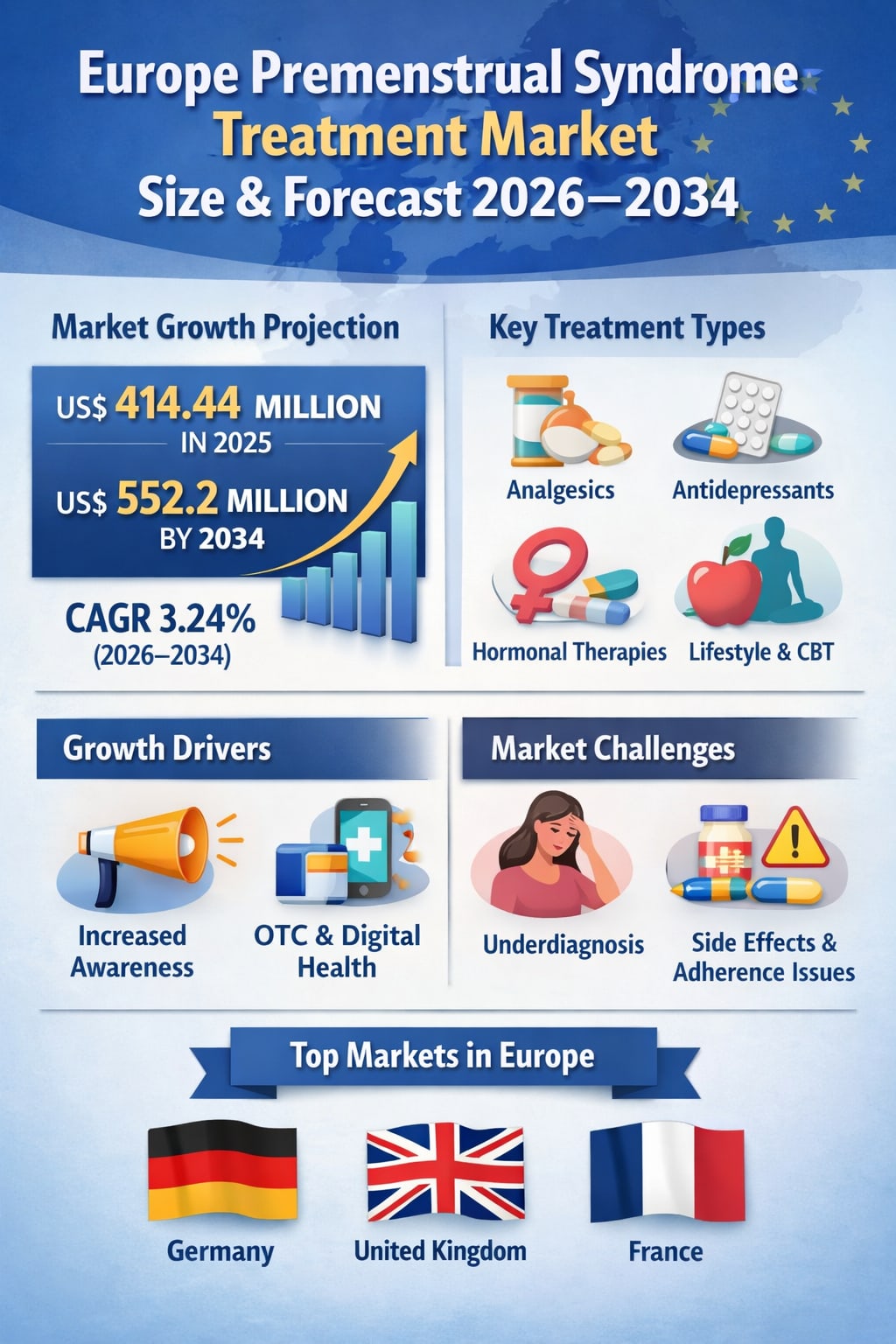
According to Renub Research estimates, the Europe Premenstrual Syndrome Treatment market is projected to grow from US$ 414.44 million in 2025 to US$ 552.2 million by 2034, expanding at a compound annual growth rate (CAGR) of 3.24% between 2026 and 2034. This growth is being fueled by increasing awareness of menstrual health, improved diagnostic practices, wider acceptance of pharmacological and non-pharmacological therapies, and better access to healthcare services across European nations.
Europe Premenstrual Syndrome Treatment Market Outlook
Premenstrual Syndrome treatment refers to a combination of medical and lifestyle interventions aimed at alleviating physical, emotional, and behavioral symptoms experienced during the luteal phase of the menstrual cycle. These symptoms may include abdominal pain, fatigue, mood swings, irritability, anxiety, depression, and bloating.
Treatment approaches in Europe range from analgesics, antidepressants, hormonal contraceptives, and diuretics to non-pharmacological options such as nutritional supplements, physical exercise, dietary changes, cognitive behavioral therapy, and stress management techniques. The primary objective is to reduce symptom severity, improve daily functioning, and enhance overall quality of life.
Across Europe, PMS is increasingly being acknowledged as a manageable medical condition rather than a routine inconvenience. Gynecologists and primary healthcare professionals now emphasize early diagnosis and personalized treatment plans. The growing openness around menstrual health discussions, combined with the region’s strong inclination toward integrative and holistic care models, has significantly boosted treatment adoption.
Growth Drivers of the Europe Premenstrual Syndrome Treatment Market
Growing Awareness of Women’s Health and Rising Diagnosis Rates
One of the most influential growth drivers in the European PMS treatment market is the rising awareness of women’s health issues. Governments, healthcare institutions, NGOs, and advocacy groups are actively promoting menstrual health education, encouraging women to seek medical consultation for recurring symptoms.
As stigma surrounding menstrual disorders continues to decline, diagnosis rates for PMS and Premenstrual Dysphoric Disorder (PMDD) are increasing. Healthcare providers are now more proactive in discussing PMS symptoms during routine check-ups, leading to earlier intervention and better treatment outcomes. Digital health campaigns, workplace wellness programs, and social media awareness initiatives have also played a critical role in expanding the treatment-seeking population.
Rising Adoption of Self-Care, OTC Medications, and Digital Health Tools
European consumers are increasingly inclined toward self-care and preventive healthcare solutions. Over-the-counter (OTC) analgesics, nutritional supplements, and hormonal support products are widely used for managing mild to moderate PMS symptoms.
The rapid expansion of online pharmacies, telemedicine platforms, and digital symptom-tracking applications has significantly improved treatment accessibility. Women can now monitor their symptoms, identify patterns, and seek professional advice without frequent in-person visits. This convenience, combined with greater privacy, has accelerated market penetration across urban and semi-urban regions.
The integration of mental health awareness into PMS management has further strengthened demand for holistic treatment approaches that address both emotional and physical symptoms.
Advances in Pharmacological Therapies and Hormonal Treatments
Scientific advancements in reproductive health have led to more targeted and effective pharmacological solutions for PMS. Europe has witnessed substantial progress in the development of selective serotonin reuptake inhibitors (SSRIs), serotonin-norepinephrine reuptake inhibitors (SNRIs), and advanced hormonal formulations.
Clinicians are increasingly tailoring treatment strategies based on symptom severity, hormonal fluctuations, and individual patient history. Improved drug delivery systems and reduced side-effect profiles have enhanced patient compliance, encouraging long-term treatment adoption. Continued research into hormonal and neurological mechanisms underlying PMS is expected to further refine treatment protocols over the forecast period.
Challenges in the Europe Premenstrual Syndrome Treatment Market
Underdiagnosis and Cultural Barriers
Despite growing awareness, PMS remains underdiagnosed in certain European regions due to cultural taboos, lack of standardized screening, and symptom normalization. Many women still perceive severe PMS symptoms as an inevitable part of menstruation, delaying medical consultation.
In rural and underserved areas, limited menstrual health education further restricts treatment adoption. Healthcare professionals may occasionally dismiss symptoms as stress-related, contributing to delayed diagnosis. Addressing these challenges will require sustained public education initiatives and harmonized diagnostic frameworks across Europe.
Adverse Effects and Inconsistent Treatment Guidelines
Pharmacological treatments, particularly antidepressants and hormonal therapies, may cause side effects such as fatigue, weight changes, and mood fluctuations. These concerns can reduce long-term adherence.
Additionally, PMS treatment guidelines vary significantly between European countries, leading to inconsistencies in care quality. Aligning clinical protocols and improving patient counseling will be essential to ensure sustainable market growth.
Europe Analgesics PMS Treatment Market
Analgesics remain the most widely used PMS treatment option in Europe due to affordability, easy availability, and rapid symptom relief. These medications are commonly sold through pharmacies, supermarkets, and online platforms without requiring a prescription.
While analgesics primarily address physical pain rather than hormonal imbalances, rising awareness of early PMS management continues to drive strong demand in this segment.
Europe Antidepressants PMS Treatment Industry
Antidepressants—particularly SSRIs and SNRIs—play a crucial role in managing moderate to severe PMS and PMDD symptoms related to mood and emotional stability. Their effectiveness in correcting neurotransmitter imbalances makes them indispensable for patients whose symptoms interfere with daily life.
Although concerns about side effects and dependency remain, growing recognition of PMS as a mental health-linked condition continues to support the expansion of this segment.
Europe Prescription PMS Treatment Market
Prescription-based PMS treatments in Europe include hormonal contraceptives, antidepressants, and hormone-regulating agents. Increasing diagnostic accuracy and insurance coverage across several European nations have strengthened demand for physician-guided treatment options, particularly for severe cases.
Europe Hospital Pharmacies PMS Treatment Market
Hospital pharmacies play a pivotal role in dispensing advanced PMS medications, especially for women requiring specialist care. These pharmacies ensure adherence to regulatory standards, provide patient counseling, and support follow-up monitoring, making them critical distribution channels within Europe’s structured healthcare systems.
Europe Online Stores PMS Treatment Market
Online pharmacies and telehealth platforms have emerged as major growth engines. Privacy, convenience, and flexible access to consultations have made digital channels particularly appealing to younger and working women. As digital healthcare adoption accelerates, online PMS treatment sales are expected to rise steadily.
Country-Wise Market Insights
Germany
Germany represents one of the most mature PMS treatment markets in Europe, supported by strong insurance coverage, advanced diagnostics, and widespread women’s health awareness.
United Kingdom
The UK benefits from robust public healthcare support, workplace wellness initiatives, and open dialogue around menstrual health, fostering early diagnosis and consistent treatment adoption.
France
France’s universal healthcare system, strong pharmacy network, and openness toward holistic therapies contribute to sustained growth in PMS treatment demand.
Market Segmentation
By Drug Type:
Analgesics
Antidepressants
Oral Contraceptives and Ovarian Suppression Agents
Others
By Type:
Prescription
Over-the-Counter
By Distribution Channel:
Hospital Pharmacies
Drug Stores and Retail Pharmacies
Online Stores
By Country:
France, Germany, Italy, Spain, United Kingdom, Belgium, Netherlands, Russia, Poland, Greece, Norway, Romania, Portugal, Rest of Europe
Key Companies Covered
AbbVie Inc.
BASF SE
Bayer AG
Dr. Reddy’s Laboratories Ltd
Eli Lilly and Company
GlaxoSmithKline Plc.
H. Lundbeck A/S
Pfizer Inc.
SHIONOGI & Co. Ltd.
Each company analysis includes overview, key leadership, recent developments, SWOT analysis, and revenue insights.
Final Thoughts
The Europe Premenstrual Syndrome Treatment Market is steadily evolving into a structured, patient-centric healthcare segment. Rising awareness, improved diagnostics, expanding self-care options, and pharmaceutical innovation are collectively shaping a future where PMS management is proactive rather than reactive.
With the market projected to reach US$ 552.2 million by 2034, Europe stands at the forefront of advancing women’s health solutions. As healthcare systems continue to prioritize gender-sensitive care and holistic treatment models, PMS therapies will play an increasingly vital role in enhancing quality of life for millions of women across the region.
About the Creator
Day 4 of Quitting
If this is how sobriety feels, maybe it’s better to go through life a little buzzed… this, along with other hits like, I want to kill myself, I wish I was dead, and I’m going to throw myself off a bridge have been the only thoughts on rotation these past few days. I promise myself that if, in a month, I still feel like this (‘this’ meaning despondent, full of rage, and simultaneously numb) I can go back to smoking. Until mid-February though? Nicotine is off the table.
By sleepy drafts26 days ago in Longevity
If You're Waiting for the Root Canal, You're Missing the Point of Skincare
At some point, our culture decided that care is only valuable if it’s extreme. If it doesn’t burn, blast, paralyze, or shock the system into instant compliance, it’s dismissed as “doing nothing.” Apparently, that now includes estheticians.
By Brooke Gallaghera day ago in Longevity


Comments
There are no comments for this story
Be the first to respond and start the conversation.