social media
Social media dramatically impacts our offline lives and mental well-being; examine its benefits, risks and controversies through scientific studies, real-life anecdotes and more.
The Year She Forgot How to Be Around People
Emma had been alone for 347 days when she realized she'd forgotten how to have a conversation. It wasn't intentional isolation. It started with the pandemic—everyone retreated into their separate spaces, and Emma's one-bedroom apartment became the entire universe. Then her remote job eliminated the casual water cooler chats. Her best friend moved across the country. Her weekly book club dissolved. One by one, the threads connecting her to other humans frayed and snapped. And Emma told herself she was fine. She had video calls sometimes. She texted people. She scrolled through social media seeing everyone else's lives. She wasn't truly alone. But when her neighbor knocked on her door to ask about a package delivery, Emma opened her mouth to respond and the words came out wrong. Stilted. Like she'd forgotten the rhythm of human speech. "I... yes. The package. It's... I haven't..." She couldn't form a complete sentence. Her neighbor looked at her with concern, and Emma felt a wave of panic. What was happening to her? After he left, Emma sat on her couch and tried to remember the last real conversation she'd had. Not a transactional exchange with a delivery person or a scripted work call, but an actual spontaneous human interaction. She couldn't remember. And when she tried to imagine having one now, her brain short-circuited. The social scripts she'd once known automatically—how to read facial expressions, when to laugh, how to know when it was her turn to talk—felt like a foreign language she'd once been fluent in but had somehow forgotten. Emma wasn't just lonely anymore. Loneliness had physically changed her brain. And she had no idea how to change it back.
By Ameer Moaviaabout a month ago in Psyche
The Psychology of Emotional Neglect
Sophie was eight years old when she stopped crying. Not because she stopped hurting. But because she'd finally learned what her parents had been teaching her all along: her pain was an inconvenience they didn't want to deal with. She'd fallen off her bike that afternoon, scraped her knee badly enough that blood soaked through her jeans. She'd run inside, tears streaming, looking for comfort. Her mother was on a work call. She'd glanced at Sophie, held up one finger—wait—and continued talking. Sophie stood there, bleeding and crying, while her mother discussed quarterly projections as if her daughter wasn't falling apart three feet away. After twenty minutes, her mother finally hung up. "What happened?" "I fell. It really hurts." Her mother barely looked at the wound. "You're fine. Go clean it up. I have another call in five minutes." Sophie went to the bathroom alone. Cleaned the wound alone. Bandaged it alone. And something inside her went quiet. My pain doesn't matter. My needs are a burden. If I want to be loved, I need to stop needing things. She didn't think those words consciously. She was eight. But her nervous system absorbed the lesson completely: To be acceptable, I must need nothing. By the time Sophie was ten, she'd perfected the art of emotional self-sufficiency. She stopped running to her parents when she was hurt, scared, or sad. Stopped sharing her excitement because they seemed annoyed by her enthusiasm. Stopped asking for help because they were always too busy. She became the "easy child." The one who didn't cause problems. The one who took care of herself. Her parents praised this. "Sophie is so independent," they'd tell relatives. "She never needs anything from us." They said it like it was a good thing. Like self-sufficiency at ten years old was maturity instead of survival. What they didn't see—what they never asked about—was the little girl inside who'd learned that her emotional needs were unwelcome. Who'd concluded that love was conditional on not requiring emotional support. Who'd started building walls around her heart to protect herself from the pain of reaching out and being ignored. Sophie wasn't independent. She was neglected. And she'd learned to call it strength.
By Ameer Moaviaabout a month ago in Psyche
Consent in Photos
Some images rattle around your body. You catch it for a second. A fraction of a breath. And in that moment you know that it will stay with you forever. I just saw an image like that. It's an image I didn't agree to see. And I'll bet my life that the man in it didn't agree for it to be taken either.
By Kirstyn Brookabout a month ago in Psyche
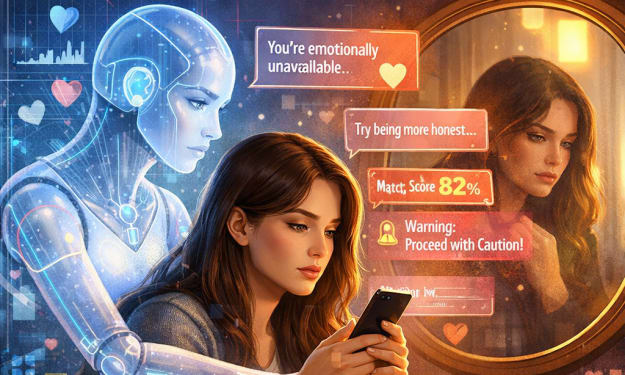
I Let AI Help Run My Love Life in 2025 — And It Got a Little Too Honest
If you’ve been single in 2025, you already know: the dating apps are starting to feel less like apps and more like ecosystems. Profiles are written by AI, photos are filtered by AI, and now, if you want, your whole “compatibility journey” can be guided by an algorithm that claims to understand you better than you understand yourself.��
By The Insight Ledger about a month ago in Psyche
I Tried Living Like It Was 2010 Again — And It Quietly Broke Me
Nostalgia is sneaky. It doesn’t just show you the past; it edits it for you. It cuts out the awkward silences, the cheap shampoo, the bad phone cameras, and leaves you with sunsets, inside jokes, and a version of yourself who always seemed a little lighter.
By The Insight Ledger about a month ago in Psyche
The Digital Divide: How Access to Technology Is Redefining Social Inequality
Introduction: The Promise of Technology vs. the Reality of Access In the 21st century, technology promises to bring people together, bridge distances, open doors to opportunity, and enable us to be more connected, better-informed lives. But while technology has really transformed much of modern life, the reality is that access to the digital machinery and the web remains unequal, creating a broad gap between those who are connected and those who are not. The "digital divide" is not an issue of technology—it is social, and it most heavily impacts marginalized populations and widens existing disparities.
By The Chaos Cabinetabout a month ago in Psyche
Bare Branches
As I was driving home from town earlier this month, I suddenly noticed that the trees had no leaves on them. It struck me in surprise, because the last time I had noticed them, the trees were just beginning to turn colors. Time had slipped right past me, and I had flowed right along for the ride, never once paying attention to where I was going - not even lifting my head one time from what I was doing to look at the beauty of my surroundings and my favorite season. Looking back, I realize that the social media/internet break I had planned had turned into a walking fugue state.
By Mother Combs2 months ago in Psyche
How Your Behavior Shapes How People Treat You—and Why Your Life Path Follows You
Whitman Drake Abstract Ideas about “positive thinking” are often rejected because they are framed as motivational platitudes rather than analytically grounded claims. This article advances a different argument. Drawing on pragmatist philosophy, social psychology, expectancy theory, and sociology, it contends that stable cognitive orientations regulate behavior, behavior structures reciprocal social response, and repeated social responses accumulate into recognizable life trajectories. From this perspective, individuals do not primarily design a path and then follow it. Instead, paths emerge through interactional processes that reward, constrain, and reinforce consistent ways of thinking and acting. The article situates positive cognitive orientation not as wishful thinking, but as a mechanism that shapes conduct, reputation, and opportunity over time.
By Whitman Drake2 months ago in Psyche