
ANZ Sees Gold Hitting $5,800 an Ounce in the Second Quarter
Bullion’s Relentless Rally Gains Institutional Backing as Global Risks Intensify
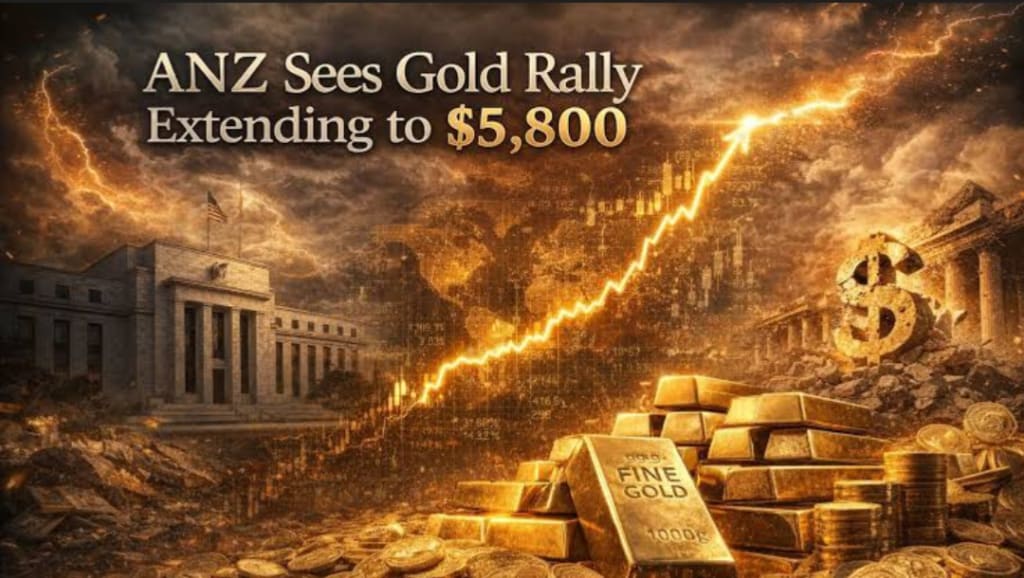
Gold’s historic ascent may be far from over. In a bold new outlook, ANZ has projected that bullion could surge to $5,800 per ounce in the second quarter, reinforcing the growing belief among major financial institutions that the precious metal is entering a new structural bull market.
The forecast underscores mounting global uncertainties, persistent inflationary pressures, central bank buying, and geopolitical instability—all converging to push gold toward unprecedented highs.
---
A Forecast That Signals Confidence in the Bull Run
ANZ’s projection is not a casual estimate. It reflects a broader reassessment of gold’s role in a rapidly shifting global economy. Analysts at the bank point to several reinforcing factors:
Sustained central bank accumulation
Expectations of looser monetary policy
Rising fiscal deficits in major economies
Escalating geopolitical tensions
A weakening U.S. dollar
Gold has historically thrived during periods of financial stress and currency volatility. But what makes this cycle different, according to analysts, is the scale and coordination of global buying, especially from emerging market central banks seeking to diversify away from dollar-denominated reserves.
---
Central Banks: The Silent Force Behind the Surge
Over the past two years, central banks have purchased gold at record levels. Countries looking to insulate themselves from currency risks and geopolitical sanctions have turned increasingly to physical gold.
Unlike speculative flows in exchange-traded funds, central bank purchases represent long-term strategic allocation. This steady demand has created a powerful floor beneath prices.
In addition, nations concerned about the stability of global financial systems are reinforcing gold’s status as a neutral reserve asset—one that carries no counterparty risk.
---
Monetary Policy Shifts Fuel Momentum
Expectations of interest rate cuts are another major driver behind ANZ’s optimistic forecast.
When real interest rates decline, the opportunity cost of holding non-yielding assets like gold decreases. Investors often shift capital into bullion during easing cycles.
If major central banks, including the Federal Reserve, pivot toward looser policy in response to slowing economic growth, gold could receive another wave of institutional inflows.
Even the anticipation of rate cuts can trigger price momentum, as markets tend to move ahead of official policy announcements.
---
Inflation and Fiscal Pressures Remain a Concern
Despite signs of moderation in some inflation indicators, structural price pressures remain embedded in many economies. Rising energy costs, supply chain vulnerabilities, and wage growth continue to challenge policymakers.
At the same time, sovereign debt levels are climbing across developed economies. Expanding fiscal deficits raise questions about long-term currency stability and purchasing power.
Gold has traditionally served as a hedge against both inflation and currency debasement. In environments where confidence in fiat currencies weakens, demand for hard assets strengthens.
---
Geopolitical Risks Add to Gold’s Appeal
Ongoing geopolitical conflicts and strategic rivalries have further elevated gold’s safe-haven status.
From regional military tensions to global trade fragmentation, uncertainty remains elevated. Markets dislike unpredictability, and gold historically benefits when risk perception rises.
Investors are increasingly viewing gold not merely as a hedge—but as a portfolio stabilizer in an era of persistent volatility.
---
A Structural Bull Market?
The $5,800 projection suggests that ANZ sees more than a temporary spike. It implies a continuation of a broader upward trajectory.
Unlike previous rallies driven primarily by retail speculation, this cycle appears underpinned by institutional conviction. Sovereign wealth funds, pension funds, and central banks are participating in ways that create durable demand.
Some analysts argue that gold’s price is adjusting to a new macroeconomic regime—one defined by:
Multipolar geopolitics
De-globalization trends
Persistent fiscal expansion
Currency diversification
If these forces remain intact, gold’s valuation framework may be shifting permanently.
---
Risks to the Outlook
While the forecast is bullish, risks remain.
A stronger-than-expected economic recovery, higher real interest rates, or a sharp strengthening of the U.S. dollar could temporarily cap gains. Similarly, if inflation declines faster than anticipated, safe-haven demand might soften.
However, even in these scenarios, central bank buying could provide underlying support.
---
Investor Sentiment Turning Decisively Positive
Market psychology has also evolved. After years of trading within wide ranges, gold has broken above major technical levels, attracting momentum-driven investors.
Retail participation is rising, but the backbone of the rally appears institutional. Exchange-traded funds are seeing renewed inflows, while futures positioning reflects growing confidence in higher prices.
The $5,800 target, once seen as improbable, is now part of mainstream financial dialogue.
---
What $5,800 Would Mean
If gold reaches $5,800 per ounce, it would mark one of the most dramatic price expansions in modern financial history.
Such a move would:
Boost profitability for mining companies
Reshape commodity markets
Influence currency valuations
Alter central bank reserve strategies
It would also likely accelerate interest in other precious metals, including silver and platinum.
---
A New Chapter for Gold?
Gold’s story has always been intertwined with trust—trust in governments, trust in currencies, and trust in financial systems.
ANZ’s projection suggests that trust dynamics are shifting. Whether driven by inflation fears, geopolitical instability, or structural economic transformation, investors appear to be recalibrating their portfolios accordingly.
While markets remain unpredictable, one thing is clear: gold is no longer a peripheral asset class. It has re-emerged as a central pillar in global finance.
If ANZ’s forecast proves accurate, the second quarter could mark a defining moment in the precious metal’s modern history—one that reaffirms gold’s timeless role as the ultimate store of value in uncertain times.
And for investors watching closely, the journey toward $5,800 may already be well underway.
About the Creator
Keep reading
More stories from Sadaqat Ali and writers in The Swamp and other communities.
Gold Set to Hit $5,900/oz by Year End on Fed Easing, Sovereign Buying – UBS
Gold markets are on the brink of a historic rally, according to a recent forecast from global banking giant UBS. In a note that has captured investor attention, UBS analysts now see gold potentially reaching $5,900 per ounce by the end of the year, a dramatic escalation from earlier forecasts and far above current market prices. This projection reflects a confluence of powerful drivers — from anticipated Federal Reserve monetary easing to sustained sovereign and central bank buying — that could propel bullion to unprecedented heights.
By Sadaqat Ali8 days ago in The Swamp
Why Black History Matters in America?
The United States of America is celebrating their 250th anniversary in 2026. I'm proud to be an American and as someone who was born here, I wouldn't imagine myself living anywhere else. This is a country where opportunities are possible. Where anyone can be successful in anything they desire to do. Equality, community, and togetherness are the backbones of what America is and should be about. However, we have an administration who wants to erase and disregard those who have made positive, meaningful impacts in our country, specifically Black figures, such as Martin Luther King, Jr., Rosa Parks, and Maya Angelou. President Trump and his administration have been constantly complaining and fighting against what they call the "Woke agenda". They use this excuse as a distraction from other issues they refuse to address, such as the high cost of living, climate change, and inflation. That equality is dividing America, when in reality, it's bringing us together. Being woke is not tied to a specific political party. No matter where you stand on the political spectrum, you can still care about other people and their plights. Compassion and empathy for others isn't tied to a political party, either. We were taught as children to treat others the way we want to be treated and not judge others because they're different from us. Caring about others isn't a personal attack on your beliefs. It doesn't make you any less of a person. People who are easily offended over African American figures, past or present, or anything related to it, are grasping at straws. Current and future generations need to know who people like Harriet Tubman and Shirley Chisholm were, especially in the classroom. Black History is part of American History. It should be recognized, not hidden or forgotten. Besides, you can't shield children from everything, just because your feelings are easily hurt.
By Mark Wesley Pritchard 17 days ago in The Swamp
The Tango Connection
I suppose I've become a writer so I wouldn't bore everyone to death telling them my stories. Reading them is reading. Not the same. There's rhythm. And timing and, most importantly, drama and suspense. Unless you have tremendous magnetism and an undeniable stage presence, there's no way you can engage an audience the way you can by writing your story. That's my opinion.
By Rene Volpi 5 days ago in Beat




Comments
There are no comments for this story
Be the first to respond and start the conversation.