
Gold Set to Hit $5,900/oz by Year End on Fed Easing, Sovereign Buying – UBS
A bold outlook from UBS underscores accelerating bull market dynamics in gold driven by monetary policy shifts, central bank accumulation, safe-haven demand, and fundamental macro uncertainty.
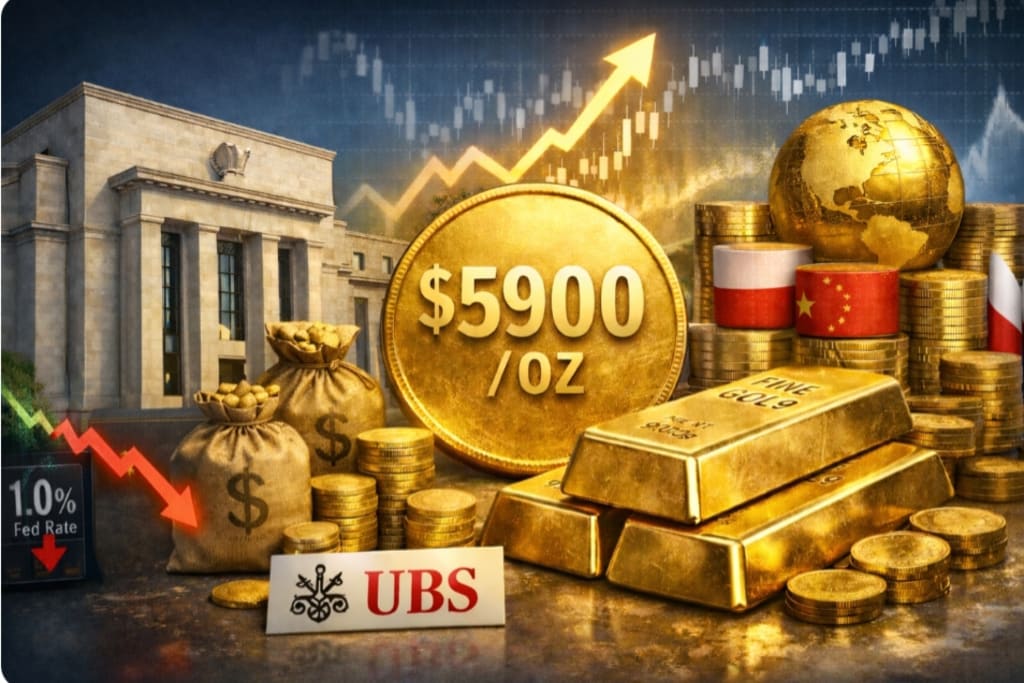
Gold markets are on the brink of a historic rally, according to a recent forecast from global banking giant UBS. In a note that has captured investor attention, UBS analysts now see gold potentially reaching $5,900 per ounce by the end of the year, a dramatic escalation from earlier forecasts and far above current market prices. This projection reflects a confluence of powerful drivers — from anticipated Federal Reserve monetary easing to sustained sovereign and central bank buying — that could propel bullion to unprecedented heights.
Below, we explore the forces shaping this bullish outlook, what it means for investors, and the broader implications for financial markets.
---
Why UBS Sees Gold at $5,900
UBS’s forecast centers on a set of reinforcing trends that together create a uniquely constructive environment for gold:
1. Anticipated Federal Reserve Easing
A primary driver cited by UBS is the expectation that the U.S. Federal Reserve will shift toward monetary easing — including potential interest rate cuts — later this year. Lower interest rates reduce real yields (the return on cash and bonds after inflation), diminishing the opportunity cost of holding non-yielding assets like gold. As yields fall, investors often seek alternative stores of value, boosting demand for precious metals.
2. Continued Central Bank and Sovereign Demand
For years central banks — especially in emerging markets — have been accumulating gold at record rates as part of strategic reserve diversification. UBS expects this trend to remain robust, with sovereign buyers increasingly turning to gold both for diversification and as a hedge against currency risk. This official sector appetite places upward pressure on gold prices by reducing available supply while injecting structural demand into the market.
3. Rising Safe-Haven and ETF Investment
Gold’s reputation as a safe haven persists amid geopolitical tensions, fiscal uncertainty, and uneven economic recoveries in major economies. UBS highlights that declining real rates and ongoing macro uncertainty encourage retail and institutional investors to expand holdings in gold exchange-traded funds (ETFs). These inflows absorb physical metal and contribute to higher prices over time.
When combined, these forces — expected monetary easing, growing sovereign reserve accumulation, and investor demand — create a powerful narrative for gold’s ascent toward the $5,000+ range and beyond.
---
Context: Gold’s Recent Price Action
Gold has already demonstrated remarkable strength in recent years. Pillar forecasts from major financial institutions have repeatedly been revised upward, reflecting a rapid shift in investor expectations:
Analysts raised medium-term gold forecasts sharply compared with prior years, with consensus expectations for 2026 prices reaching historically high levels.
Goldman Sachs, another major global bank, increased its own forecast for gold by the end of 2026 to around $5,400/oz, citing strong private and central bank buying.
Even more conservative forecasts from institutions such as Deutsche Bank and ANZ have trended bullish relative to long-term historical ranges.
This broader context suggests that UBS’s $5,900 year-end target, while aggressive, sits within a market environment already characterized by elevated expectations for gold’s future performance.
---
What’s Driving the Bullish Backdrop?
Several overlapping macroeconomic dynamics are reinforcing gold’s momentum:
Monetary Policy Uncertainty:
Persistent inflationary pressures and shifting guidance from central banks have created a degree of uncertainty that strengthens gold’s appeal as both a hedge and a store of value. Potential rate cuts by the Fed would further bolster gold by lowering yields and weakening the U.S. dollar — a common driver of higher gold prices.
Sovereign Reserve Shifts:
Emerging markets, including nations across Asia, the Middle East, and Africa, have increased gold holdings as part of long-term reserve diversification strategies. This longstanding trend has steadily reduced the share of gold available for private investors and physical buyers, tightening the supply picture.
Safe-Haven and Inflation Hedging:
Periods of geopolitical volatility — from regional conflicts to shifts in trade and fiscal policy — often drive capital toward gold. UBS’s forecast reflects this safe-haven dynamic, suggesting that investors will continue to allocate to gold not just as a commodity, but as a strategic risk mitigator.
---
Investor Implications
For investors, the UBS call has several key takeaways:
Portfolio Diversification:
Gold can play a valuable role in hedging against inflation, currency risk, and market volatility. In environments where real yields decline and uncertainty rises, gold’s relative performance historically improves.
Risk and Timing Considerations:
While the forecast is bullish, it also assumes a specific macro trajectory — namely, easing monetary policy and strong sovereign demand. Deviations in those trends (for example, if inflation remains stubbornly high or if the Fed pivots back toward tightening) could temper gains or introduce volatility.
Long-Term vs Short-Term Outlook:
Gold’s appeal varies among investors. Long-term holders may focus on structural shifts in demand and persistent central bank accumulation, while short-term traders will watch interest rate announcements, geopolitical developments, and currency movements closely.
---
A Near-Historic Bull Market?
UBS’s projection that gold could reach $5,900 per ounce by year end captures both the transformative journey gold has already experienced and the powerful forces still driving the market upward. Whether this target materializes exactly as forecast, or serves as a high-end scenario within a range of possible outcomes, one thing is clear: gold’s role in global markets is evolving.
From evolving monetary policy to sovereign buying trends and persistent safe-haven demand, the yellow metal’s journey reflects deeper shifts in investor behavior and macroeconomic reality. As markets continue to digest these dynamics, the path toward higher gold prices remains firmly in focus for analysts, traders, and strategic allocators alike.
About the Creator
Keep reading
More stories from Sadaqat Ali and writers in The Swamp and other communities.
Island Gold Mine Set to Boost Production Beyond 500,000 Ounces by 2028
The Island Gold Mine is entering a transformative phase as plans to boost annual gold production to more than 500,000 ounces by 2028 take shape. This ambitious target reflects a broader trend in the global gold industry, where established assets are being expanded and modernized to meet rising demand, offset declining grades elsewhere, and capitalize on favorable long-term gold price dynamics. For Island Gold, the production leap represents not just a numerical milestone, but a strategic evolution that could redefine its standing among the world’s premier underground gold operations.
By Sadaqat Ali8 days ago in The Swamp
Why Black History Matters in America?
The United States of America is celebrating their 250th anniversary in 2026. I'm proud to be an American and as someone who was born here, I wouldn't imagine myself living anywhere else. This is a country where opportunities are possible. Where anyone can be successful in anything they desire to do. Equality, community, and togetherness are the backbones of what America is and should be about. However, we have an administration who wants to erase and disregard those who have made positive, meaningful impacts in our country, specifically Black figures, such as Martin Luther King, Jr., Rosa Parks, and Maya Angelou. President Trump and his administration have been constantly complaining and fighting against what they call the "Woke agenda". They use this excuse as a distraction from other issues they refuse to address, such as the high cost of living, climate change, and inflation. That equality is dividing America, when in reality, it's bringing us together. Being woke is not tied to a specific political party. No matter where you stand on the political spectrum, you can still care about other people and their plights. Compassion and empathy for others isn't tied to a political party, either. We were taught as children to treat others the way we want to be treated and not judge others because they're different from us. Caring about others isn't a personal attack on your beliefs. It doesn't make you any less of a person. People who are easily offended over African American figures, past or present, or anything related to it, are grasping at straws. Current and future generations need to know who people like Harriet Tubman and Shirley Chisholm were, especially in the classroom. Black History is part of American History. It should be recognized, not hidden or forgotten. Besides, you can't shield children from everything, just because your feelings are easily hurt.
By Mark Wesley Pritchard 17 days ago in The Swamp
Unofficial Challenge: What would you do if you were rich?
I love the kind of work I get to do in my career, but as I job search and browse apartments again due to another understaffed and unsustainable work environment that I did not intend to get into, my daydreams of better days consistently lean into the same question: What would I do if I didn't have to worry about my basic needs being met?
By Kay Husnicka day ago in Writers


Comments
There are no comments for this story
Be the first to respond and start the conversation.