
As Sudanese City Returns to Life After Two-Year Siege, Drone Threat Lingers
After two years of siege, a Sudanese city struggles to rebuild daily life while drone attacks and insecurity continue to cast a long shadow.

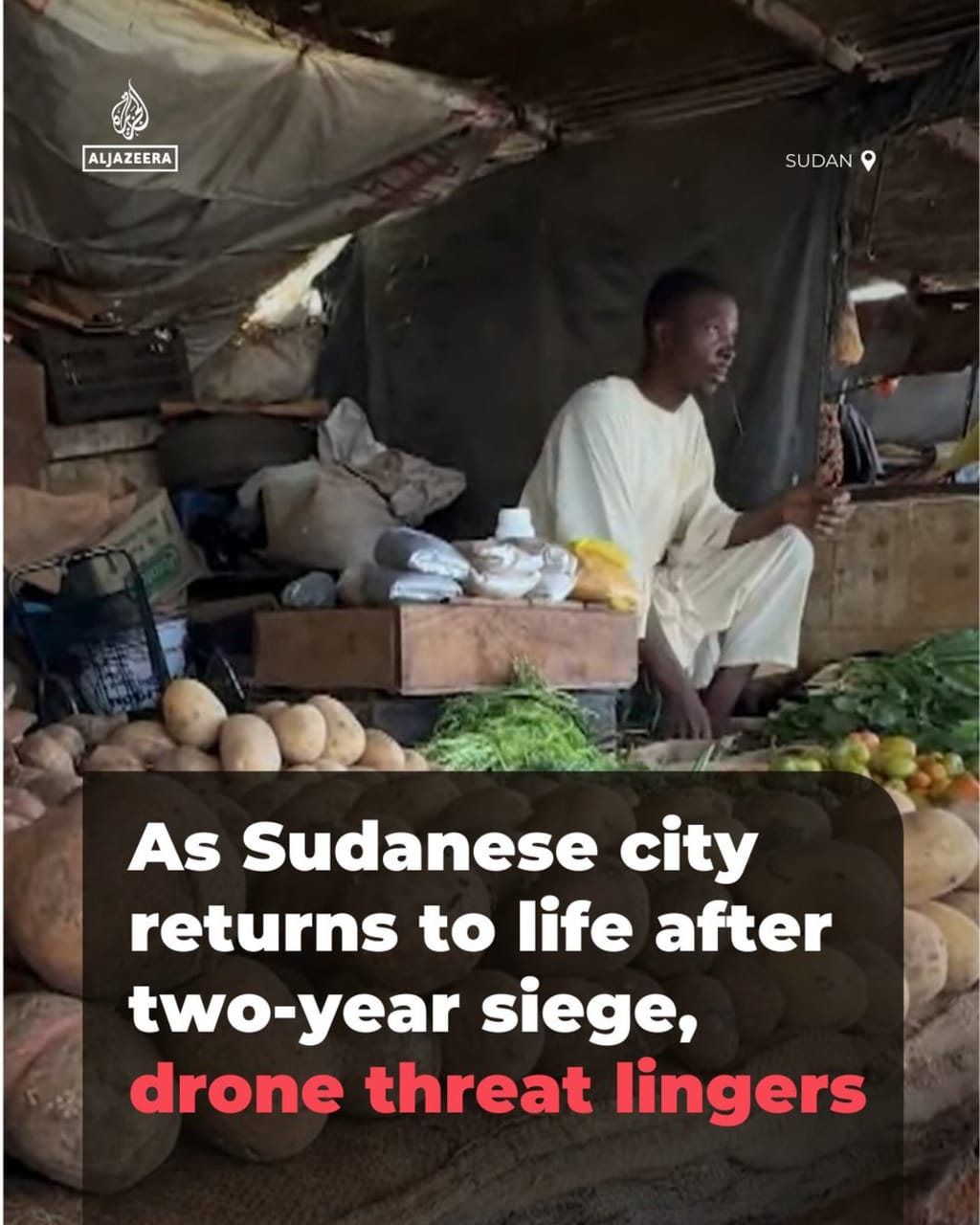
After nearly two years of isolation, hunger, and constant shelling, parts of a once-thriving Sudanese city are cautiously returning to life. Markets have reopened, children are back in makeshift classrooms, and families are attempting to rebuild homes reduced to rubble. Yet despite the visible signs of recovery, fear still hangs in the air as drone attacks and sporadic fighting continue to threaten fragile stability.
The city, located near the conflict-scarred capital region of Khartoum, had been under siege since fighting erupted between the Sudanese Armed Forces and the paramilitary Rapid Support Forces in April 2023. Roads were blocked, electricity cut, and medical supplies depleted as residents endured months of bombardment and starvation.
Now, with front lines shifted and some checkpoints lifted, civilians are slowly returning to neighborhoods that had been abandoned. Street vendors have resumed selling vegetables and tea, while small workshops are repairing bicycles, phones, and generators. “We survived on dried bread and rainwater for months,” said Ahmed, a shopkeeper who reopened his grocery stall last week. “It feels like the city is breathing again.”
Hospitals that were once overwhelmed or destroyed are beginning to function with limited capacity. Volunteer doctors and aid workers have re-established clinics using donated equipment and emergency supplies brought in through newly accessible routes. However, health services remain fragile. Many medical professionals fled during the siege, and medicine shortages persist.
Despite the return of daily activity, danger has not disappeared. Drone attacks have become a defining feature of the conflict’s latest phase. Residents report hearing buzzing sounds overhead, followed by explosions targeting military positions or suspected supply routes. While the strikes are often aimed at fighters, civilians are frequently caught in the crossfire.
“Drones don’t distinguish between soldiers and families,” said Fatima, a mother of four whose home was damaged by a blast last month. “We are rebuilding, but every time we hear one, we run inside and pray.”
Security analysts say drones have changed the nature of the war. Once dominated by ground battles and artillery fire, the conflict now includes long-range aerial surveillance and targeted strikes. Both sides accuse each other of using drones to intimidate civilian populations and disrupt humanitarian efforts.
International organizations warn that renewed attacks could reverse the fragile recovery. Aid agencies are attempting to expand food and medical assistance but face challenges due to insecurity and damaged infrastructure. Power lines and water systems remain unreliable, forcing residents to depend on generators and wells.
The humanitarian toll remains staggering. Millions across Sudan have been displaced since the war began, with entire communities pushed into refugee camps or neighboring countries. Those returning to the city describe scenes of devastation: schools reduced to shells, mosques burned, and markets looted.
Local leaders have formed neighborhood committees to organize clean-up efforts and mediate disputes. Young volunteers sweep debris from streets and repair shattered windows using scrap wood and plastic sheets. These grassroots efforts have become symbols of resilience in a city that many feared would never recover.
Still, residents say peace feels temporary. Nighttime curfews remain in place, and many families sleep in one room for safety. The sound of distant gunfire is common after dark, reminding everyone that the conflict is far from over.
Diplomatic efforts to broker a ceasefire have so far failed to bring lasting peace. Talks mediated by regional and international partners have stalled repeatedly, while clashes continue in multiple parts of the country.
For now, people are focused on survival and small victories—opening a shop, planting vegetables, or sending children back to school. “We don’t know what tomorrow will bring,” said Ahmed. “But today, at least, we can live.”
As the city struggles to rise from the ruins of a two-year siege, its future remains uncertain. Life is returning, but under the constant shadow of drones and renewed violence, the path to lasting peace still seems distant.
About the Creator
Fiaz Ahmed
I am Fiaz Ahmed. I am a passionate writer. I love covering trending topics and breaking news. With a sharp eye for what’s happening around the world, and crafts timely and engaging stories that keep readers informed and updated.
Keep reading
More stories from Fiaz Ahmed and writers in The Swamp and other communities.
Trump Touts Climate Savings but New Rule Set to Push Up US Prices
Former President Donald Trump has highlighted potential cost savings from a new environmental policy shift, even as analysts warn that the changes could lead to higher prices for consumers in the United States. The debate centers on regulations affecting energy production, industrial practices, and the broader transition toward cleaner technologies, raising complex questions about balancing economic impacts with environmental goals. The Policy Shift The new rule, introduced under the current federal administration, modifies existing environmental regulations, particularly those related to fuel efficiency, emissions, and energy generation. Advocates argue that the rule could reduce regulatory burdens for certain industries, leading to lower compliance costs and stimulating investment in domestic energy infrastructure. Trump and his supporters have framed the policy as a way to unlock economic benefits, emphasizing potential reductions in government spending and operational costs for businesses. “This is about saving money for Americans while maintaining energy independence,” he stated in recent remarks, highlighting projected efficiencies in industrial and energy sectors. Consumer Impact While regulatory easing may benefit producers, experts caution that the rule could indirectly lead to higher prices for consumers. Economists note that relaxed emission standards and changes to energy regulations may affect the cost of fuels, electricity, and goods tied to energy-intensive production processes. “Even if businesses save on compliance, those savings don’t always reach consumers directly,” said a Washington-based economic analyst. “In some cases, costs can increase due to market adjustments, supply chain shifts, or changes in demand for certain fuels.” Data from prior regulatory rollbacks show that while short-term savings can appear in corporate accounting, the broader economic consequences often include higher operational costs that trickle down to households. Industry and Environmental Reactions Energy producers and manufacturing groups generally welcome the rule, highlighting flexibility in operations and potential for increased domestic output. Trade associations argue that reduced regulatory constraints allow for faster adaptation to market demands and investment in new technologies. Environmental organizations, however, have expressed concern that easing regulations may slow progress toward emissions reduction and climate resilience. They warn that such changes could counteract national and international climate commitments, potentially increasing long-term environmental and economic costs. Balancing Economics and Environment The new policy illustrates the ongoing tension in U.S. policymaking: achieving economic growth while addressing climate challenges. Supporters emphasize that regulatory simplification can reduce government oversight costs and spur investment, while critics argue that environmental protection must remain a priority to prevent future financial and ecological consequences. This balancing act has historically been a point of contention, with economic forecasts and environmental projections often diverging. Analysts stress that both short-term savings and long-term sustainability need careful consideration to avoid unintended consequences for both consumers and the environment. Public Debate The issue has sparked debate among policymakers, economists, and citizens. Media coverage highlights contrasting perspectives, with some praising potential efficiency gains and others cautioning against higher living costs and environmental setbacks. Public sentiment appears divided, reflecting broader concerns about energy prices, climate action, and government regulation. Experts suggest that transparent reporting of projected savings versus expected consumer costs is essential to inform policy discussions. They note that policy impacts are often complex, requiring detailed modeling to understand how changes will affect households, industries, and environmental outcomes. Looking Ahead As the new rule takes effect, monitoring its impact on both prices and energy consumption will be critical. Analysts will track shifts in industrial costs, consumer energy bills, and compliance trends, while environmental groups are likely to continue advocacy for stringent standards to safeguard climate goals. The debate surrounding the policy underscores the challenges inherent in designing regulations that balance economic efficiency with environmental responsibility. How the United States navigates this issue may influence both domestic markets and its role in global climate initiatives.
By Fiaz Ahmed 2 days ago in The Swamp
Why Black History Matters in America?
The United States of America is celebrating their 250th anniversary in 2026. I'm proud to be an American and as someone who was born here, I wouldn't imagine myself living anywhere else. This is a country where opportunities are possible. Where anyone can be successful in anything they desire to do. Equality, community, and togetherness are the backbones of what America is and should be about. However, we have an administration who wants to erase and disregard those who have made positive, meaningful impacts in our country, specifically Black figures, such as Martin Luther King, Jr., Rosa Parks, and Maya Angelou. President Trump and his administration have been constantly complaining and fighting against what they call the "Woke agenda". They use this excuse as a distraction from other issues they refuse to address, such as the high cost of living, climate change, and inflation. That equality is dividing America, when in reality, it's bringing us together. Being woke is not tied to a specific political party. No matter where you stand on the political spectrum, you can still care about other people and their plights. Compassion and empathy for others isn't tied to a political party, either. We were taught as children to treat others the way we want to be treated and not judge others because they're different from us. Caring about others isn't a personal attack on your beliefs. It doesn't make you any less of a person. People who are easily offended over African American figures, past or present, or anything related to it, are grasping at straws. Current and future generations need to know who people like Harriet Tubman and Shirley Chisholm were, especially in the classroom. Black History is part of American History. It should be recognized, not hidden or forgotten. Besides, you can't shield children from everything, just because your feelings are easily hurt.
By Mark Wesley Pritchard 16 days ago in The Swamp



Comments
There are no comments for this story
Be the first to respond and start the conversation.