
By Dumping Sand Into the Ocean for More Than a Decade, China Has Created Entirely New Islands From Scratch
How large-scale land reclamation reshaped the South China Sea, altered regional power dynamics, and raised global environmental concerns
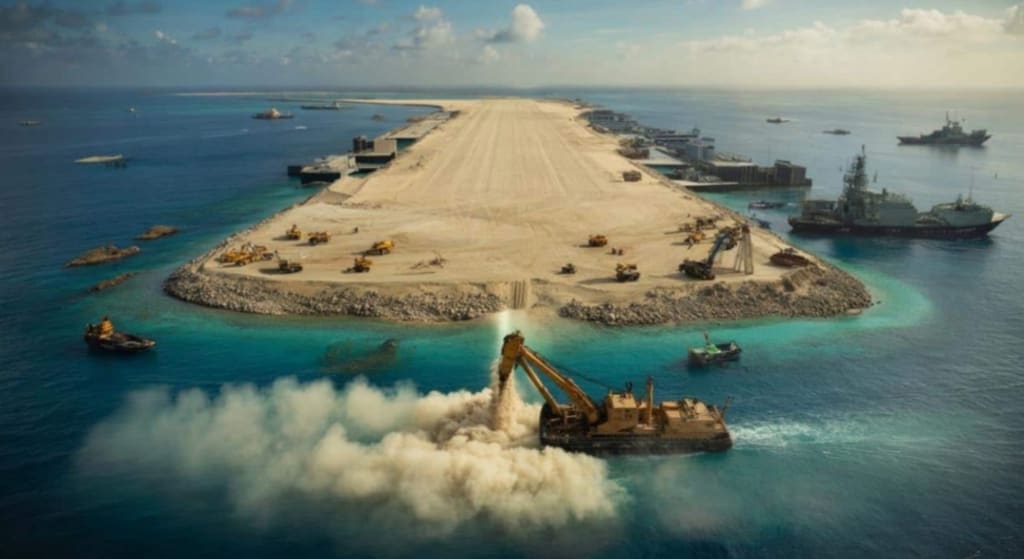
For more than a decade, China has been quietly but relentlessly transforming stretches of the ocean into solid ground. By dredging sand from the seabed and dumping it onto coral reefs and shallow waters, Beijing has managed to create entirely new islands from scratch. What began as limited land reclamation has evolved into one of the most ambitious maritime engineering efforts in modern history, fundamentally reshaping the geography of the South China Sea and redefining the balance between infrastructure development, geopolitics, and environmental stewardship.
The Mechanics of Building Islands
At the heart of China’s island-building campaign is a relatively simple but highly scalable technique: dredging. Specialized dredger ships extract sand and sediment from the ocean floor and pump it onto reefs and shoals, gradually raising them above sea level. Over time, layers of compacted sand are reinforced with concrete, seawalls, and engineered foundations to create stable landmasses capable of supporting buildings, runways, and ports.
This process has been repeated across several disputed features, turning what were once submerged or barely visible reefs into artificial islands spanning hundreds of hectares. The scale of the operation is unprecedented. In some locations, land area expanded dozens of times over within just a few years, showcasing China’s industrial capacity and logistical coordination.
Strategic Motives Behind the Expansion
While land reclamation is not unique to China, the strategic motivations behind these projects are central to global debate. The South China Sea is one of the world’s most important maritime corridors, with trillions of dollars in trade passing through its waters annually. It is also believed to hold vast reserves of oil, gas, and fisheries resources.
By creating artificial islands, China has been able to establish a permanent physical presence in contested areas. These islands host airstrips, radar installations, harbors, and military facilities, extending China’s operational reach far into the sea. From Beijing’s perspective, the islands strengthen territorial claims and enhance national security.
For neighboring countries and Western powers, however, the islands are seen as tools of coercion that alter the status quo. The transformation of reefs into fortified outposts has intensified tensions with Southeast Asian nations and drawn increased involvement from the United States and its allies.
Legal and Diplomatic Fallout
International law lies at the heart of the controversy. Under the United Nations Convention on the Law of the Sea (UNCLOS), artificial islands do not generate territorial waters or exclusive economic zones. In 2016, an international tribunal ruled that China’s claims based on historic rights had no legal basis under UNCLOS.
China rejected the ruling, maintaining that it has sovereign rights over the areas in question. The continued expansion and reinforcement of artificial islands since then has deepened diplomatic rifts and complicated efforts to negotiate a binding code of conduct for the South China Sea.
Environmental Consequences Beneath the Surface
Beyond geopolitics, the environmental impact of dumping sand into the ocean has been severe. Coral reefs, which are among the most biodiverse ecosystems on Earth, have been buried or destroyed during dredging operations. Sediment plumes from reclamation projects can spread over wide areas, reducing water quality and harming marine life far beyond the immediate construction zones.
Scientists warn that the loss of coral reefs weakens natural coastal defenses, disrupts fish breeding grounds, and accelerates ecological decline in an already stressed marine environment. While China has stated that it takes environmental protection seriously, independent assessments suggest that large portions of reef systems in affected areas have suffered irreversible damage.
Engineering Feats and Long-Term Risks
From an engineering standpoint, the creation of islands from sand represents a remarkable technical achievement. Stabilizing reclaimed land in open ocean conditions requires advanced soil treatment, wave protection systems, and continuous maintenance. Sea walls must withstand typhoons, erosion, and rising sea levels, while infrastructure must be designed to operate in corrosive marine environments.
Yet these islands also face long-term risks. Climate change is driving sea-level rise and more intense storms, raising questions about the durability of reclaimed land over decades. Maintaining these artificial islands will require ongoing investment and technological adaptation, potentially locking future generations into costly preservation efforts.
A Global Trend With Chinese Scale
China is not alone in reshaping coastlines through land reclamation. Countries such as the Netherlands, Singapore, and the United Arab Emirates have long used similar techniques to expand land area and protect against flooding. What sets China apart is the speed, scale, and strategic context of its efforts.
In just over a decade, China has added more land in disputed waters than all other claimants combined. This rapid transformation has forced the international community to confront difficult questions about how emerging technologies can alter geography faster than diplomacy and law can adapt.
What Comes Next
As regional tensions persist, China’s artificial islands remain both symbols of national ambition and flashpoints of international rivalry. Efforts to manage disputes through diplomacy continue, but trust remains fragile. Meanwhile, environmental damage underscores the need for stronger regional cooperation on marine protection.
The creation of new islands from dumped sand illustrates how human ingenuity can reshape the natural world on an extraordinary scale. It also serves as a cautionary tale. Engineering prowess alone cannot resolve the political, legal, and environmental consequences of such transformations.
Conclusion
By dumping sand into the ocean for more than a decade, China has demonstrated an unparalleled ability to manufacture land where none existed before. These artificial islands have altered maps, power dynamics, and ecosystems across the South China Sea. As the world grapples with rising seas and intensifying geopolitical competition, China’s island-building campaign stands as a defining example of how modern states can quite literally redraw the boundaries of the planet—and the complex challenges that come with doing so.
About the Creator
Keep reading
More stories from Sadaqat Ali and writers in The Swamp and other communities.
U.S. Futures Nudge Higher as Japanese Election Coaxes Investors Back to Risk
U.S. stock futures edged higher in early trading as investors around the world took comfort from the outcome of Japan’s national election, which delivered a decisive result and reduced political uncertainty in the world’s third-largest economy. The clear mandate emerging from Tokyo helped revive global risk appetite, encouraging investors to tentatively rotate back into equities after weeks of caution driven by geopolitical tensions, sticky inflation, and mixed economic data.
By Sadaqat Ali7 days ago in The Swamp
Why Black History Matters in America?
The United States of America is celebrating their 250th anniversary in 2026. I'm proud to be an American and as someone who was born here, I wouldn't imagine myself living anywhere else. This is a country where opportunities are possible. Where anyone can be successful in anything they desire to do. Equality, community, and togetherness are the backbones of what America is and should be about. However, we have an administration who wants to erase and disregard those who have made positive, meaningful impacts in our country, specifically Black figures, such as Martin Luther King, Jr., Rosa Parks, and Maya Angelou. President Trump and his administration have been constantly complaining and fighting against what they call the "Woke agenda". They use this excuse as a distraction from other issues they refuse to address, such as the high cost of living, climate change, and inflation. That equality is dividing America, when in reality, it's bringing us together. Being woke is not tied to a specific political party. No matter where you stand on the political spectrum, you can still care about other people and their plights. Compassion and empathy for others isn't tied to a political party, either. We were taught as children to treat others the way we want to be treated and not judge others because they're different from us. Caring about others isn't a personal attack on your beliefs. It doesn't make you any less of a person. People who are easily offended over African American figures, past or present, or anything related to it, are grasping at straws. Current and future generations need to know who people like Harriet Tubman and Shirley Chisholm were, especially in the classroom. Black History is part of American History. It should be recognized, not hidden or forgotten. Besides, you can't shield children from everything, just because your feelings are easily hurt.
By Mark Wesley Pritchard 14 days ago in The Swamp
The Tango Connection
I suppose I've become a writer so I wouldn't bore everyone to death telling them my stories. Reading them is reading. Not the same. There's rhythm. And timing and, most importantly, drama and suspense. Unless you have tremendous magnetism and an undeniable stage presence, there's no way you can engage an audience the way you can by writing your story. That's my opinion.
By Rene Volpi 2 days ago in Beat


Comments
There are no comments for this story
Be the first to respond and start the conversation.