
S&P 500 rises, Dow gains 200 points after Supreme Court strikes down Trump emergency tariffs: Live updates
Investors weigh legal limits on executive trade powers as markets react to policy shift

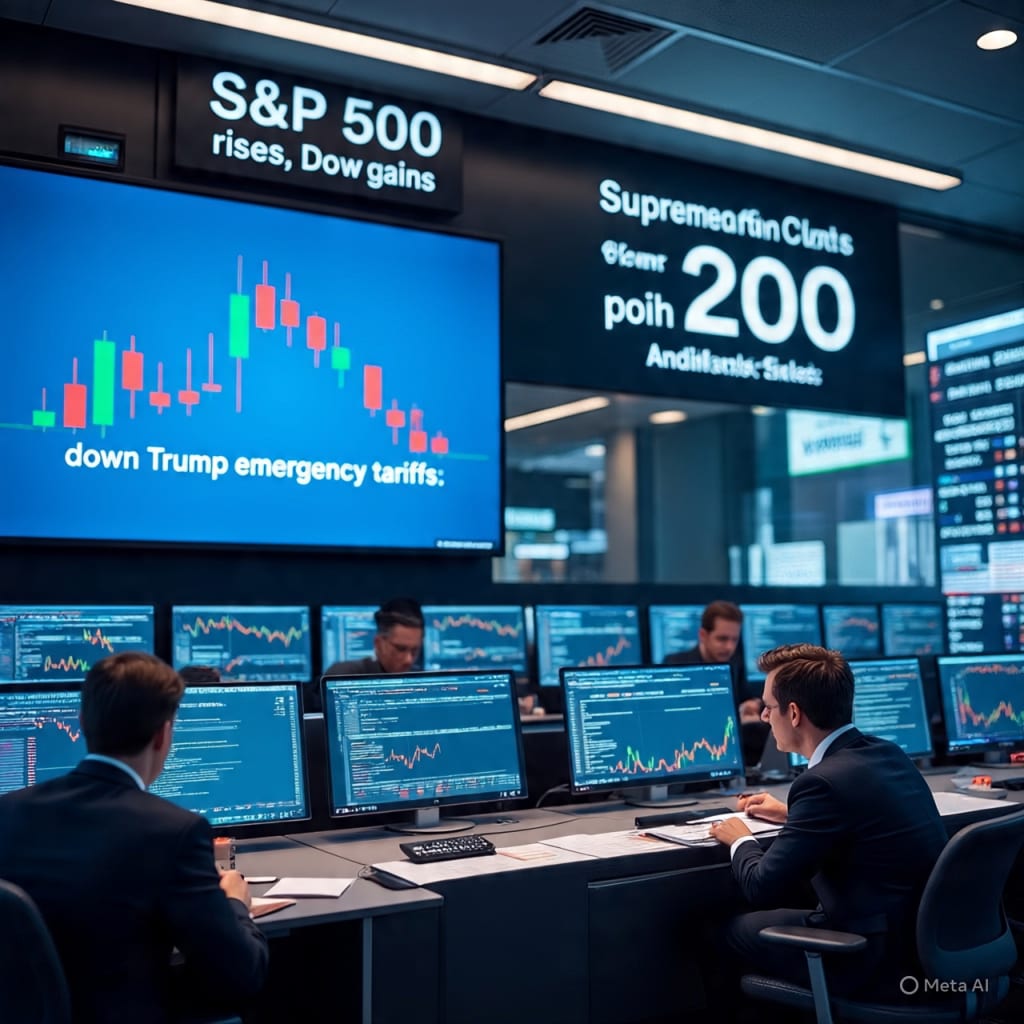
Stocks move higher after court ruling
U.S. stocks moved higher after the Supreme Court struck down emergency tariffs imposed during former President Donald Trump’s administration. Investors responded by pushing major indexes into positive territory as trading progressed.
The S&P 500 climbed in early afternoon trading, while the Dow Jones Industrial Average gained more than 200 points. The Nasdaq Composite also advanced as technology shares participated in the rally.
Market participants viewed the ruling as a development that could lower trade-related uncertainty for companies and investors.
What the Supreme Court decided
The Supreme Court ruled that the Trump administration overstepped its authority when it used emergency powers to impose certain tariffs on imported goods. The justices found that the statutory basis cited for the tariffs did not justify the scope of the measures.
The decision limits how presidents can use emergency economic laws to reshape trade policy without explicit congressional authorization.
As a result, the affected tariffs are expected to be lifted unless Congress takes new legislative action.
Dow jumps more than 200 points
The Dow rose more than 200 points shortly after the market opened and held most of those gains through midday trading. Industrial and consumer-focused companies were among the biggest contributors to the move.
Investors appeared to favor sectors that rely heavily on global supply chains. Companies that import raw materials or finished goods may benefit if tariff costs are reduced.
Market breadth was positive, with more stocks advancing than declining on the New York Stock Exchange.
S&P 500 and Nasdaq follow
The S&P 500 also moved higher, supported by gains in technology, industrials and consumer discretionary shares. The index has been sensitive to changes in trade policy because many of its largest components operate internationally.
The Nasdaq Composite advanced as well, with several major technology companies posting moderate gains. Lower trade barriers can reduce costs for hardware makers and firms with overseas production networks.
Traders said the rally reflected both relief and repositioning after weeks of uncertainty surrounding trade policy and legal challenges.
Relief for import-heavy sectors
Companies in retail, automotive and manufacturing sectors often cite tariffs as a cost burden. The removal of certain emergency tariffs could ease input costs for these industries.
Retailers that import consumer goods may see improved margins if tariff payments decline. Automakers that rely on foreign parts could also benefit.
Shares of several multinational firms rose following the ruling, as investors reassessed profit outlooks.
Impact on inflation outlook
Some analysts said the decision may have implications for inflation trends. Tariffs can raise prices by increasing costs for imported goods, which may then be passed on to consumers.
If tariffs are lifted, price pressures in certain categories could ease over time. However, economists caution that the broader inflation picture depends on many factors, including labor costs and energy prices.
Investors are watching for any signals that changes in trade policy could influence the Federal Reserve’s future interest rate decisions.
Bond market reaction
U.S. Treasury yields moved modestly during the session. The reaction in the bond market was more muted than in equities.
Some traders said the court ruling reduces one source of uncertainty but does not immediately change expectations for economic growth.
The 10-year Treasury yield fluctuated within a narrow range as investors balanced the potential for lower import costs against ongoing concerns about fiscal policy and global demand.
What this means for corporate earnings
Corporate earnings forecasts could shift if tariff expenses decline. Companies that previously absorbed higher import costs might report improved margins in upcoming quarters.
Earnings guidance will be closely watched during the next reporting season. Executives may provide updates on how the ruling affects supply chains and pricing strategies.
Analysts note that the impact will vary by industry. Firms with limited exposure to international trade may see little direct effect.
Political implications for markets
The Supreme Court’s decision also carries political implications. Trade policy has been a central issue in recent election cycles, and the ruling could influence future proposals.
If lawmakers seek to restore or revise tariff authority, markets may face another round of debate and potential volatility.
For now, investors appear focused on the immediate effect of lifting the emergency tariffs rather than long-term political outcomes.
Congress could act next
With the court limiting executive authority under emergency statutes, Congress may consider new legislation to clarify tariff powers.
Lawmakers could tighten restrictions or provide more explicit guidelines for when tariffs may be used. The direction of any bill would depend on negotiations between parties and regional interests.
Until Congress acts, presidents will need to rely on clearly defined statutory tools when adjusting trade measures.
Global markets respond
International markets also reacted to the ruling. Some Asian and European indexes traded higher, reflecting optimism that trade tensions could ease.
Countries that were subject to the tariffs may view the decision as a step toward more stable trade relations.
Currency markets showed limited movement, though some traders said the decision reduced uncertainty about future trade barriers.
Small businesses watch closely
Small and medium-sized businesses that rely on imported materials often feel tariff impacts directly. Many have argued that they lack the pricing power to pass costs on to customers.
Business groups said the ruling could provide relief, especially for firms operating on thin margins.
However, the transition period may take time. Companies will need clarity on how quickly tariff collections will stop and whether refunds will be issued for past payments.
Volatility remains possible
Despite the positive market reaction, analysts caution that volatility could return. Trade policy remains a complex issue influenced by economic, political and national security considerations.
Future administrations could pursue different approaches within the boundaries set by the Supreme Court.
Investors are likely to monitor statements from the White House and congressional leaders for signals about next steps.
Federal Reserve remains in focus
Even as markets respond to the trade ruling, the Federal Reserve continues to play a central role in shaping investor sentiment.
Lower tariff-related costs could modestly affect inflation readings, but Fed officials consider a wide range of data when setting interest rates.
Upcoming economic reports on employment and consumer prices may carry more weight for monetary policy decisions than the immediate effects of the court ruling.
Live market updates summary
As trading continued, the Dow remained up around 200 points, while the S&P 500 and Nasdaq held gains. Volume was steady, and sector performance showed broad participation.
Investors described the mood as cautiously constructive. While the decision removes one layer of uncertainty, broader economic concerns remain.
Market participants will continue to track headlines related to trade, corporate earnings and monetary policy.
The broader economic picture
The Supreme Court’s ruling highlights the intersection of law and markets. Trade policy decisions can influence costs, supply chains and international relationships.
For now, investors appear to welcome the reduction in tariff-related uncertainty. Whether the rally continues will depend on how policymakers respond and how companies adapt.
As always, markets will weigh legal developments alongside economic data and global events. The reaction to the court’s decision underscores how closely Wall Street watches Washington.
The trading day may bring further updates, but the immediate response suggests that investors see potential benefits in a clearer framework for trade policy.
About the Creator
Saad
I’m Saad. I’m a passionate writer who loves exploring trending news topics, sharing insights, and keeping readers updated on what’s happening around the world.
Why Black History Matters in America?
The United States of America is celebrating their 250th anniversary in 2026. I'm proud to be an American and as someone who was born here, I wouldn't imagine myself living anywhere else. This is a country where opportunities are possible. Where anyone can be successful in anything they desire to do. Equality, community, and togetherness are the backbones of what America is and should be about. However, we have an administration who wants to erase and disregard those who have made positive, meaningful impacts in our country, specifically Black figures, such as Martin Luther King, Jr., Rosa Parks, and Maya Angelou. President Trump and his administration have been constantly complaining and fighting against what they call the "Woke agenda". They use this excuse as a distraction from other issues they refuse to address, such as the high cost of living, climate change, and inflation. That equality is dividing America, when in reality, it's bringing us together. Being woke is not tied to a specific political party. No matter where you stand on the political spectrum, you can still care about other people and their plights. Compassion and empathy for others isn't tied to a political party, either. We were taught as children to treat others the way we want to be treated and not judge others because they're different from us. Caring about others isn't a personal attack on your beliefs. It doesn't make you any less of a person. People who are easily offended over African American figures, past or present, or anything related to it, are grasping at straws. Current and future generations need to know who people like Harriet Tubman and Shirley Chisholm were, especially in the classroom. Black History is part of American History. It should be recognized, not hidden or forgotten. Besides, you can't shield children from everything, just because your feelings are easily hurt.
By Mark Wesley Pritchard 19 days ago in The Swamp
Sudan Atrocities Are ‘Hallmarks of Genocide,’ UN Says
The international community has once again been shaken by devastating findings from the United Nations regarding the ongoing war in Sudan. According to a newly released UN investigation, the atrocities committed in the Darfur region, particularly in the city of El-Fasher, display what experts describe as the “hallmarks of genocide.”
By Sajida Sikandara day ago in The Swamp



Comments (1)
The point about uncertainty reduction being a catalyst makes a lot of sense. Do you think markets had already priced in this possibility, or was this ruling a genuine surprise?