
The U.S.–China Tech Race: Why the World Might Be Looking at It All Wrong
A Glimpse of the Traditional Narrative

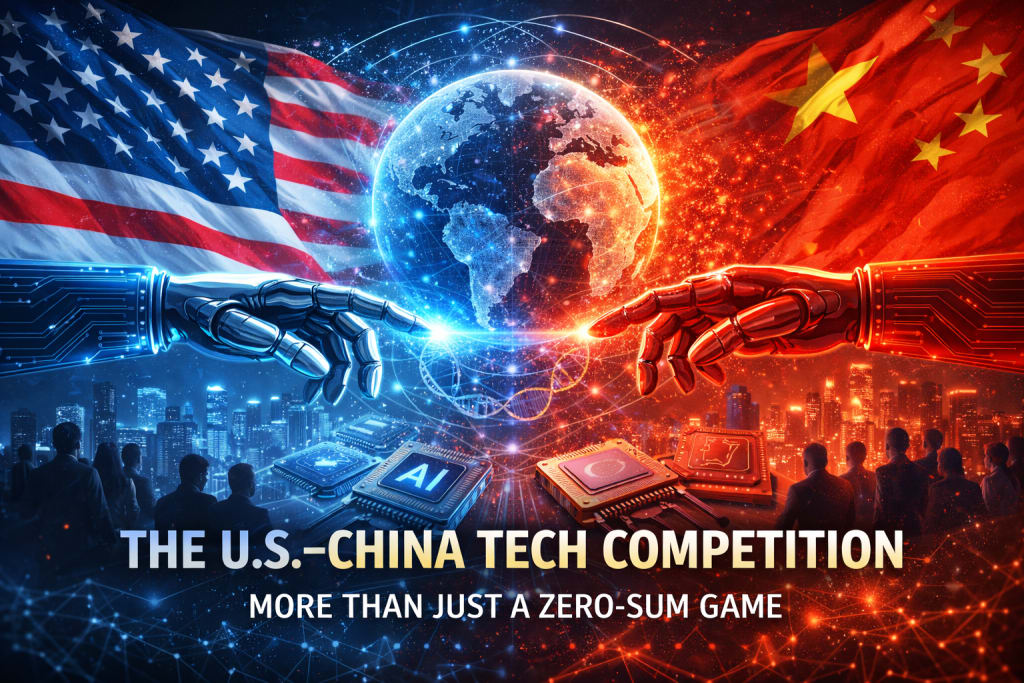
For the past decade, the narrative dominating global headlines — from Washington to Beijing to Brussels — has been the so-called tech race between the United States and China. It’s often portrayed as a high-stakes sprint where only one superpower can win, shaping the future of artificial intelligence (AI), semiconductors, biotech, and advanced technologies. But this familiar framing might be misleading — and not just overly simplistic. In reality, the competition is far more complex, strategic, and interconnected than a zero-sum race, and understanding it accurately matters for policymakers, investors, and everyday citizens alike.
A Glimpse of the Traditional Narrative
In the popular story, the U.S. and China are locked in a battlefield of innovation: the U.S. leads in cutting-edge research and fundamental AI breakthroughs, while China aggressively mobilizes state-backed resources to catch up and surpass its rival. Many believe that whichever country dominates technology will also control future economic growth, national security, and global geopolitical influence.
This framing has influenced policy decisions — from U.S. export controls on advanced AI chips to new subsidy programs promoting domestic semiconductor production — and has justified massive government spending in both capitals. However, recent developments suggest that this narrative may overstate competition and underestimate cooperation, regional dynamics, and global interdependence.
________________________________________
The Reality: A Multifaceted Competition
China: More Than Just a Follower
China’s technological rise isn’t just about imitation anymore — it’s about innovation and execution. In sectors such as consumer AI adoption, biotech research, and infrastructure build-out, China has shown unexpected strengths.
For example, China’s biotech industry has surged from being known for generic drugs to becoming a fast-innovating global player, nearly matching U.S. drug development numbers and attracting major Western investment partnerships.
In AI, Chinese firms are pushing aggressively into consumer applications built into everyday platforms like superapps, while Western companies often focus on foundational AI research. Industry voices suggest China may outpace the U.S. in certain everyday AI use cases — such as voice-activated tools and integrated agents — by emphasizing monetization and adoption speed.
This means the competition is not defined solely by who builds the best technology inside a lab but by who deploys useful tech most effectively in real life — a nuance that traditional narratives often miss.
U.S. Strengths Still Matter
It’s true that the United States retains advantages in certain areas, particularly foundational AI research, advanced semiconductor design, and high-end software ecosystems. Programs like the CHIPS and Science Act aim to solidify technological leadership by boosting domestic production of critical components.
But leadership is not static. Despite strong research capabilities, the U.S. tech sector faces challenges related to infrastructure bottlenecks, talent flows, and export policy tensions that complicate the simple “America leads, China follows” story.
________________________________________
Why “Race” Is the Wrong Metaphor
The idea of a binary race implies two things: a finish line and a clear winner. But today’s global technology landscape is much more like a complex ecosystem with multiple actors, interdependencies, and feedback loops.
1. Global Technology Isn’t Zero-Sum
In many ways, the U.S. and China depend on each other. Collaboration, trade, and shared research have historically driven innovation forward. Even amid competition, American companies often benefit from access to China’s massive developer base and market size — a fact that even major U.S. tech leaders acknowledge.
Likewise, China’s tech growth depends on global supply chains, foreign investment, and collaboration in areas like AI research and systems deployment. Decoupling may sound appealing rhetorically, but in practice it risks fragmenting the global tech ecosystem into disconnected spheres — with higher costs and slower innovation.
2. Competition Is Multipolar
Beyond the U.S. and China, other nations are shaping the future of technology. Europe, India, and Southeast Asian states each bring unique strengths — from ethical AI governance frameworks to rapid digital adoption and competitive industrial strategies. Efforts are underway to develop regional competence in AI, semiconductors, and biotech that do not neatly fit into a two-player narrative.
For instance, Europe’s strategic blueprints emphasize closing innovation gaps by leveraging strengths in privacy, regulation, and cross-industry synergies — a perspective that challenges the idea that technological dominance must reside in either the U.S. or China.
3. The Race Is Internal as Much as External
Another reason the “race” metaphor falls short is that much of the competition occurs within countries, not just between them. Both the U.S. and China contend with internal institutional challenges, regulatory debates, talent shortages, and infrastructure demands that shape how competitive they can truly be.
Across the U.S., debates over AI safety, privacy, and ethical regulations reflect deeper questions about how technology should evolve — including whether speed or responsibility should take priority.
Similarly, China’s focus on rapid integration and practical deployment raises questions about sustainability, national policy alignment, and the balance between private innovation and state direction.
________________________________________
What This Means for the Future
So if the tech competition isn’t a simple sprint, what is it?
It’s a **multi-layered strategic contest shaped by:
• Innovation ecosystems, not just national flags
• Collaboration and competition at the same time
• Industry players, governments, and global markets
• Economic dependencies and supply chain realities**
Understanding this complexity matters because policy decisions informed by outdated narratives risk missing opportunities and creating unnecessary tensions. Rather than viewing technology advancement as a zero-sum game to be “won,” the world may benefit more from strategies that emphasize resilience, cooperation, and ethical leadership in a shared technological future.
________________________________________
Conclusion: Rethinking the Narrative
The U.S.–China tech competition is real, consequential, and intensifying — but framing it as a simple race with a single winner ignores the true shape of technology leadership in the 21st century. Innovation is no longer bounded by borders, and global outcomes depend on shared progress as much as national prowess.
By updating the narrative to match reality — one of complex interdependence, shared challenges, and diverse contributions — policymakers, businesses, and citizens alike can approach the future of technology with clearer eyes and better strategies.
The tech race isn’t about choosing sides. It’s about recognizing that global innovation thrives when competition and collaboration coexist — and that understanding this might be the most important technological insight of all.
For the past decade, the narrative dominating global headlines — from Washington to Beijing to Brussels — has been the so-called tech race between the United States and China. It’s often portrayed as a high-stakes sprint where only one superpower can win, shaping the future of artificial intelligence (AI), semiconductors, biotech, and advanced technologies. But this familiar framing might be misleading — and not just overly simplistic. In reality, the competition is far more complex, strategic, and interconnected than a zero-sum race, and understanding it accurately matters for policymakers, investors, and everyday citizens alike.
About the Creator
Adil Ali Khan
I’m a passionate writer who loves exploring trending news topics, sharing insights, and keeping readers updated on what’s happening around the world.
Keep reading
More stories from Adil Ali Khan and writers in The Swamp and other communities.
Germany Discovers Massive 43 Million-Ton Lithium Reserve Beneath Abandoned Gas Field
e Introduction: A Hidden Resource That Could Power a Continent In a moment that may redefine Europe’s role in the global energy transition, Germany has announced the discovery of an enormous lithium reserve estimated at 43 million tons, buried deep beneath an abandoned natural gas field. The find is already being described as one of the largest known lithium resources on Earth, arriving at a time when demand for battery materials is exploding worldwide.
By Adil Ali Khanabout 17 hours ago in Trader
Why Black History Matters in America?
The United States of America is celebrating their 250th anniversary in 2026. I'm proud to be an American and as someone who was born here, I wouldn't imagine myself living anywhere else. This is a country where opportunities are possible. Where anyone can be successful in anything they desire to do. Equality, community, and togetherness are the backbones of what America is and should be about. However, we have an administration who wants to erase and disregard those who have made positive, meaningful impacts in our country, specifically Black figures, such as Martin Luther King, Jr., Rosa Parks, and Maya Angelou. President Trump and his administration have been constantly complaining and fighting against what they call the "Woke agenda". They use this excuse as a distraction from other issues they refuse to address, such as the high cost of living, climate change, and inflation. That equality is dividing America, when in reality, it's bringing us together. Being woke is not tied to a specific political party. No matter where you stand on the political spectrum, you can still care about other people and their plights. Compassion and empathy for others isn't tied to a political party, either. We were taught as children to treat others the way we want to be treated and not judge others because they're different from us. Caring about others isn't a personal attack on your beliefs. It doesn't make you any less of a person. People who are easily offended over African American figures, past or present, or anything related to it, are grasping at straws. Current and future generations need to know who people like Harriet Tubman and Shirley Chisholm were, especially in the classroom. Black History is part of American History. It should be recognized, not hidden or forgotten. Besides, you can't shield children from everything, just because your feelings are easily hurt.
By Mark Wesley Pritchard 9 days ago in The Swamp


Comments
There are no comments for this story
Be the first to respond and start the conversation.