
US Increases Military Pressure on Iran Ahead of High-Stakes Talks
Formal / News Style Washington boosts naval and air deployments as nuclear negotiations approach Military buildup signals tougher stance ahead of crucial US-Iran diplomatic talks 🔹 Neutral & Informative Carrier strike groups and air assets repositioned as diplomacy and deterrence collide Pentagon strengthens regional presence before renewed negotiations with Tehran 🔹 Impactful Show of force raises stakes as US and Iran prepare for decisive talks

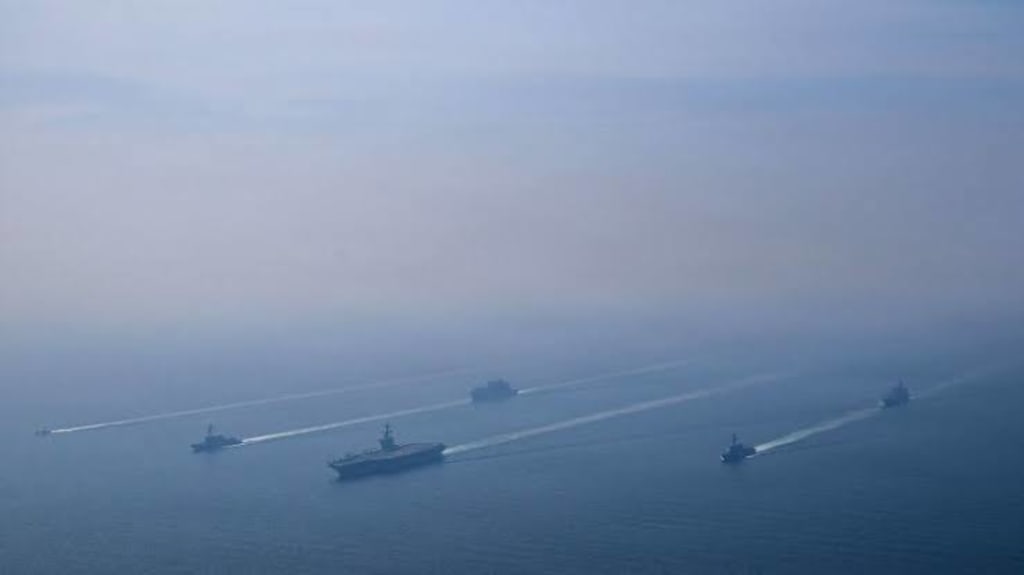
As diplomatic negotiations between the United States and Iran resume this week, Washington is simultaneously bolstering its military posture across the Middle East in what analysts describe as an effort to increase leverage over Tehran before high-stakes nuclear talks. The dual approach — blending diplomacy with a visible military buildup — underscores the fragility of the situation and the broader regional tensions that continue to shape U.S.–Iran relations.
Military Buildup in the Gulf
In the past few weeks, the United States has significantly increased its military presence in and around the Persian Gulf ahead of planned talks in Geneva, where Iranian and American officials will discuss Iran’s nuclear programme and related security issues. According to U.S. officials and defense analysts, the Department of Defense has repositioned air assets, air defense systems, and naval forces closer to the region, extending the deployments of units that were previously scheduled to rotate out.
News Channel 3-12
The surge includes the USS Abraham Lincoln carrier strike group already in the Middle East and the deployment of the USS Gerald R. Ford aircraft carrier from the Caribbean to join its complement of warships. These carrier strike groups, along with guided-missile destroyers and support ships, provide the United States with substantial air, missile, and strike capabilities if military action becomes necessary.
The Guardian +1
The buildup also encompasses repositioned Air Force assets from Europe and the United Kingdom, including aerial refueling tankers and fighter aircraft positioned to support potential operations in the region. Moreover, ground-based air defense systems have been staged nearby to protect U.S. installations and forces.
News Channel 3-12
Leverage Ahead of Negotiations
U.S. officials say the military pressure is intended to bolster the negotiating position of Washington during the ongoing talks with Iranian representatives. The discussions in Geneva are aimed at securing limits on Tehran’s nuclear activities, including uranium enrichment — a highly contentious issue that has repeatedly stalled past negotiations.
Speaking recently about the upcoming talks, U.S. President Donald Trump indicated that he would remain involved “indirectly” in the negotiations and emphasized that the United States was prepared to pursue diplomatic solutions but retains a range of military options should diplomacy fail.
However, U.S. diplomats are pushing for broader terms in negotiations that extend beyond just the nuclear question to include Iran’s ballistic missile programme and influence on regional proxy groups, according to senior American officials. These expanded demands have complicated discussions, as Tehran remains firm that its rights to enrich uranium cannot be compromised.
Iranian Response and Regional Tensions
Iran has signalled its unwillingness to be intimidated by the U.S. military presence. Iranian Foreign Minister Abbas Araghchi has emphasized that Tehran will not cede its nuclear rights under pressure and has rejected U.S. calls to curtail key elements of its defence programme. Iranian officials have also warned that increased U.S. deployments and threats of force could derail diplomatic progress and heighten the risk of confrontation.
In parallel with the U.S. military buildup, Iran’s Revolutionary Guard Corps has conducted military drills in the Strait of Hormuz, a crucial maritime chokepoint through which roughly one-fifth of global oil exports pass. These exercises, which Iran says test readiness amid rising tensions, illustrate Tehran’s determination to assert its strategic influence and signal that it will not be cowed by foreign military movements.
Risks and Stakes
The timing of the military escalation and diplomatic engagement has drawn criticism from some regional leaders and foreign policymakers, who worry that the mixture of pressure and negotiation could backfire. Gulf states, historically wary of U.S.–Iran tensions, have urged caution, warning that a misstep could disrupt oil shipments through the Strait of Hormuz, drive up global energy prices, and destabilize an already fragile region. Observers note that additional U.S. deployments risk inflaming anti-American sentiment and could strengthen hardliners in Tehran who oppose concessions.
Global Implications
Any failure of the Geneva talks — which involve not just nuclear issues but broader regional security concerns — could have far-reaching consequences. A breakdown in negotiations might embolden both sides to escalate military postures further, destabilizing markets and undermining diplomatic efforts by European and Middle Eastern mediators. Conversely, a breakthrough could reduce the military threat and ease geopolitical tensions.
As the United States keeps its military options on the table, world leaders are watching closely. The next few days of talks carry the potential to avert or accelerate a dangerous standoff between two of the Middle East’s most powerful actors.
About the Creator
Fiaz Ahmed
I am Fiaz Ahmed. I am a passionate writer. I love covering trending topics and breaking news. With a sharp eye for what’s happening around the world, and crafts timely and engaging stories that keep readers informed and updated.
Keep reading
More stories from Fiaz Ahmed and writers in The Swamp and other communities.
Mexico and Canada Plan Joint Action on Critical Minerals
Mexico and Canada are preparing to deepen cooperation on critical minerals in a move aimed at strengthening North America’s supply chains and reducing dependence on overseas sources, particularly China. The initiative reflects growing global competition over materials essential for clean energy technologies, electric vehicles, and advanced manufacturing. Officials from both countries confirmed that talks are underway to coordinate exploration, investment, and processing strategies for minerals such as lithium, nickel, cobalt, and rare earth elements. These materials are vital for batteries, renewable energy systems, and defense technologies, making them central to national security and economic planning. Strategic Motivation The joint effort comes as governments worldwide seek to secure reliable access to critical minerals amid rising geopolitical tensions and increasing demand driven by the transition to green energy. Mexico and Canada view cooperation as a way to align policies, attract private investment, and create a more resilient regional supply network. Canada already plays a major role in global mining and has identified critical minerals as a cornerstone of its industrial strategy. Mexico, meanwhile, holds significant untapped mineral reserves, including lithium deposits that have drawn international attention. By coordinating their approaches, the two countries hope to complement each other’s strengths — Canada’s mining expertise and Mexico’s geological potential. Canadian officials have emphasized that closer collaboration with Mexico could help diversify sources of supply while promoting higher environmental and labor standards across the mining sector. Mexican authorities have highlighted the importance of using mineral resources to support domestic development while participating more fully in North American industrial supply chains. Focus on Lithium and Battery Materials One of the central pillars of the joint plan is lithium, a key ingredient in electric vehicle batteries. Mexico has designated lithium as a strategic resource and has moved to increase state involvement in its extraction and management. Canada, meanwhile, is seeking to expand its lithium production and processing capacity to support its growing electric vehicle industry. Analysts say a coordinated approach could accelerate investment in refining and processing facilities, which remain a bottleneck in the global supply chain. At present, much of the world’s critical mineral processing takes place in China, leaving Western economies vulnerable to disruptions or political leverage. By working together, Mexico and Canada aim to encourage the development of regional processing hubs that would reduce reliance on distant suppliers and create high-value industrial jobs. Trade and Diplomatic Implications The plan also aligns with broader North American trade objectives under the United States-Mexico-Canada Agreement (USMCA). While the United States is not formally part of the bilateral initiative, officials acknowledge that Washington would benefit from stronger coordination between its two neighbors. Industry groups have welcomed the announcement, noting that predictable regulatory frameworks and cross-border cooperation are essential for large-scale mining and infrastructure projects. However, some environmental organizations have cautioned that mineral development must not come at the expense of ecosystems or local communities. In Mexico, where mining has historically faced opposition from indigenous and rural groups, the government has pledged that any new projects will be subject to strict environmental oversight and social consultation. Canada has similarly stressed its commitment to sustainable mining practices and partnerships with First Nations. Challenges Ahead Despite shared goals, the partnership faces obstacles. Differences in regulatory systems, investment rules, and state involvement could complicate coordination. Mexico’s recent moves to increase government control over strategic resources have raised concerns among some foreign investors, while Canada’s mining sector remains largely private-driven. Infrastructure gaps also pose a challenge. Transporting and processing minerals requires extensive rail, port, and energy networks, particularly in remote areas. Both governments will need to mobilize public and private financing to support these developments. Another key issue is workforce development. Mining and processing critical minerals require specialized skills, and both countries are exploring training programs to prepare workers for expanding industries linked to clean energy and advanced manufacturing. A Regional Vision Officials describe the initiative as part of a longer-term vision to position North America as a competitive and secure supplier of critical minerals in an increasingly fragmented global economy. With demand for electric vehicles and renewable energy projected to surge over the next decade, access to raw materials is expected to become even more strategically important. “Critical minerals are the backbone of the energy transition,” one Canadian official said. “Working with Mexico allows us to build a stronger, more secure regional supply chain that benefits both our economies.” Mexican authorities echoed that sentiment, saying cooperation would help ensure that resource development contributes to national growth while supporting regional integration. Looking Ahead Formal agreements are expected to be announced later this year, outlining specific areas of cooperation such as joint geological surveys, information sharing, and investment incentives. If successful, the partnership could serve as a model for broader continental coordination on resources vital to the future economy. As global competition intensifies, Mexico and Canada’s joint action on minerals signals a strategic shift toward collaboration over competition — a move designed to secure their place in the evolving landscape of clean energy and high-tech industries.
By Fiaz Ahmed about 19 hours ago in The Swamp
Why Black History Matters in America?
The United States of America is celebrating their 250th anniversary in 2026. I'm proud to be an American and as someone who was born here, I wouldn't imagine myself living anywhere else. This is a country where opportunities are possible. Where anyone can be successful in anything they desire to do. Equality, community, and togetherness are the backbones of what America is and should be about. However, we have an administration who wants to erase and disregard those who have made positive, meaningful impacts in our country, specifically Black figures, such as Martin Luther King, Jr., Rosa Parks, and Maya Angelou. President Trump and his administration have been constantly complaining and fighting against what they call the "Woke agenda". They use this excuse as a distraction from other issues they refuse to address, such as the high cost of living, climate change, and inflation. That equality is dividing America, when in reality, it's bringing us together. Being woke is not tied to a specific political party. No matter where you stand on the political spectrum, you can still care about other people and their plights. Compassion and empathy for others isn't tied to a political party, either. We were taught as children to treat others the way we want to be treated and not judge others because they're different from us. Caring about others isn't a personal attack on your beliefs. It doesn't make you any less of a person. People who are easily offended over African American figures, past or present, or anything related to it, are grasping at straws. Current and future generations need to know who people like Harriet Tubman and Shirley Chisholm were, especially in the classroom. Black History is part of American History. It should be recognized, not hidden or forgotten. Besides, you can't shield children from everything, just because your feelings are easily hurt.
By Mark Wesley Pritchard 16 days ago in The Swamp
Israel Gives Itself More Control Over the Occupied West Bank
The Israeli government has taken a decisive step that could redefine the political and legal reality of the occupied West Bank. In a move that has triggered sharp international criticism and deep Palestinian concern, Israel has approved new measures that significantly expand its administrative, legal, and territorial control over the area. Supporters frame the decision as a bureaucratic adjustment; critics warn it marks a dangerous slide toward de facto annexation.
By Aqib Hussain8 days ago in The Swamp
Nancy Guthrie: Is a miracle still possible after close to two weeks?
Close to two weeks since Nancy Guthrie's abduction As of February 12, 2026, Nancy Guthrie remains classified as missing for 12 days, but there is no official confirmation that she is deceased. Blood matching Guthrie’s DNA was found on her front porch, indicating she likely suffered an injury during the abduction.
By Cheryl E Preston5 days ago in Geeks



Comments
There are no comments for this story
Be the first to respond and start the conversation.