
US Navy on the Hunt for Strike Drones That Can Launch from Any Warship
Formal / news style The Pentagon seeks low-cost, ship-launched unmanned weapons to expand firepower and counter growing threats from China and Russia. A new drone program aims to turn every Navy vessel into a distributed strike platform. Lessons from modern wars push the Navy toward mass-produced, ship-based attack drones. Analytical / serious Washington accelerates unmanned warfare plans to reshape naval combat in the Indo-Pacific. The search for launch-anywhere drones signals a major shift in U.S. maritime strategy. Short & impactful Every warship could soon become a drone carrier. Low-cost strike drones may redefine American sea power.

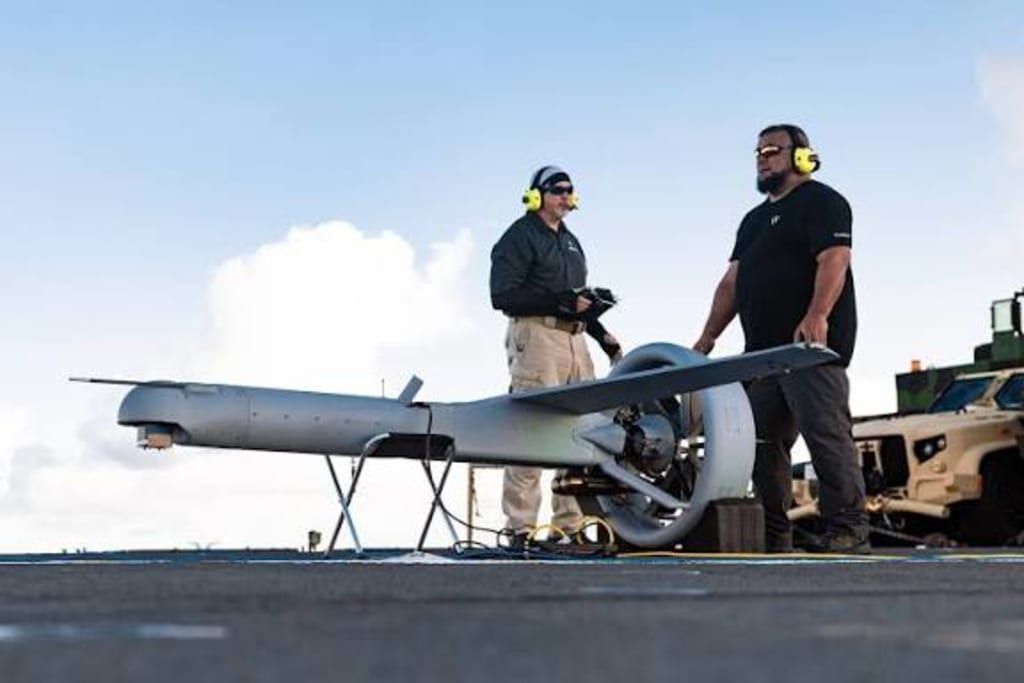
The U.S. Navy is quietly accelerating its search for a new generation of strike drones capable of launching from virtually any warship, a move aimed at transforming every vessel in the fleet into a potential offensive platform amid rising tensions in the Pacific and beyond.
Senior defense officials say the initiative reflects lessons learned from recent conflicts, particularly the widespread use of low-cost, long-range drones in Ukraine and the Middle East. The Navy now wants small, lethal unmanned systems that can be fired from standard ship-based launchers and strike targets hundreds of kilometers away without putting pilots or high-value aircraft at risk.
The concept, described by Navy planners as “distributed strike,” would allow destroyers, frigates, amphibious ships, and even support vessels to deploy armed drones from their existing Vertical Launch System (VLS) cells or modular deck launchers. Instead of relying solely on carrier-based aircraft or expensive cruise missiles, commanders could unleash swarms of autonomous or semi-autonomous drones to overwhelm enemy air defenses.
From Defense to Offense
For years, ship-launched drones were primarily used for surveillance and reconnaissance. Systems such as the ScanEagle and MQ-8 Fire Scout provided real-time intelligence but carried no weapons. That is now changing.
According to Navy officials familiar with the program, the service is seeking a strike-capable unmanned aerial vehicle that can be:
launched from multiple ship classes,
operated with minimal crew training,
and produced at a fraction of the cost of conventional missiles.
“These drones are not meant to replace cruise missiles or fighter jets,” one naval officer said privately. “They are meant to supplement them — and in some scenarios, to be used in large numbers where attrition is expected.”
The Navy’s interest is tied closely to its broader push toward unmanned and autonomous warfare under the Pentagon’s “Replicator” initiative, which aims to deploy thousands of expendable drones within two years to counter China’s growing military power.
A Response to China’s Anti-Access Strategy
The urgency behind the project stems largely from China’s expanding missile forces and air defenses in the Western Pacific. Beijing’s strategy of denying access to U.S. forces — often called anti-access/area denial (A2/AD) — relies on targeting aircraft carriers and major bases.
Strike drones launched from dispersed ships would complicate that strategy.
“Instead of one aircraft carrier projecting power, you could have dozens of ships each capable of launching multiple strike drones,” said a U.S. defense analyst. “It creates a much more survivable and unpredictable threat.”
Unlike traditional aircraft, these drones could be programmed for one-way missions, similar to loitering munitions. They could fly low to avoid radar, identify targets using onboard sensors, and strike with precision explosives.
Technical Challenges
Designing a drone that can be launched from “any warship” presents major engineering hurdles. The system must fit inside standard launch tubes or compact canisters, withstand saltwater environments, and integrate with existing combat systems such as Aegis radar and shipboard command networks.
Industry sources say the Navy is testing several prototypes, including tube-launched drones that unfold their wings after launch and use jet or propeller propulsion. Some models are designed to carry small warheads, while others focus on electronic warfare, jamming enemy radars before follow-on missile strikes.
Another key challenge is command and control. The Navy wants drones that can operate in contested environments where GPS and communications may be disrupted. This means greater autonomy and onboard decision-making — a shift that raises both technical and ethical questions.
Cost and Speed Matter
One of the driving forces behind the program is cost. A Tomahawk cruise missile can cost over $1 million per unit. In contrast, the Navy hopes its strike drones can be produced for tens or hundreds of thousands of dollars each.
That price difference enables mass deployment.
“If you can launch 50 drones for the cost of a few missiles, you change the economics of naval warfare,” said a former Pentagon acquisition official.
A New Era of Naval Power
The push for ship-launched strike drones signals a deeper transformation in how the Navy views combat at sea. Rather than relying on a small number of highly expensive platforms, future operations may depend on networks of manned ships and unmanned weapons working together.
While still in development, officials say operational testing could begin within the next few years. If successful, the program would mark the first time in U.S. naval history that almost every warship could serve as a drone strike platform.
As one senior officer summarized, “The future fleet won’t just sail. It will launch clouds of unmanned weapons. And that changes everything.”
About the Creator
Fiaz Ahmed
I am Fiaz Ahmed. I am a passionate writer. I love covering trending topics and breaking news. With a sharp eye for what’s happening around the world, and crafts timely and engaging stories that keep readers informed and updated.
Keep reading
More stories from Fiaz Ahmed and writers in The Swamp and other communities.
Europe Gets Rare LNG Cargo from China Amid Gas Crunch
Europe has received a rare shipment of liquefied natural gas (LNG) from China as the continent continues to grapple with tight gas supplies and volatile energy markets, highlighting a quiet but significant shift in global gas trade flows driven by geopolitical pressure and economic pragmatism. According to shipping data and industry sources, the LNG cargo originated from a Chinese buyer that chose to resell or divert its contracted supply to European terminals rather than consume it domestically. Such transactions are unusual, as China is typically one of the world’s largest LNG importers, competing directly with Europe for supplies from major exporters such as Qatar, Australia, and the United States. The delivery comes at a time when European gas storage levels remain under strain following consecutive winters of heavy withdrawals and continued uncertainty over pipeline supplies from Russia. While Europe has dramatically reduced its dependence on Russian gas since 2022, the replacement strategy has made the region far more reliant on LNG imports — and therefore vulnerable to shifts in global demand. A Rare Reversal of Roles Historically, LNG flows have moved from producers to Asia first, where buyers were willing to pay premium prices. China, Japan, and South Korea dominated the LNG market for years, leaving Europe dependent on pipelines from Russia and Norway. That pattern began to change after Russia’s invasion of Ukraine, when Europe scrambled to secure LNG cargoes at almost any price. Asian buyers, including China, found themselves in a new position: able to profit from reselling gas originally meant for their own markets. Energy analysts say China’s decision to divert a cargo to Europe reflects a combination of weaker domestic gas demand and favorable market pricing in Europe. “China’s industrial consumption has slowed compared with previous years, and at the same time European buyers are paying a premium to secure supply,” said one senior LNG trader familiar with the transaction. “It makes commercial sense for Chinese firms to resell some of their contracted volumes.” Strategic Implications for Europe For Europe, the arrival of LNG from China carries symbolic as well as practical importance. It demonstrates that the global gas market is now fully interconnected, with cargoes moving wherever prices are highest and political risks are lowest. European officials have worked to diversify supply through long-term contracts with the United States, Qatar, and African producers. However, short-term spot cargoes remain essential during periods of peak demand or unexpected cold spells. “This is a reminder that Europe’s energy security now depends on global LNG dynamics, not just regional pipeline politics,” said an energy policy adviser in Brussels. “Even a country like China can become an indirect supplier when market conditions allow.” The cargo also underscores Europe’s success in outbidding Asian markets at times, reversing a decades-long imbalance in energy trade power. China’s Quiet Flexibility China’s state-owned energy companies have become major players in LNG trading over the past decade. While originally focused on securing supply for domestic use, they increasingly act as portfolio traders, buying LNG under long-term contracts and selling it on the open market when demand at home is lower. During previous energy crises, Chinese firms resold several LNG cargoes to Europe, generating substantial profits. This latest shipment follows that pattern, reflecting Beijing’s willingness to use its energy assets flexibly rather than hoard supplies. At the same time, China continues to expand pipeline gas imports from Russia and Central Asia, reducing pressure on LNG consumption at home and freeing up cargoes for resale. Market Pressures Remain Despite the symbolic boost, one cargo will do little to solve Europe’s broader gas crunch. Storage levels remain below historical averages in some countries, and weather uncertainty continues to drive price swings. Industry experts warn that Europe could face renewed competition from Asia if Chinese and Japanese demand rebounds sharply during extreme cold or economic recovery. “If China’s economy accelerates or if there is a harsh winter in Northeast Asia, those LNG flows could quickly reverse again,” said a senior analyst at a global energy consultancy. “Europe is not out of danger yet.” The situation also exposes the fragility of Europe’s energy transition. While renewable power capacity is expanding rapidly, gas remains essential for electricity generation and heating, especially when wind and solar output falls. A New Energy Reality The rare LNG shipment from China to Europe illustrates how the gas market has entered a new era defined by flexibility, competition, and geopolitics. Instead of long, predictable routes from producer to consumer, cargoes now chase price signals across oceans. For Europe, the cargo is both a relief and a warning: relief that alternative supplies are still available, and a warning that energy security now depends on complex global trade relationships rather than fixed pipelines. As one European energy official put it privately, “Today China is selling us gas. Tomorrow, we may be bidding against China for the same cargo. That is the new normal.”
By Fiaz Ahmed about 24 hours ago in The Swamp
The Saddest Thing - The Billionaires Who Rule America Aren't Even Enjoying Themselves
This single post says more about our ruling class than a thousand policy papers. The saddest thing about today's system is that the men robbing the rest of us - sabotaging our economic prospects, our pensions, our access to affordable healthcare - are not even happy.
By Scott Christenson🌴6 days ago in The Swamp
I've Just Realized
The President doesn't understand music. There. It felt very good to write that; it's some thing I just realized today. Oh , yes; he plays it. He TRUMPets it in rallies and meetings, pumps it across the airwaves when he gathers up our minutes waiting for his late arrival.
By Judey Kalchik 4 days ago in Beat


Comments
There are no comments for this story
Be the first to respond and start the conversation.