
US Pressures Vanuatu at UN Over ICJ’s Landmark Climate Change Ruling
Formal / News Style Pacific nation faces diplomatic pushback after historic court decision Washington seeks to limit impact of ruling on climate responsibility Tensions rise over legal accountability for global emissions 🔹 Neutral & Informative How a landmark judgment reshaped climate diplomacy Small island states push back against major powers 🔹 Impactful & Catchy When climate justice meets global politics A ruling that changed the rules of the climate debate

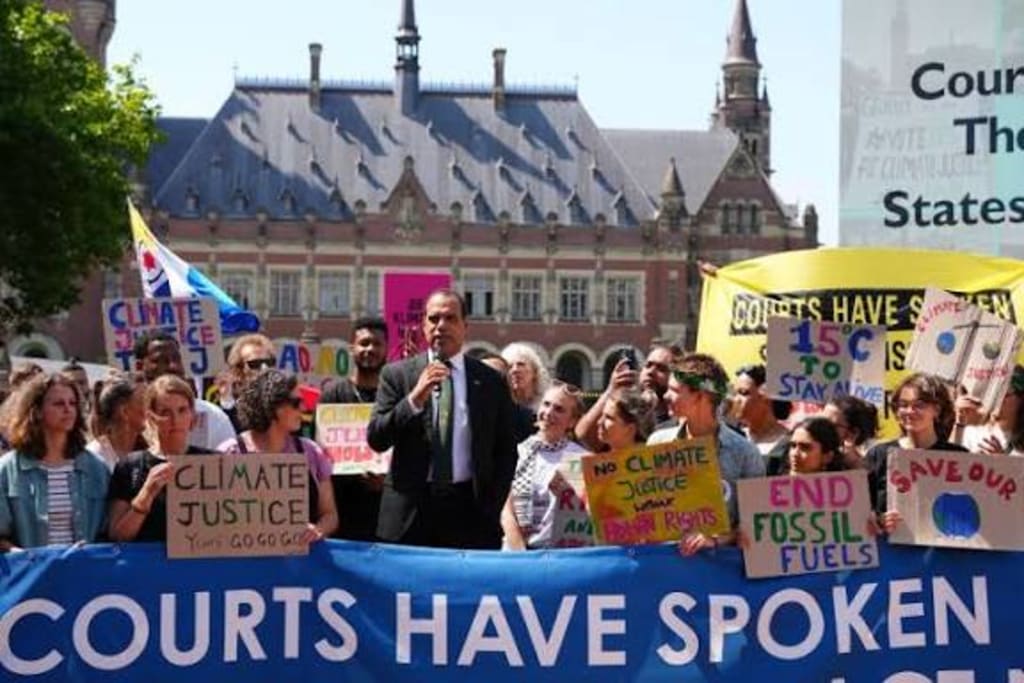
The United States has come under scrutiny after reports emerged that it applied diplomatic pressure on Vanuatu at the United Nations following a landmark advisory ruling by the International Court of Justice on climate change obligations.
The ICJ ruling, hailed by climate-vulnerable nations as a historic step toward accountability, declared that states have a legal duty to protect the environment and prevent harm caused by greenhouse gas emissions. The opinion strengthened arguments that wealthy and high-emitting countries could be held responsible under international law for climate damage affecting vulnerable nations.
Vanuatu, which led years of campaigning to bring the issue before the court, celebrated the decision as a victory for small island states threatened by rising seas and extreme weather. However, diplomatic sources say the United States has since sought to limit how the ruling is interpreted and applied within UN forums.
Diplomatic Tensions After Historic Decision
According to officials familiar with the discussions, U.S. representatives warned Vanuatu and allied countries against pushing for binding resolutions or enforcement mechanisms that could expose major economies to legal or financial consequences. While the ICJ’s opinion is not legally binding, it carries significant moral and political weight and is expected to influence future climate negotiations and litigation.
A senior diplomat from a Pacific nation described the pressure as “deeply disappointing,” adding that the ruling was meant to amplify the voices of countries most affected by climate change rather than silence them.
“The court affirmed what we have known for decades—that those who contribute most to climate change must act to prevent harm,” the diplomat said. “Attempts to water down that message undermine the spirit of international cooperation.”
US Position on Climate Responsibility
The U.S. government has not denied engaging in talks with Vanuatu but maintains that its actions are intended to preserve consensus and prevent divisions within the UN system. A spokesperson said Washington supports global climate action through existing agreements, including the Paris Agreement, and remains committed to reducing its emissions.
However, officials cautioned against what they called “overreach” in interpreting the ICJ opinion as a basis for new legal liabilities. They argued that climate challenges should be addressed through diplomacy and cooperative frameworks rather than through courts.
“Climate change requires collective solutions,” the spokesperson said. “We must avoid approaches that risk fragmenting international efforts or creating legal uncertainty.”
A Victory for Climate-Vulnerable Nations
For Vanuatu and other island nations, the ICJ decision represents a milestone after years of advocacy by youth groups, environmental organizations, and Pacific governments. The ruling recognized that environmental harm caused by climate change can violate human rights and international law, giving vulnerable states a stronger platform in negotiations with major emitters.
Environmental activists accused the United States of attempting to weaken the ruling’s impact. Several non-governmental organizations called on Washington to respect the court’s findings and support efforts to translate them into meaningful action.
“This ruling is about survival,” said a spokesperson for a global climate justice network. “It affirms that powerful nations cannot ignore the consequences of their emissions on communities that are losing land, livelihoods, and lives.”
Broader Implications for Global Politics
The controversy highlights a growing divide between industrialized countries and developing nations over responsibility for climate damage. While wealthier states emphasize voluntary commitments and technological solutions, vulnerable countries increasingly demand legal recognition of loss and damage.
Analysts say the dispute also reflects fears among major economies that the ICJ ruling could open the door to lawsuits or compensation claims. Several governments are reportedly reviewing their legal exposure and diplomatic strategies in light of the decision.
“The court’s opinion changes the conversation,” said an international law expert based in Europe. “Even if it is advisory, it sets a standard that future climate negotiations cannot ignore.”
What Comes Next
Vanuatu is expected to continue pushing for stronger language on climate responsibility in upcoming UN resolutions. Supporters hope the ICJ ruling will be referenced in future climate talks and used to strengthen global commitments to reduce emissions and protect vulnerable communities.
Whether U.S. pressure will succeed in moderating that push remains uncertain. For now, the episode underscores how climate change is no longer only an environmental issue, but a legal and diplomatic battleground shaping relations between powerful states and those most at risk.
As the international community grapples with rising temperatures and intensifying climate impacts, the ICJ’s landmark ruling—and the response to it—may mark a turning point in how responsibility for climate change is defined on the world stage.
About the Creator
Fiaz Ahmed
I am Fiaz Ahmed. I am a passionate writer. I love covering trending topics and breaking news. With a sharp eye for what’s happening around the world, and crafts timely and engaging stories that keep readers informed and updated.
Keep reading
More stories from Fiaz Ahmed and writers in The Swamp and other communities.
One Last Chat With David Brooks
In a quiet corner of a Washington café, the conversation with David Brooks felt less like an interview and more like a reflection on a lifetime spent observing American society. Known for his measured voice and thoughtful analysis, Brooks spoke candidly about politics, culture, and the deeper moral questions he believes now define the nation’s future. Brooks, a longtime columnist and author, has built his career on exploring not only what people think, but why they think it. In what he described as a “moment of pause,” he said the country is undergoing a profound identity shift. “We are not just divided politically,” he noted. “We are divided emotionally and spiritually. People don’t feel seen or heard, and that creates anger.” When asked about the current political climate, Brooks avoided the language of crisis and instead framed it as a test of character. He argued that institutions are weaker not because of ideology, but because of declining trust. “Democracy runs on habits—listening, compromise, humility,” he said. “When those habits erode, the system struggles.” Brooks has often positioned himself as a bridge between conservative and liberal audiences, emphasizing civic responsibility over partisan loyalty. He said this role has become harder in an era of social media outrage. “There’s a reward system for cruelty now,” he explained. “The loudest voices get the most attention, and nuance gets buried.” Yet Brooks remains cautiously optimistic. He pointed to younger generations who, he believes, are redefining leadership in quieter ways. “I see students who care deeply about mental health, community service, and fairness,” he said. “They may not trust institutions, but they trust relationships. That matters.” The discussion turned personal when Brooks reflected on his own evolution as a writer. Early in his career, he focused on policy and political strategy. Over time, he became more interested in character, purpose, and meaning. “I realized people don’t just want answers,” he said. “They want to know how to live well in a confusing world.” He spoke about loneliness as one of the greatest challenges facing modern society. Despite unprecedented connectivity, Brooks believes many Americans feel isolated. “We’ve built a culture of achievement but not a culture of belonging,” he said. “Success without connection is empty.” Brooks also addressed criticism that commentators like himself are out of touch with everyday struggles. He acknowledged the gap. “Writers like me live in a bubble,” he admitted. “The danger is thinking your bubble is the whole country. That’s why listening is more important than talking.” When asked what advice he would give young journalists, Brooks emphasized curiosity and moral seriousness. “Don’t just report what happened,” he said. “Ask what it means. Ask who was hurt. Ask what responsibility looks like.” He warned against chasing attention at the expense of truth. “Fame is a terrible editor,” he added with a smile. The conversation inevitably returned to the future of American discourse. Brooks said the nation must relearn the art of disagreement without dehumanization. “We don’t need less conflict,” he said. “We need better conflict—conflict that leads somewhere constructive.” As the interview drew to a close, Brooks reflected on legacy. He dismissed the idea of being remembered for political opinions. Instead, he hoped his work would encourage empathy. “If people say I helped them understand someone different from themselves, that’s enough,” he said. Outside, the afternoon traffic hummed past, indifferent to the weight of the discussion inside. Brooks gathered his notes and prepared to leave for another speaking engagement. Before parting, he offered one final thought: “The story of America is not just about power. It’s about character. And that story is still being written.” In an age of instant reactions and endless commentary, Brooks’s calm, reflective tone felt almost out of place—and yet deeply necessary. The conversation did not provide simple answers, but it offered something rarer: a reminder that public life is ultimately about human life, with all its contradictions and hopes. “One last chat” may be an overstatement, Brooks said with a quiet laugh. “There’s always more to talk about.” But for a moment, the exchange captured the essence of his career: thoughtful, restrained, and rooted in the belief that understanding is still possible, even in divided times.
By Fiaz Ahmed a day ago in The Swamp
Why Black History Matters in America?
The United States of America is celebrating their 250th anniversary in 2026. I'm proud to be an American and as someone who was born here, I wouldn't imagine myself living anywhere else. This is a country where opportunities are possible. Where anyone can be successful in anything they desire to do. Equality, community, and togetherness are the backbones of what America is and should be about. However, we have an administration who wants to erase and disregard those who have made positive, meaningful impacts in our country, specifically Black figures, such as Martin Luther King, Jr., Rosa Parks, and Maya Angelou. President Trump and his administration have been constantly complaining and fighting against what they call the "Woke agenda". They use this excuse as a distraction from other issues they refuse to address, such as the high cost of living, climate change, and inflation. That equality is dividing America, when in reality, it's bringing us together. Being woke is not tied to a specific political party. No matter where you stand on the political spectrum, you can still care about other people and their plights. Compassion and empathy for others isn't tied to a political party, either. We were taught as children to treat others the way we want to be treated and not judge others because they're different from us. Caring about others isn't a personal attack on your beliefs. It doesn't make you any less of a person. People who are easily offended over African American figures, past or present, or anything related to it, are grasping at straws. Current and future generations need to know who people like Harriet Tubman and Shirley Chisholm were, especially in the classroom. Black History is part of American History. It should be recognized, not hidden or forgotten. Besides, you can't shield children from everything, just because your feelings are easily hurt.
By Mark Wesley Pritchard 13 days ago in The Swamp
If You Write A Book, Don’t Tell Anyone
There are days when I’m grateful Amazon doesn’t tell me specifically who has bought my book and who hasn’t. If they did, I would be heartbroken when I read the list and noticed all the important names in my life were not on my list of customers.
By Ellen Frances7 days ago in Writers




Comments
There are no comments for this story
Be the first to respond and start the conversation.