
Air Brake System Market Size, Growth & Forecast 2025–2033 | Renub Research
Global Demand for Safer, Smarter Braking Systems Drives Steady Market Expansion

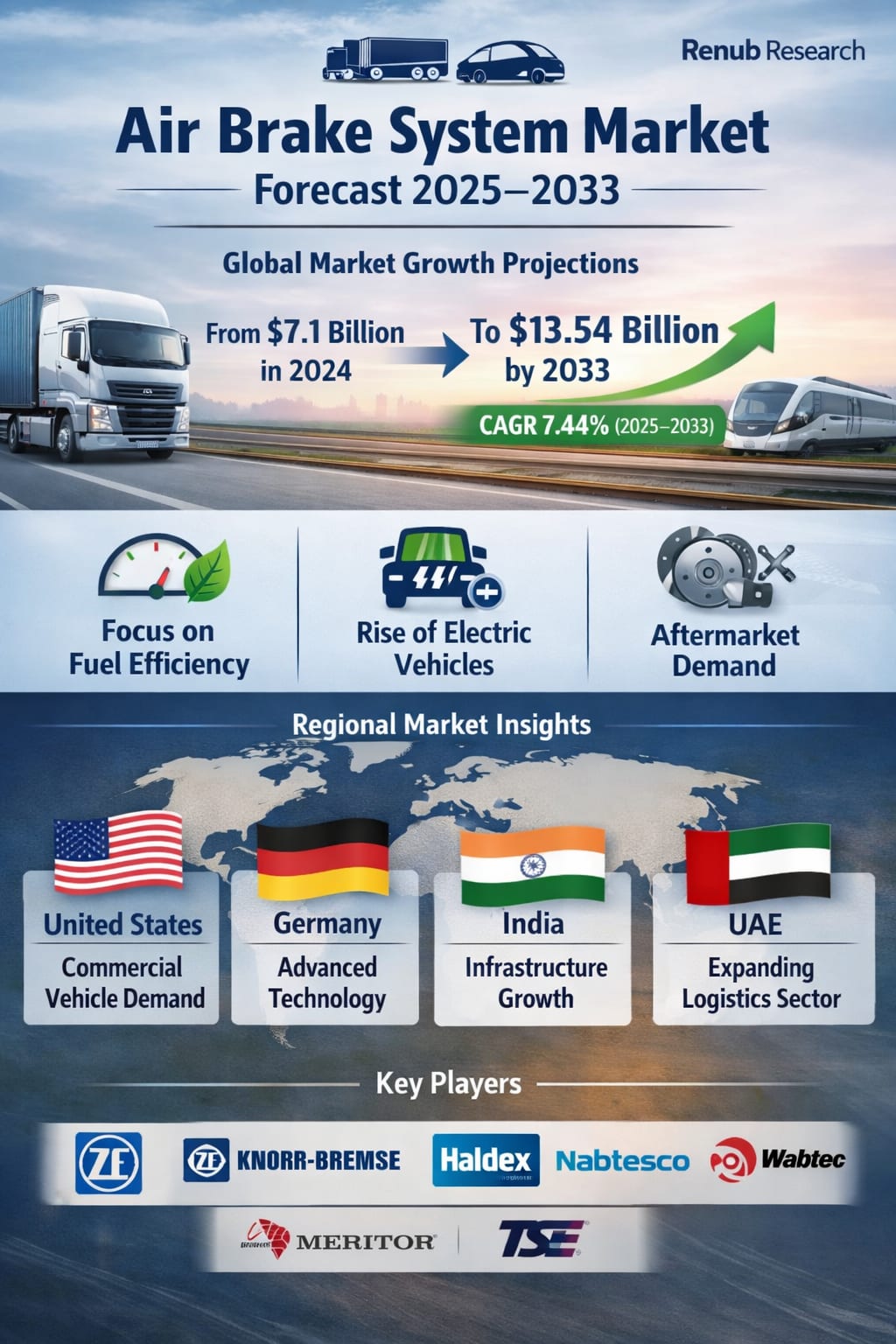
Air Brake System Market Overview
The Global Air Brake System Market is entering a phase of consistent and technology-driven expansion. According to Renub Research, the market is expected to grow from US$ 7.1 billion in 2024 to US$ 13.54 billion by 2033, registering a CAGR of 7.44% from 2025 to 2033. This steady rise reflects the increasing importance of vehicle safety, regulatory compliance, and performance efficiency across commercial transportation and rail networks worldwide.
Air brake systems are friction-based braking mechanisms that use compressed air pressure to slow down or stop vehicles. Unlike hydraulic braking systems, air brakes are specifically designed for heavy-duty applications, making them ideal for trucks, buses, trailers, and rolling stock. Their ability to provide strong, reliable braking performance even under heavy loads has made them the preferred choice in commercial and industrial transportation.
A standard air brake system consists of several critical components, including compressors, air tanks, dryers, brake chambers, foot valves, slack adjusters, and brake drums or discs. Together, these components ensure consistent braking force, reduced wear and tear, and improved safety under demanding operating conditions.
With the global transportation sector under increasing pressure to improve safety standards, reduce accidents, and enhance operational efficiency, air brake systems are becoming more advanced, lighter, and smarter. The rise of electric vehicles (EVs), high-speed rail projects, and large-scale logistics operations is further reshaping the future of this market.
Global Air Brake System Industry Outlook
Air brake systems have long been recognized for their durability, reliability, and superior control, especially in heavy vehicles. Compared to traditional hydraulic systems, air brakes offer several advantages: they are less prone to failure, easier to maintain in large fleets, and safer in the event of leaks or pressure loss.
One of the key reasons behind the widespread adoption of air brake systems is their fail-safe nature. In most designs, a loss of air pressure automatically triggers the brakes, reducing the risk of runaway vehicles—an essential feature for trucks and trains operating on highways, slopes, and long-distance routes.
In recent years, manufacturers have also focused on lightweight air brake systems for line-haul trucks and trailers. These newer systems use fewer components, provide better ground clearance, and offer improved protection against road debris, all while maintaining strong braking performance. This evolution is helping fleet operators reduce vehicle weight, improve fuel efficiency, and lower maintenance costs.
At the same time, the railway sector is emerging as a major growth driver. The expansion of metro networks, high-speed rail projects, and freight corridors—especially in Asia-Pacific and parts of Europe—is creating strong demand for advanced, high-performance air brake systems that can operate safely at higher speeds and heavier loads.
Key Factors Driving the Air Brake System Market Growth
1. Growing Focus on Fuel Efficiency
Fuel efficiency has become a top priority for fleet operators and transportation companies worldwide. Traditional braking systems often result in significant energy losses during deceleration, which directly affects overall vehicle efficiency.
Modern air brake systems are increasingly being integrated with electronic controls, automated brake adjustment systems, and energy-efficient compressors. These technologies help optimize braking performance, reduce unnecessary energy loss, and minimize component wear and tear. Over time, this leads to lower fuel consumption, longer component life, and reduced operating costs.
As fuel prices remain volatile and sustainability goals become more stringent, air brake systems are playing a crucial role in helping commercial vehicles achieve better total cost of ownership (TCO) and improved environmental performance.
2. Rise of Electric Vehicles (EVs)
The rapid growth of electric vehicles is significantly influencing the evolution of braking systems. EVs rely heavily on regenerative braking, a technology that captures kinetic energy during braking and converts it into electrical energy stored in the battery.
Air brake systems designed for EV platforms must be compatible with regenerative braking while still meeting strict safety and performance requirements. This has pushed manufacturers to develop customized, lightweight, and high-efficiency braking solutions that can seamlessly integrate with electric drivetrains.
As electric buses, electric trucks, and hybrid commercial vehicles become more common, the demand for advanced air brake systems tailored to these platforms is expected to accelerate, creating new growth opportunities for the market.
3. Expanding Aftermarket Demand
The global fleet of commercial vehicles is growing steadily, and with it comes a rising need for maintenance, repairs, and replacement of air brake components. Industries such as logistics, freight transport, mining, and public transportation depend heavily on vehicle uptime and operational reliability.
Components like brake chambers, air dryers, compressors, and slack adjusters require regular inspection and periodic replacement. This ongoing need is driving strong growth in the aftermarket segment, making it a key revenue stream for manufacturers and service providers.
As commercial vehicles continue to age and rack up higher mileage, the aftermarket for air brake systems is expected to remain a stable and expanding part of the overall market.
Challenges in the Air Brake System Market
1. Limited Awareness and Training
In several developing regions, a lack of technical awareness and trained personnel remains a significant barrier. Air brake systems are more complex than conventional braking systems and require proper installation, regular maintenance, and skilled troubleshooting.
Without adequate training programs and technical infrastructure, fleet operators may hesitate to adopt advanced air brake technologies. This can lead to improper usage, higher failure rates, and increased long-term costs—ultimately slowing market penetration in these regions.
2. Complexity and Cost of Maintenance
Air brake systems consist of multiple interconnected components, all of which require regular inspection and servicing. This makes maintenance more time-consuming and expensive compared to simpler braking systems.
In regions where access to specialized service centers or trained technicians is limited, maintenance challenges can discourage adoption. High service costs and downtime concerns may also impact smaller fleet operators, particularly in emerging markets.
Air Brake System Market by Region
United States
The U.S. air brake system market is driven by the strong demand for trucks, buses, and trailers, along with strict safety regulations enforced by agencies such as the FMCSA. The adoption of Electronic Braking Systems (EBS) and Anti-lock Braking Systems (ABS) is further improving vehicle safety and performance. While high initial costs and maintenance complexity remain challenges, continuous infrastructure development and growth in logistics keep the market on a steady upward path.
Germany
Germany plays a central role in Europe’s air brake system market, supported by its strong automotive industry and strict safety standards. Global leaders like Knorr-Bremse and ZF Friedrichshafen are headquartered here, driving innovation in air disc brakes and electronic braking technologies. Advanced infrastructure and a strong export network further strengthen Germany’s position, although high maintenance costs and the need for specialized training remain ongoing concerns.
India
India’s air brake system market is expanding due to rising safety awareness, infrastructure development, and growth in commercial vehicles and railways. Government initiatives focused on transportation modernization, along with increasing adoption of electronically controlled and regenerative braking systems, are accelerating market growth. As urbanization and logistics demand continue to rise, India is expected to become one of the most promising markets in this sector.
United Arab Emirates
The UAE is witnessing strong growth in air brake system adoption, driven by expanding construction, logistics, and public transportation sectors. Strict safety regulations and increasing use of advanced technologies such as telematics and electronic braking systems are shaping market trends. The presence of global manufacturers and large-scale infrastructure projects positions the UAE as a key market in the Middle East.
Market Segmentation
By Type:
Air Drum
Air Disc
By Component:
Compressor
Governor
Tank
Air Dryer
Foot Valve
Brake Chamber
Slack Adjuster
Others
By Application:
Truck
Bus
Rolling Stock
By Region:
North America (United States, Canada)
Europe (France, Germany, Italy, Spain, United Kingdom, Belgium, Netherlands, Turkey)
Asia Pacific (China, Japan, India, Australia, South Korea, Thailand, Malaysia, Indonesia, New Zealand)
Latin America (Brazil, Mexico, Argentina)
Middle East & Africa (South Africa, Saudi Arabia, United Arab Emirates)
Competitive Landscape
The global air brake system market is highly competitive, with leading players focusing on technology innovation, strategic partnerships, and product upgrades. Key companies include:
ZF Friedrichshafen AG
Haldex Group
Nabtesco Corporation
Knorr-Bremse AG
Wabtec Corporation
TSE Brakes Inc.
Federal-Mogul Holding Corporation
Meritor Inc.
These companies are investing heavily in R&D to develop lighter, smarter, and more efficient braking systems suited for next-generation commercial vehicles and rail applications.
Final Thoughts
The Global Air Brake System Market is on a strong and sustainable growth trajectory, supported by rising safety standards, expanding commercial vehicle fleets, rail infrastructure development, and the rapid shift toward electric and energy-efficient transportation. With the market projected to reach US$ 13.54 billion by 2033, air brake systems will remain a critical pillar of modern mobility.
While challenges such as maintenance complexity and skill shortages persist, ongoing technological innovation and supportive government regulations are expected to offset these barriers. For manufacturers, suppliers, and investors, the coming decade presents significant opportunities to shape the future of safer, smarter, and more efficient braking systems worldwide.
About the Creator
Keep reading
More stories from shibansh kumar and writers in Trader and other communities.
Fingerprint Sensor Market Trends & Forecast 2025–2033 | Renub Research
Fingerprint Sensor Market: A Future Built on Secure Identity The global fingerprint sensor market is entering a powerful growth phase as digital security becomes a top priority across industries. According to Renub Research, the fingerprint sensor market is expected to reach US$ 18.79 billion by 2033, rising from US$ 8.02 billion in 2024, at a strong CAGR of 9.92% from 2025 to 2033. This impressive expansion reflects the world’s growing dependence on biometric authentication for smartphones, financial transactions, government services, and connected devices.
By shibansh kumarabout 21 hours ago in Trader
Australia Isobutanol Market: Precision Chemicals Fueling Sustainable Growth
The Australia isobutanol market is steadily building momentum as industrial sectors increasingly adopt this versatile chemical intermediate. According to IMARC Group, the market size reached USD 30.00 million in 2024 and is forecast to grow to USD 47.95 million by 2033, representing a compound annual growth rate (CAGR) of 5.35 % between 2025 and 2033. This growth reflects robust demand from automotive and industrial applications, alongside a broader shift toward bio-based and sustainable solvent solutions.
By Rashi Sharma2 days ago in Trader
Introduction to Mutual Funds: A Beginner’s Guide to Smart Investing
Introduction Mutual funds are one of the most popular investment options for beginners and experienced investors alike. They pool money from multiple investors to invest in a diversified portfolio of stocks, bonds, or other securities. Mutual funds offer a simple way to achieve diversification, professional management, and potential long-term growth without the complexity of managing individual investments.
By Hammad Nawaz4 days ago in Trader
Unofficial Challenge: What would you do if you were rich?
I love the kind of work I get to do in my career, but as I job search and browse apartments again due to another understaffed and unsustainable work environment that I did not intend to get into, my daydreams of better days consistently lean into the same question: What would I do if I didn't have to worry about my basic needs being met?
By Kay Husnick2 days ago in Writers




Comments
There are no comments for this story
Be the first to respond and start the conversation.