
Fingerprint Sensor Market Trends & Forecast 2025–2033 | Renub Research
Biometric Security Goes Mainstream as Smartphones, Payments, and Smart Devices Drive Global Adoption

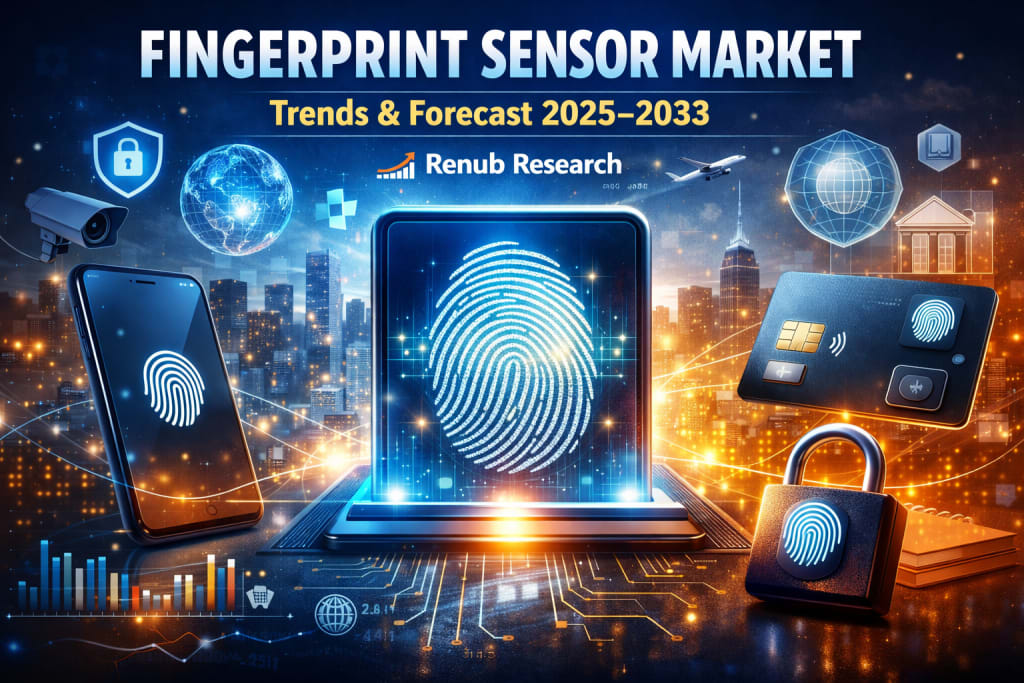
Fingerprint Sensor Market: A Future Built on Secure Identity
The global fingerprint sensor market is entering a powerful growth phase as digital security becomes a top priority across industries. According to Renub Research, the fingerprint sensor market is expected to reach US$ 18.79 billion by 2033, rising from US$ 8.02 billion in 2024, at a strong CAGR of 9.92% from 2025 to 2033. This impressive expansion reflects the world’s growing dependence on biometric authentication for smartphones, financial transactions, government services, and connected devices.
In an era where data breaches, identity theft, and cybercrime are rising concerns, fingerprint sensors offer a fast, reliable, and user-friendly solution for identity verification. From unlocking phones and laptops to authorizing digital payments and securing government databases, fingerprint-based authentication has become deeply embedded in everyday life.
The market’s growth is being fueled by several powerful forces: increasing security threats, the rapid adoption of biometric features in smartphones and Internet of Things (IoT) devices, continuous advancements in sensor technologies, supportive government initiatives for secure identification systems, and the accelerating use of contactless and digital payment solutions worldwide.
Global Fingerprint Sensor Industry Overview
A fingerprint sensor is a biometric device that identifies or authenticates an individual by analyzing the unique patterns of ridges and valleys on a person’s finger. These sensors convert physical fingerprint characteristics into digital data, which is then matched against stored records for verification.
There are several major types of fingerprint sensors in use today, including optical, capacitive, ultrasonic, and thermal sensors, each based on different technological principles. Optical sensors capture an image of the fingerprint, capacitive sensors measure electrical differences, ultrasonic sensors use sound waves to map the fingerprint in 3D, and thermal sensors detect temperature variations between ridges and valleys.
Fingerprint sensors are widely used in smartphones, laptops, tablets, government ID systems, access control devices, banking applications, and smart home security systems. Their popularity continues to grow because they offer a strong balance of security, speed, convenience, and cost-effectiveness compared to traditional authentication methods like passwords, PINs, or physical keys.
As digital ecosystems expand and more services move online, the need for secure, frictionless identity verification is becoming critical. This is positioning fingerprint sensors as a core technology in the future of digital security.
Why the Fingerprint Sensor Market Is Growing So Fast
The fingerprint sensor market is benefiting from a perfect storm of technological, economic, and social trends. The global shift toward digital services, mobile payments, and smart devices has dramatically increased the importance of secure authentication methods.
Smartphones remain one of the biggest growth engines for the market. Today, fingerprint sensors are standard features in many devices across premium, mid-range, and even budget segments. Beyond phones, laptops, tablets, wearables, and smart home devices are also increasingly integrating biometric security.
At the same time, businesses and governments are under growing pressure to protect sensitive data and comply with stricter data protection regulations. Biometric authentication, especially fingerprint recognition, is seen as a reliable way to reduce fraud, prevent unauthorized access, and improve overall cybersecurity frameworks.
Another key driver is the expansion of digital payments and online banking. As consumers move away from cash and toward contactless and mobile payments, secure and quick authentication methods are essential. Fingerprint sensors make it possible to authorize transactions in seconds, improving both security and user experience.
Growth Drivers for the Fingerprint Sensor Market
Growing Emphasis on Identity Verification and Security
One of the strongest drivers of the fingerprint sensor market is the global focus on identity verification and data security. With the rise of cloud services, e-commerce, digital banking, and remote work, secure access to systems and data has become more important than ever.
Traditional passwords and PINs are increasingly seen as weak and vulnerable to hacking, phishing, and data leaks. Fingerprint sensors, on the other hand, provide a biometric layer of security that is far more difficult to replicate or steal.
This has led to growing adoption across consumer electronics, financial services, government, healthcare, and enterprise security systems. Innovations such as in-display fingerprint sensors and integrated biometric modules are also making it easier for manufacturers to embed this technology into modern, sleek devices without compromising design.
A notable example of innovation is Samsung Display’s launch of a Sensor OLED Display, which integrates light-sensing organic photodiodes directly into the screen, showing how fingerprint sensing is becoming more seamlessly embedded into everyday devices.
Notable Developments in Sensor Technology
Continuous technological innovation is another major factor driving the market forward. Modern fingerprint sensors are becoming more accurate, faster, smaller, and more energy-efficient, making them suitable for a wide range of applications beyond smartphones.
Ultrasonic and in-display fingerprint sensors, for example, offer improved security and better performance under challenging conditions, such as wet or dirty fingers. These advancements are expanding the use of fingerprint sensors into areas like wearables, automotive systems, smart locks, and IoT devices.
Companies like Goodix Technology have been expanding their portfolios with new sensor solutions and connectivity technologies, highlighting the industry’s focus on smart connectivity and next-generation biometric devices. As sensor performance improves and costs gradually decline, fingerprint authentication is expected to become even more widespread.
Enforcement of Government Regulations and Compliance Standards
Government regulations related to data protection, cybersecurity, and digital identity are also playing a crucial role in boosting the fingerprint sensor market. Around the world, authorities are introducing stricter rules to protect personal data and prevent identity fraud.
These regulations are pushing organizations in sectors such as banking, healthcare, telecommunications, and public services to adopt stronger authentication methods. Fingerprint sensors, with their proven reliability and user acceptance, are increasingly being used as a compliant and secure solution for identity verification and access control.
In many countries, governments are also investing directly in biometric ID programs, border control systems, and national identity databases, further strengthening the long-term outlook for the fingerprint sensor industry.
Challenges in the Fingerprint Sensor Market
Integration Complexity
Despite strong growth prospects, the fingerprint sensor market faces several technical challenges. One of the biggest is integration complexity, especially as device manufacturers push for thinner, lighter, and bezel-less designs.
Embedding fingerprint sensors into displays or under glass surfaces requires advanced engineering and precise calibration. Ensuring compatibility with different screen technologies, operating systems, and hardware platforms adds further complexity. These challenges can increase development time and costs, potentially slowing adoption in some market segments.
High Cost of Advanced Sensors
Another important barrier is the high cost of advanced fingerprint sensors, particularly ultrasonic and in-display variants. These sensors require sophisticated materials and manufacturing processes, which raise production costs.
As a result, some manufacturers, especially in price-sensitive markets, may hesitate to adopt these premium solutions. This can limit penetration in low- and mid-range devices and slow down adoption in developing regions where affordability remains a key concern.
Regional Market Insights
United States Fingerprint Sensor Market
The United States is one of the leading markets for fingerprint sensors, driven by strong demand from consumer electronics, financial services, healthcare, and government sectors. The rapid growth of digital payments, mobile banking, and online services has increased the need for secure authentication technologies.
A notable development came in March 2024, when SmartMetric, Inc. received patents for biometric fingerprint sensor technology embedded into credit cards. This innovation allows fingerprint sensors to be integrated directly into the card surface alongside EMV chips, significantly improving transaction security.
With rising cybersecurity concerns and strict data protection requirements, the U.S. market is expected to remain a major driver of innovation and adoption in the global fingerprint sensor industry.
India Fingerprint Sensor Market
India represents one of the fastest-growing markets for fingerprint sensors, thanks to the widespread adoption of smartphones, digital payments, and government-backed biometric programs. The Aadhaar system, which uses fingerprint-based identification for millions of citizens, has played a major role in familiarizing the population with biometric authentication.
Banks, fintech companies, healthcare providers, and government agencies are increasingly investing in fingerprint-based security solutions to improve service delivery and reduce fraud. Ongoing improvements in sensor accuracy, size, and cost are further supporting adoption across both urban and rural markets.
Germany Fingerprint Sensor Market
Germany’s fingerprint sensor market is being driven by demand from banking, healthcare, government services, and the automotive sector. The country’s strong focus on data privacy and cybersecurity is accelerating the adoption of secure biometric authentication technologies.
In September 2023, a partnership between Mastercard and Mercedes enabled customers to use fingerprint sensors in their cars to make digital payments at thousands of service stations across Germany. This highlights how biometric technology is moving beyond phones and into everyday real-world applications.
United Arab Emirates Fingerprint Sensor Market
The UAE is witnessing strong growth in fingerprint sensor adoption due to increasing use in government services, immigration control, banking, healthcare, and consumer electronics. The government’s push for digital transformation and secure identity systems has created a favorable environment for biometric technologies.
Rising awareness of data security, combined with investments in smart city initiatives and digital infrastructure, is further boosting the demand for advanced fingerprint sensor solutions across the region.
Fingerprint Sensor Market Segmentation
By Type:
Capacitive
Optical
Ultrasonic
Thermal
By Vertical:
Consumer Electronics
Government & Defense
BFSI
Healthcare
Commercial Security
Smart Homes
Travel & Immigration
Others
By Country (25 Market Viewpoints):
North America (United States, Canada)
Europe (France, Germany, Italy, Spain, United Kingdom, Belgium, Netherlands, Turkey)
Asia Pacific (China, Japan, India, Australia, South Korea, Thailand, Malaysia, Indonesia, New Zealand)
Latin America (Brazil, Mexico, Argentina)
Middle East & Africa (South Africa, Saudi Arabia, United Arab Emirates)
Competitive Landscape and Key Players
The global fingerprint sensor market is highly competitive, with companies focusing on innovation, strategic partnerships, and product differentiation. The report covers companies from four viewpoints: company overview, key persons, recent developments & strategies, and sales analysis.
Key Players Include:
Qualcomm Technologies Inc.
TDK Corporation
Vkansee Technology Inc.
Egis Technology Inc.
Fingerprint Cards AB
Shenzhen Goodix Technology Co. Ltd
Idex Biometrics ASA
NEC Corporation
These companies are investing heavily in R&D to improve sensor performance, reduce costs, and expand applications across new industries.
Final Thoughts
The fingerprint sensor market is on a strong growth trajectory, driven by the global shift toward digital services, rising security concerns, and rapid advancements in biometric technology. With the market expected to grow from US$ 8.02 billion in 2024 to US$ 18.79 billion by 2033, the role of fingerprint sensors in everyday life will only become more significant.
From smartphones and smart homes to banking, government services, and automotive applications, fingerprint authentication is becoming a cornerstone of modern digital security. While challenges such as integration complexity and high costs remain, ongoing innovation and economies of scale are likely to make these technologies more accessible over time.
As businesses, governments, and consumers continue to prioritize secure and convenient identity verification, fingerprint sensors will remain at the heart of the global biometric revolution—shaping how we access, protect, and interact with the digital world in the years ahead.
About the Creator
Keep reading
More stories from shibansh kumar and writers in Trader and other communities.
ATM Market Trends, Deployment & Forecast 2025–2033 | Renub Research
Global ATM Market Outlook The global Automated Teller Machine (ATM) market continues to play a crucial role in the modern financial ecosystem, even as digital payments and mobile banking platforms gain momentum. According to Renub Research, the ATM Market is expected to grow from US$ 25.20 billion in 2024 to US$ 35.50 billion by 2033, registering a compound annual growth rate (CAGR) of 3.88% from 2025 to 2033.
By shibansh kumara day ago in Trader
How AI and Directed Energy Could Trigger Miscalculations
How AI and Directed Energy Could Trigger Miscalculations Modern warfare is entering a phase where speed, automation, and precision are becoming more important than sheer firepower. Artificial Intelligence (AI) and directed-energy weapons—such as laser defense systems—are often presented as tools that will reduce human error and make war more controllable. Paradoxically, these same technologies may increase the risk of miscalculation, escalation, and even unintended large-scale conflict.
By Wings of Time 5 days ago in Trader
Mexico Fleet Leasing Market Size, Industry Trends, Share, Growth and Forecast
Why the Mexico Fleet Leasing Market Is Accelerating Business Mobility: Trends & Future Outlook Mexico’s fleet leasing market is becoming a strategic backbone for businesses that rely on transportation, logistics, and mobile operations. Instead of owning vehicles outright, companies increasingly prefer leasing models that provide flexibility, cost control, and operational efficiency. From delivery fleets to corporate cars and heavy commercial vehicles, leasing is transforming how organizations manage mobility.
By Jackson Watson2 days ago in Trader



Comments
There are no comments for this story
Be the first to respond and start the conversation.