
Australia Bionic Devices Market Size and Forecast 2025–2033
How Innovation, Government Backing, and Medical Breakthroughs Are Shaping the Future of Bionics in Australia

Introduction: A New Era of Human Enhancement in Australia
Bionic devices are no longer confined to science fiction or experimental laboratories. In Australia, they have become a vital part of modern healthcare, helping thousands of people regain hearing, mobility, vision, and even life-sustaining heart function. From cochlear implants to artificial hearts and advanced prosthetic limbs, bionic technology is steadily transforming how disabilities and chronic conditions are treated.
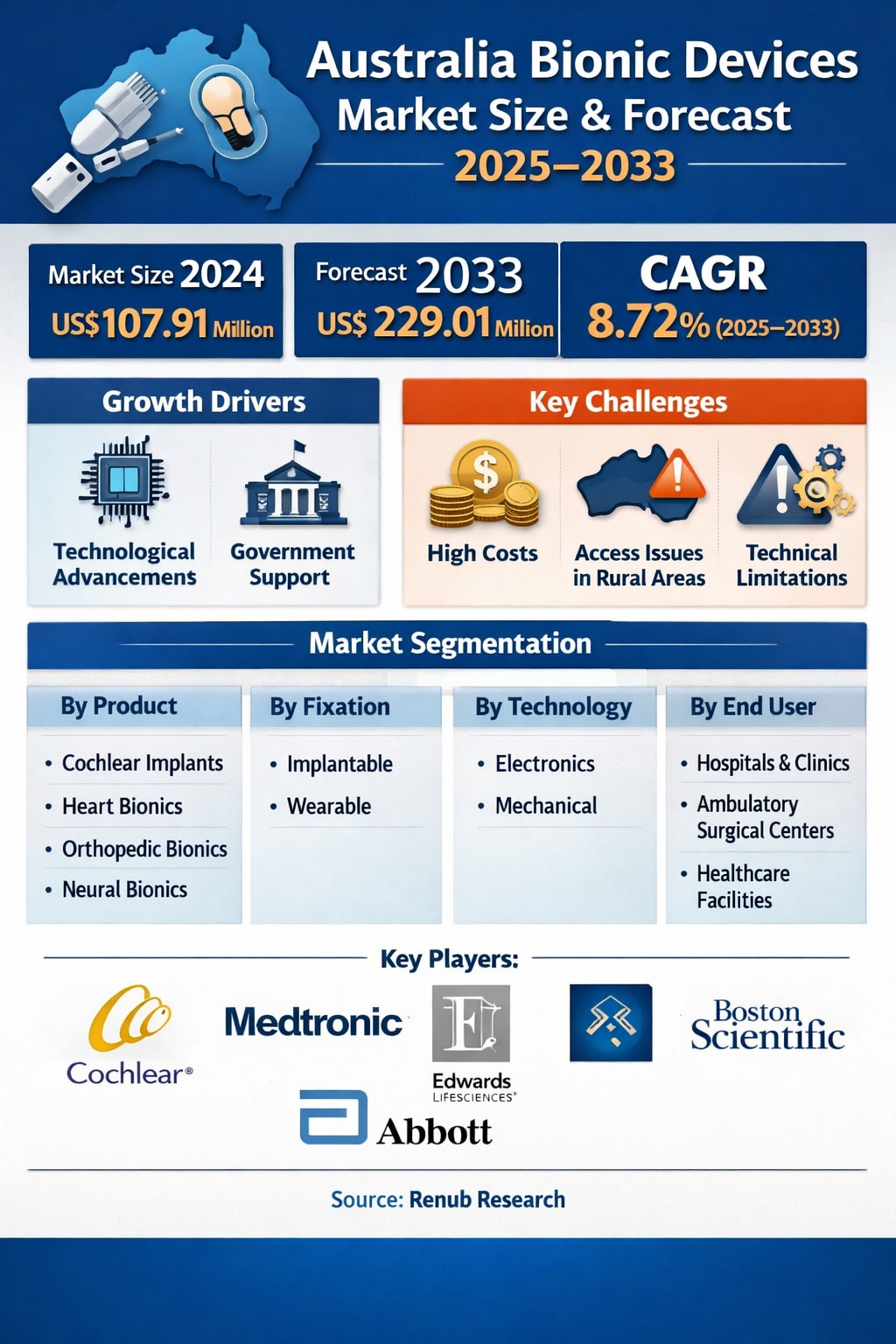
According to Renub Research, the Australia Bionic Devices Market was valued at US$ 107.91 million in 2024 and is projected to reach US$ 229.01 million by 2033, growing at a CAGR of 8.72% during 2025–2033. This strong growth trajectory reflects not only rising medical needs but also Australia’s leadership in biomedical research, supportive government policies, and a healthcare system that actively embraces innovation.
Bionic devices are advanced medical implants or wearable technologies designed to restore or enhance bodily functions lost due to injury, disease, or congenital conditions. These devices combine electronic, mechanical, and sometimes biological components to mimic or support natural human functions. In Australia, bionics has a particularly proud legacy—most famously with the cochlear implant, an Australian innovation that has restored hearing to people with severe or profound hearing loss across the globe.
Today, the country stands at the forefront of next-generation bionic solutions, including neural interfaces, orthopedic prosthetics, retinal implants, and artificial hearts. With an aging population, rising prevalence of chronic diseases, and strong investment in medical research, the Australian bionic devices market is entering a decisive decade of expansion.
Market Overview: Why Bionics Matter More Than Ever
Australia’s healthcare system is well-developed, technologically advanced, and strongly supported by public funding and research institutions. This environment creates fertile ground for the adoption of sophisticated medical technologies such as bionic devices.
Several factors are converging to push the market forward:
A growing elderly population with higher rates of hearing loss, mobility impairment, and cardiovascular disease
Rising survival rates after trauma and chronic illness, increasing the need for long-term assistive technologies
Continuous breakthroughs in biomedical engineering and materials science
Strong collaboration between universities, research institutes, hospitals, and medical device companies
Supportive government initiatives aimed at improving quality of life for people with disabilities
Bionic devices in Australia are no longer niche or experimental solutions. They are increasingly viewed as mainstream, life-enhancing medical interventions that reduce long-term healthcare costs, improve patient independence, and significantly raise quality of life.
Key Growth Drivers in the Australia Bionic Devices Market
1. Technological Advancements in Biomedical Engineering
Australia has a robust research and innovation ecosystem, particularly in medical technology and biomedical engineering. Institutions such as the Bionics Institute, CSIRO, and leading universities are working alongside private companies to develop smarter, more responsive, and more durable bionic systems.
Modern bionic devices now integrate AI-driven sensors, advanced microprocessors, and bio-compatible materials that allow for more natural movement, better sensory feedback, and improved long-term performance. These innovations are making devices more comfortable, more reliable, and more acceptable to patients across different age groups.
A powerful example of this innovation culture came in February 2022, when Australia’s world-first Bionic Eye System received Breakthrough Device designation from the U.S. FDA. Developed by a collaboration including the Centre for Eye Research Australia, the Bionics Institute, CSIRO’s Data61, and the University of Melbourne, this technology aims to restore functional vision to people affected by retinitis pigmentosa. Such milestones highlight Australia’s global influence in bionic research and reinforce confidence in the market’s future.
2. Government Support and Healthcare Investment
Government backing plays a crucial role in the expansion of the bionic devices market. Australia invests heavily in healthcare infrastructure, medical research, and disability support programs. Initiatives such as the National Disability Insurance Scheme (NDIS) help improve access to advanced assistive technologies for eligible patients, while public funding supports clinical trials and commercialization of new medical devices.
In February 2024, the Australian Government announced an investment of $50 million to develop and commercialize the world’s most advanced artificial heart technology. This project is not only expected to save lives but also to generate significant economic and technological returns for the country, underlining the strategic importance of bionics in Australia’s healthcare and innovation agenda.
Such investments reduce risk for manufacturers, encourage local production and research, and accelerate the translation of laboratory breakthroughs into real-world medical solutions.
3. Increasing Prevalence of Chronic Diseases and Disabilities
Chronic diseases are a major and growing burden on Australia’s healthcare system. Conditions such as diabetes, cardiovascular disease, arthritis, and neurodegenerative disorders are becoming more common, particularly as the population ages. In 2024, around 64% of Australia’s disease burden was attributed to the top five disease groups, most of which are chronic in nature.
At the same time, improvements in emergency and long-term care mean more people are surviving serious injuries and illnesses—but often with lasting functional impairments. This creates sustained demand for prosthetics, neural stimulators, cochlear implants, and cardiac assist devices that can restore independence and improve daily functioning.
As awareness grows and diagnostic capabilities improve, more patients are being identified earlier and offered bionic solutions as part of long-term treatment strategies, further driving market growth.
Challenges Facing the Australia Bionic Devices Market
High Costs and Accessibility Barriers
Despite technological progress, bionic devices remain expensive. The high cost of research, development, advanced materials, and precision manufacturing makes many devices financially out of reach for some patients, even with partial government support or insurance coverage.
Geographical disparities also play a role. While major urban centers have world-class hospitals and specialist services, rural and remote communities often face limited access to implantation procedures, rehabilitation services, and long-term device maintenance. This uneven distribution of care can slow overall market penetration.
Technical Limitations and Patient Adaptation
Not every bionic device works perfectly for every patient. Issues such as biological compatibility, infection risk, mechanical wear, and user adaptation can affect long-term outcomes. Some patients may find it difficult to adjust to complex devices, particularly older users or those with limited access to training and follow-up care.
Ensuring long-term support, regular upgrades, and seamless integration with evolving medical needs remains a key challenge for manufacturers and healthcare providers alike.
Segment Insights: How Different Parts of the Market Are Evolving
Australia Heart Transplant Bionic Devices Market
Bionic heart devices, including ventricular assist devices (VADs) and total artificial hearts, are gaining prominence in Australia due to the rising incidence of end-stage heart failure and the persistent shortage of donor organs. These devices can serve as a bridge to transplant or, in some cases, as long-term solutions.
Australia’s advanced cardiac care infrastructure and skilled surgical teams are supporting the adoption of these complex technologies. A landmark moment came in March 2025, when St Vincent’s Hospital successfully implanted Australia’s first BiVACOR Total Artificial Heart, marking a major milestone in the country’s cardiac care history and opening new possibilities for patients with severe heart failure.
Australia Orthopedic Bionic Devices Market
Orthopedic bionics—including prosthetic limbs, exoskeletons, and advanced joint implants—represent one of the most visible and rapidly evolving segments. Demand is being driven by an aging population, rising rates of osteoarthritis, and sports- and accident-related injuries.
Modern orthopedic bionics increasingly use AI-assisted motion control, adaptive joint mechanisms, and lightweight composite materials to deliver more natural movement and greater comfort. Australia’s strong rehabilitation network and government-backed healthcare programs are helping more patients access these life-changing technologies.
Australia Implantable Bionic Devices Market
Implantable devices such as cochlear implants, retinal implants, and neural stimulators are already well established in Australia. The country’s global reputation in cochlear implant technology is a testament to its leadership in this space.
These devices offer long-term or permanent solutions for conditions like severe hearing loss, Parkinson’s disease, and certain visual impairments. Ongoing clinical trials, supportive regulatory frameworks, and sustained research funding continue to expand the range of treatable conditions and improve device performance.
Australia Electronics Bionic Devices Market
Electronics form the backbone of modern bionics. Microprocessors, biosensors, actuators, and wireless communication modules enable real-time feedback, precise control, and smarter interaction between device and user.
Australia’s investment in medical electronics research is helping to improve energy efficiency, durability, miniaturization, and connectivity, making bionic devices more reliable and user-friendly. Collaboration between tech companies and medical researchers is especially important in pushing these boundaries further.
End-User Landscape: Hospitals, Clinics, and Healthcare Facilities
Hospitals and clinics remain the primary centers for consultation, implantation, and post-surgical rehabilitation. Australia’s major urban hospitals are equipped to perform complex procedures such as neural stimulation and artificial organ implantation, often in partnership with research institutions.
Beyond hospitals, specialized healthcare and rehabilitation facilities play a crucial role in long-term patient support. These centers focus on therapy, device optimization, and continuous monitoring, ensuring that patients achieve the best possible outcomes from their bionic solutions. The growing emphasis on personalized care and remote monitoring is further expanding this segment.
Market Segmentation Overview
By Product:
Auditory Bionic / Cochlear Implants
Heart Transplant
Orthopedic Bionics
Neural Bionics
By Fixation:
Implantable
Wearable / Externally Worn
By Technology:
Electronics
Mechanical
By End User:
Hospitals & Clinics
Ambulatory Surgical Centers
Healthcare Facilities
Competitive Landscape: Key Players Shaping the Market
The Australian bionic devices market features a mix of global medical device leaders and strong regional players. Each company is typically analyzed across four key viewpoints: overview, key people, recent developments, and revenue performance.
Key players include:
Cochlear Ltd.
Medtronic Australasia Pty Ltd
Edwards Lifesciences Australia Pty Ltd
Baxter International Inc.
Boston Scientific Corp
Abiomed Australia Pty Ltd
Abbott Laboratories
These companies are investing heavily in R&D, strategic partnerships, and product innovation to strengthen their positions in a market that is becoming increasingly competitive and technologically sophisticated.
Future Outlook: What Lies Ahead for Australia’s Bionic Devices Market
Looking ahead to 2033, the outlook for the Australia bionic devices market remains strongly positive. With Renub Research forecasting growth from US$ 107.91 million in 2024 to US$ 229.01 million by 2033, the sector is set to benefit from continuous technological progress, supportive government policies, and rising patient demand.
Emerging trends such as AI-integrated prosthetics, brain-computer interfaces, smarter implantable sensors, and fully implantable artificial organs are likely to redefine what bionic devices can achieve. At the same time, efforts to reduce costs, improve accessibility, and expand services into regional areas will be critical for ensuring that these innovations benefit a broader segment of the population.
Final Thoughts
The Australia bionic devices market stands at the intersection of technology, medicine, and human resilience. What was once considered futuristic is now becoming a practical, life-changing reality for thousands of patients across the country.
With strong research foundations, proactive government support, and a healthcare system open to innovation, Australia is well positioned to remain a global leader in bionics. As the market moves toward US$ 229.01 million by 2033, the real measure of success will not only be financial growth—but the number of lives transformed by these remarkable technologies.
About the Creator
Australia Isobutanol Market: Precision Chemicals Fueling Sustainable Growth
The Australia isobutanol market is steadily building momentum as industrial sectors increasingly adopt this versatile chemical intermediate. According to IMARC Group, the market size reached USD 30.00 million in 2024 and is forecast to grow to USD 47.95 million by 2033, representing a compound annual growth rate (CAGR) of 5.35 % between 2025 and 2033. This growth reflects robust demand from automotive and industrial applications, alongside a broader shift toward bio-based and sustainable solvent solutions.
By Rashi Sharma2 days ago in Trader
Introduction to Mutual Funds: A Beginner’s Guide to Smart Investing
Introduction Mutual funds are one of the most popular investment options for beginners and experienced investors alike. They pool money from multiple investors to invest in a diversified portfolio of stocks, bonds, or other securities. Mutual funds offer a simple way to achieve diversification, professional management, and potential long-term growth without the complexity of managing individual investments.
By Hammad Nawaz4 days ago in Trader
Unofficial Challenge: What would you do if you were rich?
I love the kind of work I get to do in my career, but as I job search and browse apartments again due to another understaffed and unsustainable work environment that I did not intend to get into, my daydreams of better days consistently lean into the same question: What would I do if I didn't have to worry about my basic needs being met?
By Kay Husnick2 days ago in Writers



Comments
There are no comments for this story
Be the first to respond and start the conversation.