
Australia Die Casting Components Market 2026: Lightweight Manufacturing, EV Transition and Precision Engineering Growth
How automotive electrification, infrastructure development and advanced casting technologies are shaping Australia’s die casting components industry

Australia Die Casting Components Market Overview
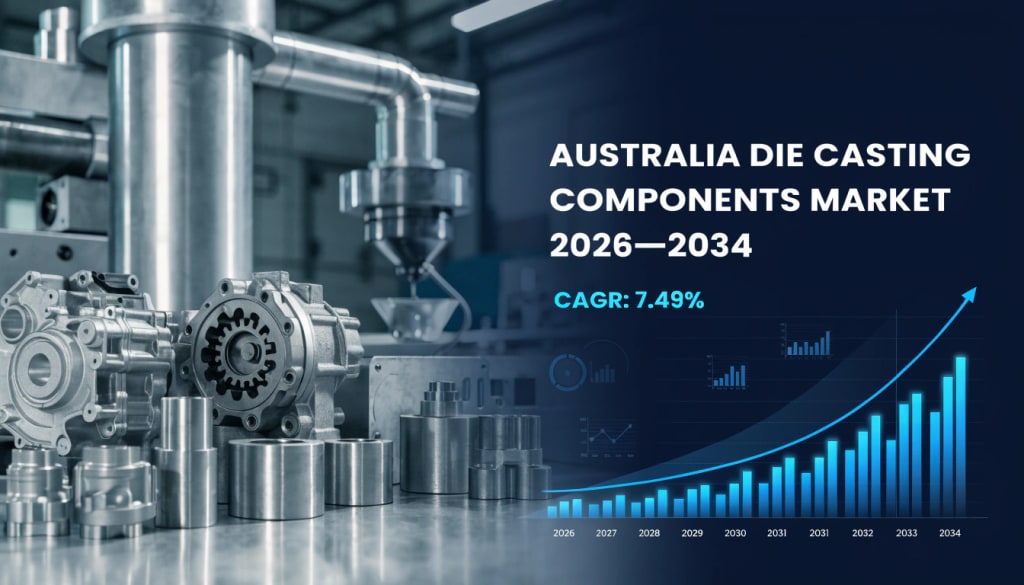
Australia’s die casting components market is experiencing robust expansion as industrial modernisation, automotive electrification and infrastructure development drive demand for precision-engineered metal parts. Die casting components are widely used across automotive, aerospace, mining, construction and electronics sectors due to their dimensional accuracy, durability and ability to support high-volume production. As industries increasingly prioritise lightweight, high-performance components, die casting technologies are becoming central to advanced manufacturing strategies in Australia.
According to IMARC Group, the Australia die casting components market size reached USD 1,372.0 million in 2025 and is projected to grow to USD 2,627.82 million by 2034, exhibiting a compound annual growth rate (CAGR) of 7.49% during 2026–2034. Growth is supported by rising electric vehicle adoption, construction expansion and sustained mining sector investment.
Key Market Drivers
Automotive Electrification and Lightweight Component Demand
The transition toward electric vehicles is significantly increasing the use of lightweight die-cast components such as motor housings, battery enclosures and structural parts. Lightweight materials help improve vehicle efficiency and performance, reinforcing demand for advanced die casting solutions.
Infrastructure Development and Construction Activity
Expanding residential and commercial construction projects are driving demand for precision metal components including structural fittings and architectural elements. Infrastructure programs are strengthening manufacturing activity and supporting market growth.
Mining Sector Equipment Requirements
Australia’s mining industry relies heavily on durable die-cast components for heavy machinery, drilling systems and processing equipment. Continued mining investment is sustaining demand for high-strength cast components capable of operating in harsh environments.
Advancements in Die Casting Technologies
Manufacturers are adopting high-pressure die casting, advanced alloys and automated production systems to improve efficiency and product quality. Technology integration is enabling production of complex geometries with superior mechanical properties and minimal post-processing.
Request a Sample Report with the Latest 2026 Data & Forecasts
What the Opportunities Are
Australia’s die casting components market presents substantial opportunities as manufacturing innovation, industrial diversification and sustainability trends accelerate.
Expansion of Electric Vehicle Component Manufacturing
Electric mobility growth creates opportunities for die casting manufacturers to supply battery housings, inverter casings and lightweight structural components. Partnerships with automotive OEMs can strengthen long-term supply contracts and innovation collaboration.
Growth of Aluminum Die Casting Applications
Aluminum die castings dominate the market due to lightweight characteristics, corrosion resistance and thermal conductivity. Expanding aluminum usage across automotive, electronics and industrial machinery segments provides strong growth potential for manufacturers.
Automation and Industry 4.0 Integration
The integration of robotics, AI-enabled process optimisation and real-time quality monitoring offers opportunities to improve productivity and reduce defects. Automation adoption can enhance competitiveness while addressing labour shortages.
Infrastructure and Renewable Energy Project Demand
Large-scale transport corridors, renewable energy installations and industrial infrastructure projects require specialised metal components. Die casting suppliers can capitalise on multi-year infrastructure pipelines generating sustained component demand.
Localised Manufacturing and Supply Chain Resilience
Government initiatives promoting domestic manufacturing capability are encouraging local sourcing of industrial components. This trend creates opportunities for Australian die casting firms to strengthen domestic supply chains and reduce import dependency.
Together, these opportunities highlight a shift toward advanced, localised and sustainability-aligned die casting production ecosystems.
Recent News and Developments
March 2025: Federal budget allocations included over USD 17 billion for transport corridor infrastructure, supporting construction activity and increasing demand for precision die-cast industrial components used in equipment and structural applications.
June 2025: Automotive manufacturing analysis highlighted that the automotive sector accounted for approximately 50% of die casting component demand in 2025, reinforcing the sector’s dominant role in market consumption patterns.
September 2025: Manufacturing data showed that OEM channels represented around 70% of component sales, reflecting strong long-term supply relationships between die casting producers and industrial equipment manufacturers.
January 2026: Technology adoption trends indicated that high-pressure die casting accounted for roughly 55% of production processes, highlighting industry shift toward advanced manufacturing methods enabling high-precision and high-volume component production.
Why You Should Know About the Australia Die Casting Components Market?
The Australia die casting components market represents a strategically important segment of the country’s manufacturing ecosystem, supporting automotive, mining, infrastructure and advanced engineering industries. As lightweight manufacturing, electrification and automation reshape industrial production, die casting components are becoming essential enablers of efficiency and performance.
With projected growth to USD 2.63 billion by 2034, supported by EV adoption, infrastructure investment and technology innovation, the sector offers meaningful opportunities for manufacturers, equipment suppliers and investors seeking exposure to advanced industrial component markets.
As Australia continues strengthening domestic manufacturing capability and transitioning toward next-generation industrial technologies, the die casting components market is positioned for sustained expansion within the broader precision manufacturing landscape.
About the Creator
Amyra Singh
Market research analyst who loves spotting patterns, digging into data, and turning insights into strategies that help brands grow and stay ahead of the curve.
Keep reading
More stories from Amyra Singh and writers in Trader and other communities.
Australia Warehousing & Storage Market 2026: E-Commerce Acceleration, Smart Logistics and Infrastructure-Driven Expansion
Australia Warehousing & Storage Market Overview Australia’s warehousing and storage market is expanding rapidly as digital commerce growth, supply chain modernisation and infrastructure investment reshape logistics requirements across the country. Warehousing facilities have evolved from traditional storage sites into technologically advanced logistics hubs supporting inventory management, order fulfillment and last-mile distribution. As consumer expectations around delivery speed and reliability continue to rise, businesses are increasingly investing in strategically located and automated warehousing infrastructure.
By Amyra Singhabout 8 hours ago in Trader


Comments
There are no comments for this story
Be the first to respond and start the conversation.