
Fixing the Future: Why the Consumer Electronics Repair and Maintenance Market Is Booming Worldwide
From smartphones to smart homes, the global repair economy is reshaping how we consume, save, and sustain technology

Consumer Electronics Repair and Maintenance Market Size: A Growing Global Opportunity
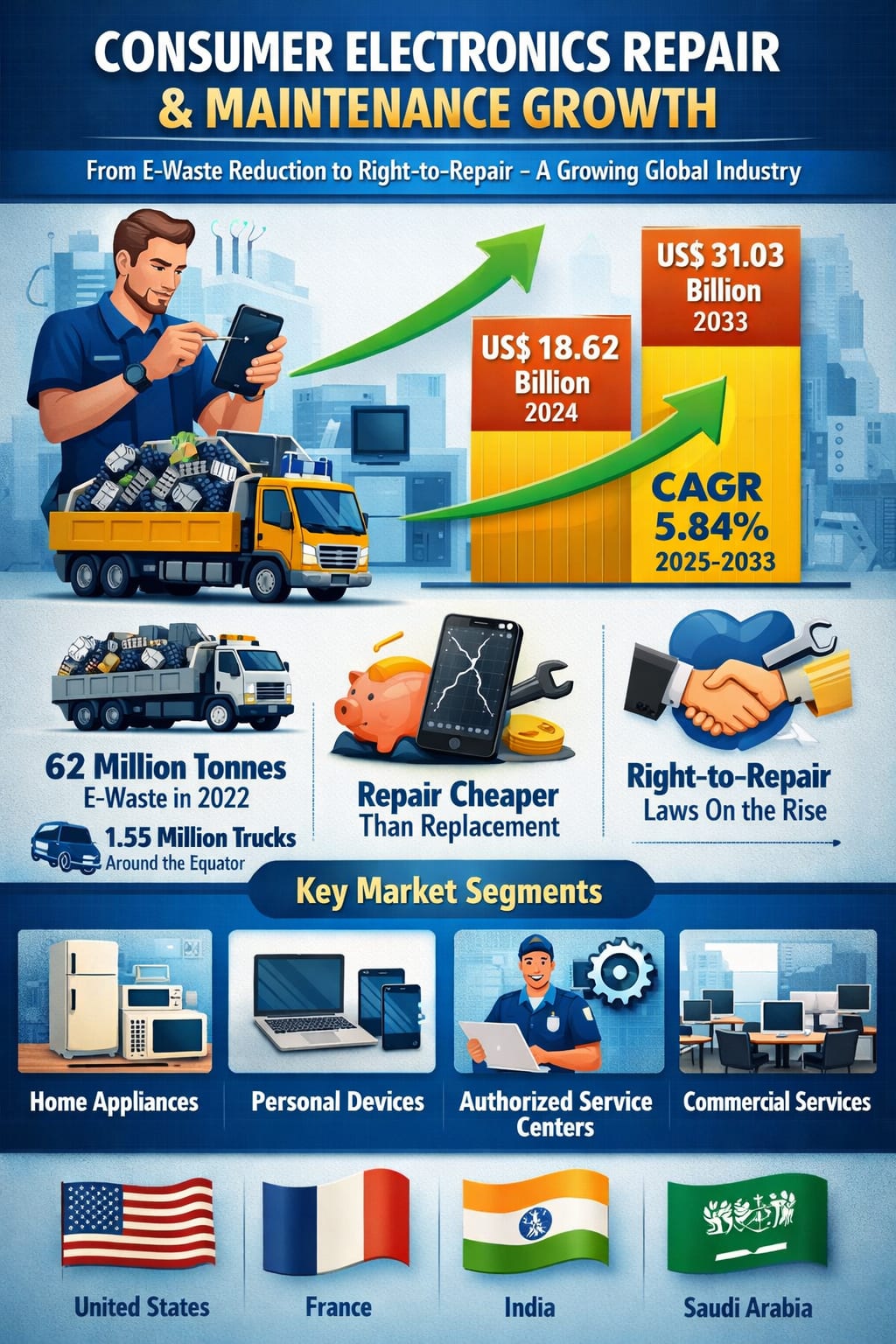
The global consumer electronics repair and maintenance market is no longer a quiet, behind-the-scenes industry. It is rapidly becoming one of the most important pillars of the modern technology ecosystem. According to Renub Research, the market was valued at US$ 18.62 billion in 2024 and is projected to reach US$ 31.03 billion by 2033, expanding at a compound annual growth rate (CAGR) of 5.84% between 2025 and 2033.
This steady growth is being fueled by a mix of economic, environmental, and technological factors. Rising device prices, increasing awareness of electronic waste, stronger sustainability movements, and the global push for “right-to-repair” laws are all reshaping how consumers and businesses think about their electronics. Instead of replacing devices at the first sign of trouble, more people are choosing to repair, refurbish, and maintain them.
In many ways, the repair and maintenance market is becoming the backbone of the circular economy in consumer electronics—keeping products in use longer, reducing waste, and making technology more affordable and accessible across both developed and emerging economies.
What Does Consumer Electronics Repair and Maintenance Really Mean?
Consumer electronics repair and maintenance includes the inspection, diagnosis, servicing, and restoration of a wide range of devices such as:
Smartphones and tablets
Laptops and desktop computers
Televisions and audio systems
Gaming consoles
Household appliances like refrigerators, washing machines, and microwaves
The services cover everything from hardware replacement and software troubleshooting to cleaning, part refurbishment, and fixing electrical or physical damage. The main goal is simple but powerful: keep devices working efficiently and extend their usable life.
On a global scale, this industry plays a crucial role in reducing electronic waste, conserving resources, and offering cost-effective alternatives to buying new devices. In both developed and developing countries, repair services help close the digital divide by making technology usable for longer periods and at lower cost.
With environmental awareness rising and new electronics becoming increasingly expensive, both consumers and businesses are turning to professional repair services. Add to that the momentum of right-to-repair campaigns and green regulations, and it becomes clear why this market is gaining such strong traction worldwide.
Key Drivers Fueling Market Growth
1. Rising Electronic Waste and Environmental Awareness
The world is facing a massive e-waste problem. In 2022 alone, around 62 million tonnes of electronic waste were generated globally—an increase of 82% since 2010—and this figure is expected to reach 82 million tonnes by 2030. Shockingly, only about 1% of rare earth element demand is currently met through recycling.
To put the scale into perspective, 62 million tonnes of e-waste could fill 1.55 million 40-tonne trucks, enough to circle the Earth’s equator.
This growing crisis is pushing governments and consumers to seek more sustainable alternatives. Repair and maintenance services directly address this issue by extending product lifespans, reducing landfill waste, and lowering carbon footprints. As sustainability becomes a core purchasing consideration, repair is no longer just a cost-saving choice—it’s an environmental statement.
2. Cost-Effectiveness Compared to Device Replacement
Modern consumer electronics—especially smartphones, laptops, and large home appliances—have become significantly more expensive. For many households and businesses, replacing a faulty device is simply not economical.
Repairing, on the other hand, offers a much more affordable solution, especially in price-sensitive markets. In emerging economies, consumers often rely heavily on maintenance services to maximize the life of their devices. The availability of low-cost spare parts and skilled technicians further strengthens this trend.
As inflation and living costs rise globally, the logic of “repair instead of replace” is becoming more compelling, making cost-efficiency one of the strongest growth drivers for this market.
3. Government Support and the Right-to-Repair Movement
One of the most powerful structural shifts in this industry is the global right-to-repair movement. Governments are increasingly introducing policies that require manufacturers to provide access to spare parts, repair manuals, and diagnostic tools to consumers and independent technicians.
In March 2023, the European Commission proposed a “Right to Repair” directive covering products like household appliances, TVs, vacuum cleaners, servers, and mobile phones.
In the United States, New York became the first state to pass a digital right-to-repair law in December 2022, known as the Digital Fair Repair Act, which took effect in July 2023.
In India, the government introduced a repairability index in August 2024 for mobile devices and electronics to help consumers make informed choices and encourage manufacturers to design more repair-friendly products.
These initiatives are lowering entry barriers for independent repair shops, boosting consumer confidence, and promoting responsible consumption—collectively accelerating the growth of the global repair and maintenance market.
Challenges Facing the Industry
Limited Access to Spare Parts and Technical Information
Despite progress, many manufacturers still tightly control their supply chains and restrict access to proprietary components and repair documentation. This makes repairs more expensive and time-consuming, especially for third-party service providers.
The result is reduced competition, delayed service, and frustrated customers—particularly in regions where right-to-repair regulations are weak or poorly enforced. If this issue persists, it could slow down the overall growth and efficiency of the market.
Rapid Technological Change and Increasing Product Complexity
Today’s electronics are smaller, smarter, and more complex than ever. Devices now feature AI chips, IoT connectivity, and sealed or modular components that are difficult to open and fix.
While this innovation improves user experience, it also means repairs require specialized training and advanced tools, increasing operational costs and reducing the number of qualified technicians. Fast product cycles force repair shops to constantly update skills and inventory, making the business more challenging and sometimes pushing consumers toward replacement instead of repair.
Market Segmentation: Where the Growth Is Coming From
Home Appliances Repair and Maintenance
Large appliances like refrigerators, washing machines, air conditioners, and microwaves form a major segment of the market. As prices rise, households increasingly choose to repair rather than replace. Warranty expirations, frequent usage, and the shift toward energy-efficient appliances are further boosting demand for professional maintenance services and long-term service contracts.
Authorized Service Centers
Authorized service centers remain the preferred choice for many consumers, especially for high-end or complex devices. They offer manufacturer-approved repairs, genuine parts, trained technicians, and warranty-backed services, which helps build trust and brand loyalty.
As more manufacturers expand their global service networks and partnerships, this segment continues to grow steadily while also helping combat counterfeit parts and ensure regulatory compliance.
Residential End Users
Homes account for a large share of repair demand due to heavy reliance on TVs, smartphones, laptops, and kitchen appliances. With rising living costs and the growth of remote work and online education, keeping home electronics functional has become more critical than ever.
The increasing adoption of smart home devices is also creating fresh demand for technicians who can maintain connected systems and networks.
Commercial End Users
Businesses, schools, hospitals, and retail chains depend on electronics such as monitors, printers, projectors, and communication systems. For them, downtime equals lost productivity and revenue.
Many organizations now sign annual maintenance contracts to ensure smooth operations and predictable costs. As digitalization spreads across industries like logistics, finance, and retail, commercial repair and maintenance demand continues to rise steadily.
Regional Market Highlights
United States
The U.S. leads the global market thanks to strong consumer awareness, advanced technology adoption, and growing support for right-to-repair laws. With both authorized and independent repair networks well established, and sustainability becoming a bigger priority, the market outlook remains highly positive.
France
France stands out with its repairability index, which rates products based on how easy they are to repair. This policy is actively influencing consumer choices and pushing manufacturers to design more repair-friendly products. Government support for training and local repair shops is fostering a strong culture of repair and reuse.
India
India is one of the fastest-growing markets in this space. A rapidly expanding middle class, widespread smartphone usage, and strong price sensitivity mean consumers often prefer repair over replacement. The country’s vast network of skilled technicians and informal repair centers provides affordable solutions, while government initiatives are strengthening the overall ecosystem.
Saudi Arabia
Driven by Vision 2030 and rapid digital transformation, Saudi Arabia is seeing rising demand for electronics repair and maintenance. Harsh climate conditions, increasing device usage, and growing awareness of sustainability are encouraging more consumers and businesses to invest in maintenance rather than replacement.
Market Segmentation Snapshot
By Product:
Home Appliances
Personal Devices
Entertainment Devices
By Service Provider:
Authorized Service Centers
Independent Repair Shops
By End User:
Residential
Commercial
By Region:
North America (U.S., Canada)
Europe (France, Germany, Italy, Spain, U.K., Belgium, Netherlands, Turkey)
Asia Pacific (China, Japan, India, South Korea, Thailand, Malaysia, Indonesia, Australia, New Zealand)
Latin America (Brazil, Mexico, Argentina)
Middle East & Africa (Saudi Arabia, UAE, South Africa)
Key Players Shaping the Industry
Some of the prominent companies operating in the global consumer electronics repair and maintenance market include:
The Cableshoppe
Redington Services
Electronix Services
B2X Care Solutions
Encompass Parts
uBreakiFix
Asurion, LLC
Best Buy Co. Inc.
Each of these players is analyzed across four key viewpoints: Overview, Key Persons, Recent Developments & Strategies, and Revenue Analysis.
Final Thoughts: Repair Is No Longer a Backup Option—It’s the Future
The global consumer electronics repair and maintenance market is undergoing a fundamental shift. What was once seen as a secondary service is now becoming a core pillar of sustainable consumption and smart economics.
With the market expected to grow from US$ 18.62 billion in 2024 to US$ 31.03 billion by 2033, driven by environmental concerns, rising device costs, and supportive regulations, repair is clearly stepping into the spotlight.
In a world increasingly focused on sustainability, affordability, and resource efficiency, fixing what we own is no longer just practical—it’s essential. The future of consumer electronics isn’t only about what we buy next, but also about how well we take care of what we already have.



Comments
There are no comments for this story
Be the first to respond and start the conversation.