
Europe Sulphur Recovery Technologies Market Analysis & Forecast 2026–2034
Stricter Environmental Rules, Refinery Upgrades, and Circular Economy Goals Drive Steady Growth Across Europe

Introduction
Europe’s industrial landscape is undergoing a quiet but crucial transformation. As governments tighten environmental regulations and industries move toward cleaner, more sustainable operations, technologies that once worked behind the scenes are now stepping into the spotlight. One such area is sulphur recovery technologies—a critical set of processes used to remove and recycle sulphur from oil, gas, and industrial streams.
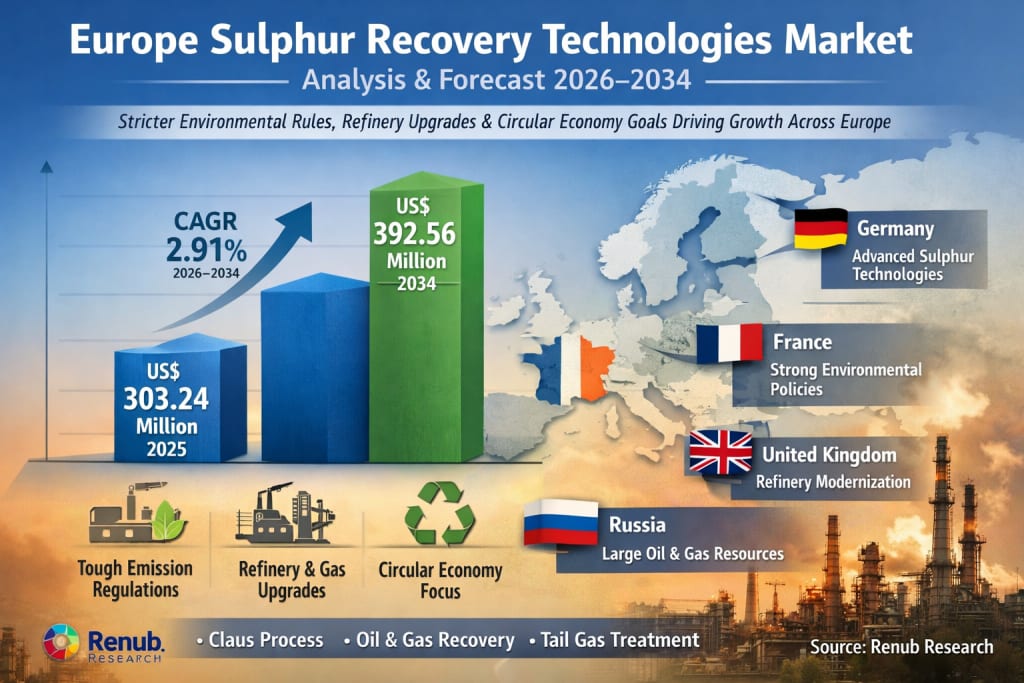
According to Renub Research, the Europe Sulphur Recovery Technologies Market was estimated at US$ 303.24 million in 2025 and is forecasted to reach US$ 392.56 million by 2034, growing at a CAGR of 2.91% from 2026 to 2034. This steady growth reflects a mix of regulatory pressure, infrastructure modernization, and a broader push toward sustainability across the region.
Sulphur recovery is no longer just about compliance. It is increasingly about efficiency, resource optimization, and supporting Europe’s transition toward cleaner industrial processes. From refineries and gas processing plants to chemical facilities, sulphur recovery units (SRUs) have become essential components of modern industrial operations.
Europe Sulphur Recovery Technologies Market Outlook
Sulphur Recovery Technologies (SRTs) refer to a group of industrial processes used to recover elemental sulphur from hydrogen sulphide (H₂S)-rich gas streams generated during petroleum refining, natural gas processing, and other petrochemical operations. The most commonly applied method is a combination of thermal and catalytic processes that convert toxic hydrogen sulphide into stable, reusable elemental sulphur.
This technology plays a critical role in preventing harmful emissions, reducing corrosion in industrial systems, and enabling the reuse of sulphur in products such as fertilizers, chemicals, and pharmaceuticals. In Europe, where environmental standards are among the strictest in the world, efficient sulphur recovery is not optional—it is a necessity.
The region’s focus on cleaner fuels, lower sulphur content, and environmentally responsible manufacturing has accelerated the adoption of advanced sulphur recovery systems. At the same time, Europe’s mature oil and gas infrastructure is undergoing continuous upgrades, creating a favorable environment for the installation of modern SRUs and tail gas treatment units.
Another important factor is the growing emphasis on the circular economy. Instead of treating sulphur as waste, industries are increasingly viewing it as a valuable byproduct. This shift is strengthening the business case for investing in efficient and high-recovery sulphur technologies across the continent.
Key Drivers of the Europe Sulphur Recovery Technologies Market
Tough Environmental Regulations and Emission Standards
One of the strongest forces driving this market is Europe’s strict environmental policy framework. The European Union and national governments have implemented rigorous limits on sulphur dioxide (SO₂) and other harmful emissions. These regulations directly impact refineries, gas processing plants, and petrochemical facilities, all of which must manage sulphur-containing streams safely and efficiently.
Non-compliance can result in heavy fines, operational restrictions, or even shutdowns. As a result, many companies are upgrading older systems and investing in high-efficiency sulphur recovery and tail gas treatment technologies. This regulatory pressure ensures a steady demand for advanced sulphur recovery solutions across Europe.
In parallel, broader climate and emissions policies—such as long-term CO₂ reduction targets—are also encouraging industries to modernize their processes. While sulphur recovery is not directly about carbon emissions, it fits into the wider push for cleaner, more responsible industrial operations.
Modernization of Refining and Gas Processing Infrastructure
Europe’s oil refining and natural gas processing sectors are in a continuous state of modernization. Many facilities were built decades ago and now require upgrades to handle more complex feedstocks, including higher-sulphur crude and sour gas.
With changing supply patterns and increased imports of sour hydrocarbons, the need for robust and flexible sulphur recovery units is growing. Modern SRUs are designed to achieve higher recovery rates, better energy efficiency, and lower emissions, making them a natural choice for upgrade projects.
In addition, Europe’s investments in cross-border energy infrastructure, including hydrogen and CO₂ networks, are reshaping the region’s energy system. These developments indirectly support the sulphur recovery market by driving new projects and retrofits in the broader energy and industrial ecosystem.
Rising Focus on Sustainability and the Circular Economy
Sustainability is no longer just a corporate slogan in Europe—it is a core business requirement. Industries are under pressure to reduce waste, improve resource efficiency, and demonstrate real progress toward environmental goals.
Sulphur recovery fits perfectly into this narrative. Instead of releasing harmful gases into the atmosphere, companies can convert hydrogen sulphide into useful elemental sulphur. This sulphur is then used in fertilizers, chemicals, rubber processing, and pharmaceutical applications, turning a hazardous byproduct into a valuable resource.
As circular economy principles gain more traction, sulphur recovery technologies are increasingly seen not just as compliance tools, but as strategic investments that support both environmental and economic objectives.
Challenges Facing the Market
High Capital and Operating Costs
Despite its clear benefits, sulphur recovery technology comes with significant upfront costs. Installing advanced SRUs and tail gas treatment units requires substantial capital investment, particularly due to the complexity of the equipment and the use of specialized catalysts and materials.
Operating and maintenance costs can also be high, especially for smaller and mid-sized facilities with lower processing volumes. This cost sensitivity can slow down adoption in certain segments of the market, even when regulatory pressure is strong.
Technical Complexity and Operational Demands
Sulphur recovery processes involve complex thermal and catalytic reactions that require precise control. Variations in feed gas composition, sulphur content, and operating conditions can affect recovery efficiency and overall plant stability.
Many older European facilities face additional challenges because their existing infrastructure is not always fully compatible with modern control systems. On top of that, operating these units requires highly skilled personnel, creating a dependency on specialized expertise that is not always easy to source.
Europe Sulphur Recovery Claus Process Market
The Claus Process remains the backbone of sulphur recovery in Europe. It accounts for the majority of sulphur recovery units installed in refineries and gas processing plants across the region. This well-established thermal process converts hydrogen sulphide into elemental sulphur through a series of controlled reactions.
What keeps the Claus Process relevant is its scalability and adaptability. Modern European facilities often combine it with advanced tail gas treatment technologies, pushing sulphur recovery rates beyond 99.9%. This is essential for meeting today’s ultra-strict emission standards.
As older refineries are upgraded and environmental limits become even tighter, demand for modernized Claus-based systems is expected to remain strong throughout the forecast period.
Europe Sulphur Recovery Technologies in Oil Refining
In the downstream oil sector, sulphur recovery plays a crucial role in producing cleaner fuels and protecting equipment from corrosion. As European refineries process increasing volumes of sour crude, efficient desulphurization and sulphur recovery systems are becoming more important than ever.
These technologies help refineries meet ultra-low sulphur fuel standards, improve product quality, and comply with environmental regulations. At the same time, they allow operators to recover and monetize sulphur as a byproduct, improving overall process economics.
Ongoing refinery upgrades and stricter fuel quality requirements are expected to keep demand for sulphur recovery technologies in the oil sector on a steady upward path.
Europe Sulphur Gas Recovery Technologies Market
Natural gas and LNG projects are another important growth area for sulphur recovery in Europe. Many gas streams contain hydrogen sulphide, which must be removed for safety, environmental, and pipeline quality reasons.
Gas-based sulphur recovery systems, often integrated with amine treatment and tail gas cleanup units, enable the processing of sour gas with minimal emissions. As Europe diversifies its gas supply sources and strengthens its energy security, the need for flexible and efficient gas treatment solutions is increasing.
The push for cleaner fuels and lower emissions further supports the adoption of advanced sulphur gas recovery technologies across the region.
Country-Level Market Insights
France
France benefits from strong environmental regulations and a well-established refining and petrochemical sector. The country’s focus on emissions reduction and process efficiency supports steady demand for advanced sulphur recovery systems. Its commitment to the circular economy also encourages the reuse of recovered sulphur in fertilizers and chemicals.
Germany
Germany stands out as a technologically advanced market, supported by its strong industrial base and engineering expertise. Refineries and chemical plants in the country are equipped with high-efficiency sulphur recovery and tail gas treatment systems designed to meet strict emission limits. Ongoing industrial modernization ensures continuous upgrades in sulphur recovery technologies.
United Kingdom
In the UK, the market is driven by refinery upgrades and offshore gas processing. Even as the country moves toward cleaner energy sources, existing oil and gas operations still require effective sulphur management. Investments in industrial and energy infrastructure continue to support demand for modern sulphur recovery units.
Russia
Russia holds a significant share of Europe’s sulphur recovery market due to its large oil and gas resources and sulphur-rich feedstocks. The need for high-capacity sulphur recovery units in refineries and gas plants is strong, especially as the country focuses on modernization, export-quality fuels, and better environmental performance.
Market Segmentation
By Technology:
Claus Process
Tail Gas Treatment
By Source:
Oil
Gas
Others
By Country:
France
Germany
Italy
Spain
United Kingdom
Belgium
Netherlands
Russia
Poland
Greece
Norway
Romania
Portugal
Rest of Europe
Competitive Landscape
The European sulphur recovery technologies market features several major global and regional players. Companies are typically evaluated across five viewpoints: overview, key persons, recent developments, SWOT analysis, and revenue analysis.
Key companies include:
Bechtel Corporation (Bechtel Group Inc.)
Black & Veatch Holding Company
Chiyoda Corporation
KT-Kinetics Technology SpA
Linde plc
Shell plc
Sulfur Recovery Engineering Inc.
WorleyParsons Ltd.
These companies compete on technology efficiency, project execution capabilities, and long-term service support, with a strong focus on meeting Europe’s demanding regulatory standards.
Final Thoughts
The Europe Sulphur Recovery Technologies Market may not always grab headlines, but it plays a vital role in the region’s industrial and environmental strategy. With the market projected to grow from US$ 303.24 million in 2025 to US$ 392.56 million by 2034 at a CAGR of 2.91%, the outlook is one of steady, regulation-driven expansion rather than explosive growth.
Stricter environmental rules, ongoing refinery and gas infrastructure upgrades, and the rising importance of circular economy principles are all shaping the future of this market. While challenges such as high costs and technical complexity remain, the long-term need for clean, efficient, and compliant industrial processes ensures that sulphur recovery technologies will continue to be a critical part of Europe’s energy and industrial ecosystem.
About the Creator
Sakshi Sharma
Content Writer with 7+ years of experience crafting SEO-driven blogs, web copy & research reports. Skilled in creating engaging, audience-focused content across diverse industries.
Keep reading
More stories from Sakshi Sharma and writers in Trader and other communities.
United States Medical Ceramics Market Size & Forecast 2026–2034
Introduction: A Material Quietly Transforming Modern Medicine Medical ceramics may not dominate headlines, but they are rapidly becoming one of the most critical material classes in modern healthcare. From hip replacements and dental implants to surgical tools and reconstructive procedures, these advanced biomaterials are redefining how long medical devices last, how safely they interact with the human body, and how well patients recover after surgery.
By Sakshi Sharmaabout 10 hours ago in Trader
Nike Stock Outlook: Investment Perspective and Growth Potential in 2026
Introduction Nike, Inc. is one of the world’s leading sportswear and athletic footwear companies, renowned for its innovation, global brand presence, and strong consumer loyalty. Nike’s stock has historically been a favorite among investors seeking exposure to the growing athletic apparel and footwear market.
By Hammad Nawaz5 days ago in Trader



Comments
There are no comments for this story
Be the first to respond and start the conversation.