
Germany Service Robotics Market Size Set to Surge by 2033: How AI, Automation, and Aging Demographics Are Reshaping the Future
From US$ 1.4 Billion in 2024 to US$ 20.8 Billion by 2033, Germany’s service robotics industry is entering a golden decade of innovation, investment, and real-world adoption.

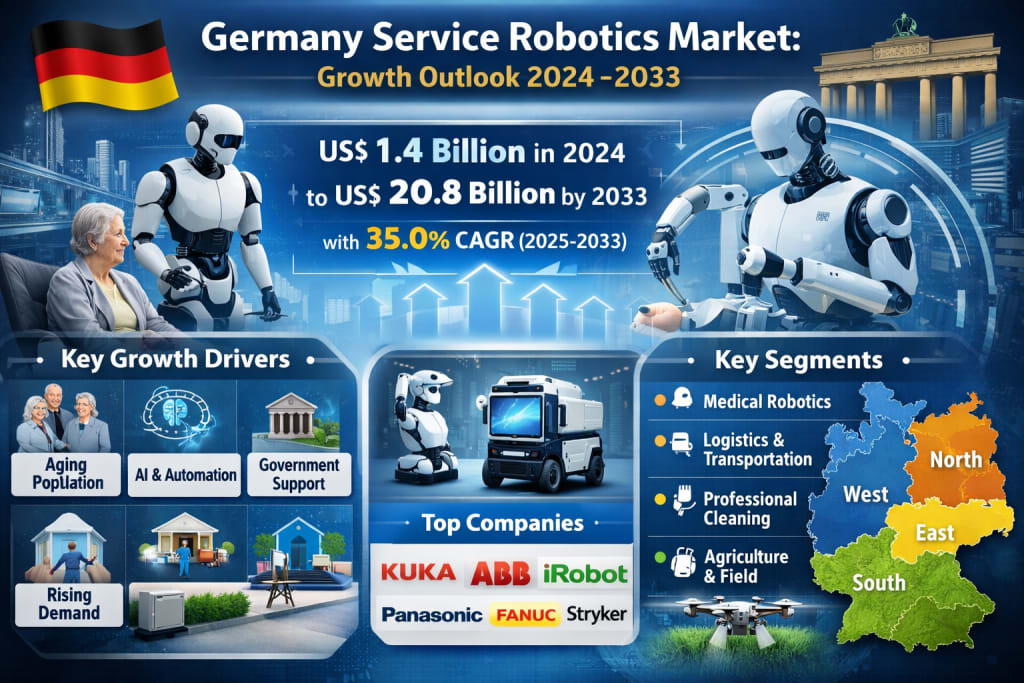
Germany Service Robotics Market: A New Era of Intelligent Automation
According to Renub Research’s latest industry analysis, the Germany Service Robotics Market is expected to expand dramatically, reaching US$ 20.8 billion by 2033 from US$ 1.4 billion in 2024, growing at an impressive CAGR of 35.00% from 2025 to 2033. This rapid rise highlights how service robotics is no longer a niche technology but a foundational pillar of Germany’s digital and industrial transformation.
Germany has long been recognized as Europe’s industrial powerhouse, particularly in engineering, automotive manufacturing, and advanced machinery. However, in recent years, the focus has expanded beyond traditional factory automation into service robotics—robots designed to assist humans in everyday environments such as hospitals, homes, farms, hotels, warehouses, and public spaces.
Unlike industrial robots that typically operate in controlled, structured settings, service robots work in dynamic, human-centered environments. They clean floors, deliver goods, assist surgeons, support elderly care, monitor crops, and even greet guests in hotels. These robots rely heavily on artificial intelligence (AI), machine learning, advanced sensors, and real-time data processing to navigate complex spaces and interact safely with people.
The German market is benefiting from a unique convergence of factors: an aging population, labor shortages, strong industrial demand for efficiency, rapid AI innovation, and consistent government backing for robotics and digital technologies. Together, these drivers are pushing service robots from experimental tools into essential infrastructure across multiple sectors of the economy.
Understanding Service Robotics: Beyond the Factory Floor
Service robots are autonomous or semi-autonomous machines designed to perform useful tasks for humans outside traditional industrial assembly lines. Their applications range from professional cleaning robots in commercial buildings and delivery robots in logistics hubs to medical robots assisting in surgeries and care robots supporting elderly patients.
In Germany, service robots are increasingly being deployed in healthcare, agriculture, hospitality, logistics, and domestic environments. What makes these systems particularly valuable is their ability to operate in unstructured environments, adapt to changing conditions, and collaborate directly with human users.
Modern service robots integrate:
Artificial intelligence for decision-making
Machine vision and sensors for navigation and object recognition
Machine learning for continuous performance improvement
Connectivity through cloud and IoT systems for real-time data exchange
By automating repetitive, physically demanding, or hazardous tasks, service robots improve productivity, enhance safety, and elevate overall quality of life. In a country like Germany—where precision, efficiency, and engineering excellence are deeply embedded in industrial culture—this technology fits naturally into the broader economic strategy.
Market Growth Drivers Powering Germany’s Service Robotics Boom
1. Industrial Automation and Industry 4.0 Momentum
Germany’s commitment to Industry 4.0 remains one of the strongest growth engines for the service robotics market. While industrial robots have been used for decades in manufacturing, the new wave of automation focuses on collaborative robots (cobots) and service-oriented systems that support human workers rather than replace them.
In sectors such as automotive, electronics, and logistics, service robots are being deployed for material handling, inspection, internal transport, and quality control. These robots help companies achieve:
Higher operational efficiency
Improved workplace safety
Greater production flexibility
Reduced error rates
As German manufacturers continue to modernize their facilities and supply chains, demand for intelligent, adaptable service robots is rising steadily. The push for smart factories and smart logistics hubs ensures that robotics remains a core investment priority.
2. Advancements in Artificial Intelligence and Machine Learning
AI and machine learning are transforming what service robots can do. Instead of following fixed instructions, modern robots can now:
Interpret complex environments
Recognize objects and people
Learn from experience
Make real-time decisions
Interact more naturally with humans
In Germany, where precision engineering meets cutting-edge software development, AI-powered robotics is finding applications in healthcare diagnostics, warehouse automation, smart homes, and agriculture. For example, medical robots can assist surgeons with extreme precision, while agricultural robots can analyze soil conditions and optimize harvesting processes.
As AI algorithms become more sophisticated and hardware becomes more affordable, service robots are becoming smarter, safer, and more cost-effective, accelerating their adoption across both public and private sectors.
3. Strong Government Support and Strategic Funding
Government backing plays a crucial role in Germany’s robotics leadership. The Federal Ministry of Education and Research (BMBF) invests more than €40 million annually in robotics research, focusing on AI-driven systems, advanced sensors, and real-world applications such as healthcare and rescue operations.
In addition, Germany’s High-Tech Strategy 2025 allocates around €70 million per year to research in human-technology interaction, ensuring that robots are designed to work safely and effectively alongside people. Programs like PAiCE, with a budget of €50 million over five years, support digital industry platforms and corporate collaboration.
Furthermore, the Robotics Institute Germany (RIG) receives up to €20 million over four years to build a distributed research network aimed at accelerating the integration of AI into robotic systems. These initiatives not only strengthen Germany’s innovation ecosystem but also attract private investment and global partnerships.
4. Aging Population and Healthcare Demand
Germany, like many developed nations, is facing a rapidly aging population. This demographic shift is creating growing pressure on healthcare systems, nursing homes, and home-care services. Service robots are increasingly seen as part of the solution.
In healthcare, robots are being used for:
Surgical assistance
Patient monitoring
Hospital logistics and delivery
Rehabilitation support
Elderly care and companionship
By reducing the physical workload on healthcare professionals and improving service efficiency, medical and assistive robots help address labor shortages while maintaining high standards of care. This trend is expected to remain a major long-term growth driver for the German service robotics market.
Challenges Limiting Market Expansion
High Initial Costs
Despite their long-term benefits, service robots often require significant upfront investment. The costs associated with hardware, software customization, system integration, infrastructure upgrades, staff training, and ongoing maintenance can be substantial.
For small and medium-sized enterprises (SMEs), these financial barriers can delay or prevent adoption altogether. Even though robotics can deliver strong returns over time, uncertainty around ROI and budget constraints remain key obstacles, particularly in price-sensitive industries.
Cybersecurity and Data Protection Risks
As service robots become more connected through cloud platforms and IoT networks, cybersecurity risks are rising. These systems often handle sensitive data, especially in sectors like healthcare and logistics. A cyberattack could lead to:
Data breaches
Operational disruptions
Safety risks
Loss of customer trust
In Germany, strict regulations such as GDPR add another layer of complexity, requiring companies to invest heavily in secure systems, compliance, and continuous updates. For smaller firms, these requirements can be both costly and technically challenging, potentially slowing down broader market adoption.
Recent Developments in the Germany Service Robotics Industry
The competitive landscape continues to evolve rapidly. In September 2023, ABB strengthened its presence in Germany by acquiring a controlling stake in a local robotics company specializing in automation solutions for small and medium-sized businesses. This move highlights growing interest in making robotics more accessible to a wider range of enterprises.
In August 2023, Yaskawa and SoftBank Robotics announced a collaboration to develop advanced humanoid robots for service industries, underlining the industry’s focus on more interactive, human-friendly robotic systems.
Such partnerships and acquisitions signal increasing consolidation, technological collaboration, and strategic investment across the German robotics ecosystem.
Market Segmentation: Where Growth Is Coming From
By Segment:
Transportation & Logistics
Professional Cleaning
Medical Robotics
Hospitality
Agriculture & Field
By Region:
East Germany
West Germany
North Germany
South Germany
Each of these segments is benefiting from different demand drivers. Logistics and professional cleaning are seeing rapid adoption due to efficiency and cost-saving needs, while medical robotics and agriculture are gaining momentum through technological innovation and demographic pressures.
Key Players Shaping the Market
The Germany service robotics market features a strong mix of global and regional leaders, including:
KUKA
iRobot Corporation
Intuitive Surgical, Inc.
Panasonic Corporation
Fanuc
ABB Ltd
Stryker Corporation
These companies are analyzed across four key dimensions: company overview, key leadership, recent developments and strategies, and sales performance. Their continuous investment in R&D, partnerships, and product innovation is setting the pace for market growth over the coming decade.
The Road Ahead: A Decade of Intelligent Transformation
With a projected CAGR of 35.00% from 2025 to 2033, Germany’s service robotics market is clearly entering a phase of hyper-growth. The combination of industrial strength, AI leadership, government support, and real-world demand across healthcare, logistics, agriculture, and services creates a powerful foundation for sustained expansion.
As costs gradually decrease, AI capabilities improve, and cybersecurity frameworks mature, service robots will move from being “advanced tools” to becoming everyday partners in work and life across Germany.
Final Thoughts
The rise of service robotics in Germany is more than just a technological trend—it represents a fundamental shift in how work, care, and services are delivered in a modern economy. From hospitals and warehouses to farms and hotels, intelligent robots are reshaping productivity, safety, and quality of life.
With the market expected to grow from US$ 1.4 billion in 2024 to US$ 20.8 billion by 2033, Germany is positioning itself not only as a European leader but also as a global powerhouse in service robotics innovation. For businesses, policymakers, and investors alike, the message is clear: the future of service robotics in Germany is not just promising—it is already unfolding.
About the Creator
Keep reading
More stories from shibansh kumar and writers in Trader and other communities.
Mexico UPS Market Size and Forecast 2025–2033: Powering a Digitally Resilient Economy
Mexico UPS Market Overview Mexico’s Uninterruptible Power Supply (UPS) market is entering a phase of steady and strategic growth, supported by the country’s accelerating digital transformation, expanding industrial base, and rising dependence on mission-critical infrastructure. According to Renub Research, the Mexico UPS Market is expected to reach US$ 274.34 million by 2033, up from US$ 176.54 million in 2024, growing at a CAGR of 5.02% from 2025 to 2033. This trajectory reflects a broader structural shift in the Mexican economy, where uninterrupted power is no longer a luxury but a necessity.
By shibansh kumarabout 9 hours ago in Trader
Australia Flower Market Blooming to USD 1.8 Billion by 2034 on Shifting Consumer Preferences and E commerce Growth
The Australia flower market is experiencing steady expansion as cultural traditions, lifestyle trends, and digital adoption reshape how consumers engage with floral products. According to the latest IMARC Group analysis, the market reached USD 1.2 billion in 2025 and is expected to grow to USD 1.8 billion by 2034, registering a compound annual growth rate (CAGR) of 4.19% during 2026–2034.
By Amélie Belle3 days ago in Trader



Comments
There are no comments for this story
Be the first to respond and start the conversation.