
Global Taxi Market Size and Forecast 2025–2033: How Digital Mobility Is Redefining Urban Transport
From street hails to smart apps, the global taxi industry is accelerating into a new era of convenience, sustainability, and tech-driven growth.

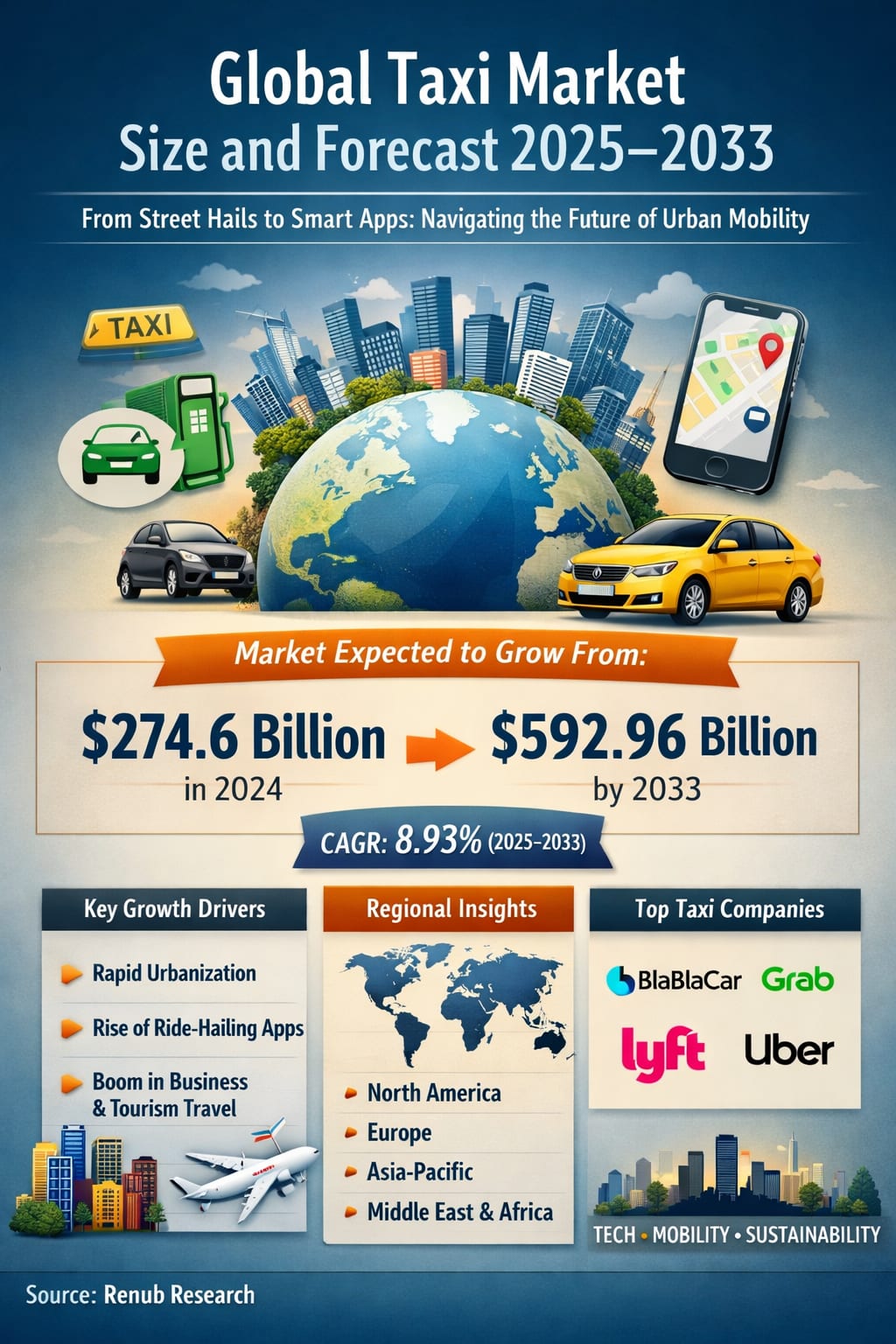
Global Taxi Market at a Glance
According to Renub Research’s latest industry outlook, the global taxi market is expected to grow from US$ 274.6 billion in 2024 to US$ 592.96 billion by 2033, expanding at a compound annual growth rate (CAGR) of 8.93% from 2025 to 2033. This impressive growth trajectory reflects more than just rising demand for transportation—it signals a fundamental shift in how people move within cities.
Rapid urbanization, the widespread adoption of ride-hailing applications, and a growing preference for flexible, convenient, and environmentally conscious travel options are reshaping the global taxi ecosystem. What was once a traditional, street-based service has evolved into a technology-driven mobility platform that integrates digital payments, GPS tracking, real-time booking, and increasingly, electric vehicles.
Today’s taxi market is no longer just about getting from point A to point B. It is about speed, reliability, transparency, safety, and sustainability—all delivered through a smartphone screen.
Global Taxi Industry Overview
Urbanization and rising population density have intensified the demand for efficient, comfortable, and on-demand transportation. In many large cities, owning a private car is becoming less practical due to traffic congestion, high maintenance costs, limited parking, and environmental concerns. Taxis, in contrast, offer flexible point-to-point mobility without the burdens of ownership.
The growth of ride-hailing platforms has further amplified this shift. With features such as quick reservations, optimized routing, fare transparency, and digital payments, taxis have become more accessible and user-friendly than ever before. These platforms also help operators improve fleet utilization and reduce idle time, making the entire system more efficient.
Innovation continues to reshape the sector. For example, in January 2024, YelowSoft introduced an in-app wallet for ride-hailing services, enabling one-click payments, enhanced security, faster transactions, and reward programs aimed at improving customer retention and operational efficiency. Such developments highlight how the taxi industry is increasingly blending transportation with fintech and digital services.
In regions where public transportation infrastructure is limited or overstretched, taxis play an even more critical role. They bridge the mobility gap, offering reliable transport options for daily commuters, tourists, and business travelers alike.
The U.S. Market: A Technology-Driven Transition
The United States holds a significant share of the global taxi market, driven by urban expansion, rising congestion, and a tech-savvy population that prefers on-demand services. Traditional taxi services, once dominant in major cities, now coexist with app-based ride-hailing platforms that emphasize convenience, speed, and transparency.
Technological integration—ranging from GPS navigation and digital payments to real-time ride tracking—has dramatically improved the customer experience. At the same time, sustainability is becoming a key theme. The adoption of electric and hybrid vehicles is gaining momentum as operators seek to reduce carbon emissions and align with environmental goals.
A notable example is Lyft’s expansion of its “Green” mode to 14 major U.S. cities in April 2023, allowing users to request electric and hybrid vehicles directly through the app. This move supports Lyft’s broader ambition to achieve an all-electric fleet by 2030 and reflects a wider industry push toward greener mobility solutions.
Government support for smart city initiatives and clean transportation further strengthens the market outlook, positioning the U.S. taxi sector at the forefront of digital and sustainable transformation.
Key Factors Driving the Taxi Market Growth
1. Population Growth and Urbanization
The rapid pace of global urbanization is one of the strongest drivers of taxi market expansion. As cities grow and population densities increase, the demand for fast, reliable, and accessible transportation rises sharply. In densely populated urban centers, private car ownership often becomes impractical due to congestion, parking shortages, and high costs.
Taxis provide a flexible and cost-effective alternative for both short and long-distance travel. They cater to daily commuters, occasional travelers, and those who prefer not to commit to owning a vehicle. In many developing nations, where urbanization is accelerating, taxis are becoming an essential part of the urban mobility ecosystem.
2. Growth of App-Based Ride-Hailing Services
The rise of platforms such as Uber, Lyft, Grab, and DiDi has transformed the traditional taxi business model. These apps allow users to book rides instantly, track vehicles in real time, view estimated fares, and make cashless payments—all from their smartphones.
This digital convenience has significantly increased consumer trust and engagement. For drivers and fleet operators, intelligent matching algorithms improve utilization rates and reduce downtime. As a result, the entire value chain becomes more efficient, scalable, and data-driven.
This digital revolution is one of the main reasons the taxi market is experiencing strong growth across both developed and emerging economies.
3. Rising Business and Tourism Travel
Global business travel and tourism continue to rebound and expand, creating sustained demand for reliable on-demand transportation. Tourists often rely on taxis for safe and comfortable travel in unfamiliar cities, especially where public transport is limited or complex.
Business travelers, on the other hand, prioritize punctuality, convenience, and comfort—making taxis an ideal choice for airport transfers, meetings, and intra-city travel. The growth of international flights, conferences, and tourism hubs directly supports the expansion of taxi services worldwide.
Challenges Facing the Taxi Industry
1. Workforce Issues and Driver Shortages
One of the most pressing challenges for the taxi industry is the shortage of professional drivers. The COVID-19 pandemic accelerated this problem, and the rise of the gig economy has provided drivers with alternative income options such as food delivery and flexible freelance work.
Long working hours, inconsistent earnings, safety concerns, and limited benefits make taxi driving less attractive, particularly to younger workers. An aging workforce and fewer new entrants further compound the issue. To remain competitive, operators must find ways to improve working conditions, offer better incentives, and ensure sustainable income models.
2. Gaps in Technological Adoption
While ride-hailing platforms have embraced digital tools, many traditional taxi operators still lag behind. The absence of integrated booking systems, GPS tracking, real-time monitoring, and cashless payment options puts them at a disadvantage in a market where customers expect seamless digital experiences.
This technology gap not only affects customer satisfaction but also limits operational efficiency and data-driven decision-making. Financial constraints, lack of technical expertise, and resistance to change remain key barriers to digital transformation for smaller operators.
Taxi Market Overview by Regions
The global taxi market shows strong regional variation:
North America and Europe lead in technology adoption and ride-hailing penetration.
Asia-Pacific is the fastest-growing region, driven by urbanization, large populations, and smartphone adoption.
Latin America and Africa show rising demand, although infrastructure and regulatory challenges remain.
United States
The U.S. taxi market is highly competitive and shaped by evolving consumer expectations. Major cities such as New York, Chicago, and San Francisco remain key hubs, but demand is also growing in suburban and smaller urban areas. Regulatory differences across states create both challenges and opportunities, while environmental regulations are pushing fleets toward cleaner vehicles.
United Kingdom
The UK taxi market blends tradition with technology. Iconic black cabs operate alongside private hire vehicles and app-based platforms. Strict regulations ensure high service quality, but operators face challenges such as labor shortages, environmental mandates, and intense competition from digital platforms.
India
India’s taxi market is one of the fastest-evolving in the world. Rapid urbanization, a growing middle class, and widespread smartphone use have fueled the rise of app-based ride-hailing. Major cities like Delhi, Mumbai, and Bengaluru show strong demand, although challenges such as congestion, regulatory complexity, and service consistency persist. The shift toward electric vehicles is also gaining momentum.
United Arab Emirates
The UAE boasts a highly organized and technologically advanced taxi sector. Cities like Dubai and Abu Dhabi feature modern fleets equipped with GPS, digital meters, and app-based booking systems. The country’s focus on smart mobility and cashless payments supports continued growth, although congestion and sustainability goals are shaping future strategies.
Recent Developments in the Taxi Industry
In August 2024, the Pan Car App was launched in Kangra, Himachal Pradesh, India. Developed by local youth, the app allows users to book taxis from home, reducing the need to visit taxi stands and saving time. The initiative, launched by R. S. Bali, Chairman of the Tourism Corporation, was praised as a step toward self-employment and tech-driven regional development.
In March 2024, Xanh SM Laos expanded its electric taxi services to Savannakhet after successful operations in Vientiane and Vang Vieng. With a starting fare of around USD 0.90, the company aims to promote eco-friendly transportation and strengthen its position in Laos’s green mobility transition.
Market Segmentation Snapshot
By Booking Type:
Online Booking
Offline Booking
By Vehicle Type:
Cars
Motorcycle
Other
By Service Type:
Ride Hailing
Ride Sharing
By Region:
North America (United States, Canada)
Europe (France, Germany, Italy, Spain, United Kingdom, Belgium, Netherlands, Turkey)
Asia Pacific (China, Japan, India, Australia, South Korea, Thailand, Malaysia, Indonesia, New Zealand)
Latin America (Brazil, Mexico, Argentina)
Middle East & Africa (South Africa, Saudi Arabia, United Arab Emirates)
Competitive Landscape
The global taxi market features a mix of international giants and regional innovators. Key players include:
BlaBlaCar
Bolt Technologies OU
Curb Mobility LLC
DiDi Chuxing (Beijing Xiaoju Technology Co. Ltd)
Flywheel Software Inc.
Gojek Tech
Grab Holdings Inc.
FREE NOW
Kabbee Exchange Limited
Lyft Inc.
Uber Technologies Inc.
These companies compete on technology, pricing, service quality, geographic reach, and sustainability initiatives, making the market highly dynamic and innovation-driven.
Final Thoughts
With the global taxi market projected to nearly double in value from 2024 to 2033, the industry stands at the center of a broader mobility revolution. Digital platforms, urbanization, changing consumer behavior, and sustainability goals are collectively reshaping how people move within cities.
The future of the taxi industry will not be defined solely by vehicles on the road, but by data, platforms, user experience, and environmental responsibility. Operators that successfully blend technology with reliability and green mobility will be best positioned to thrive in this fast-evolving landscape.
As cities continue to grow and mobility needs become more complex, taxis—now smarter, cleaner, and more connected than ever—will remain a vital pillar of global urban transportation.
About the Creator
Sakshi Sharma
Content Writer with 7+ years of experience crafting SEO-driven blogs, web copy & research reports. Skilled in creating engaging, audience-focused content across diverse industries.
Keep reading
More stories from Sakshi Sharma and writers in Trader and other communities.
Thailand Fertilizer Market Size and Forecast 2025–2033: Nourishing the Future of Sustainable Agriculture
Introduction According to Renub Research’s latest industry assessment, the Thailand Fertilizer Market is expected to reach US$ 1,732.51 million by 2033, growing from US$ 1,071.08 million in 2024, at a compound annual growth rate (CAGR) of 5.50% from 2025 to 2033. This steady expansion reflects Thailand’s strong agricultural foundation, rising food demand, increasing export-oriented crop production, and a gradual shift toward more efficient and sustainable farming practices.
By Sakshi Sharmaabout 11 hours ago in Trader
ASX Midday Update: Australian Market Trades Cautiously as Sector Rotation Dominates
ASX Midday Update In today’s ASX midday update, Australian shares are trading in a narrow range as investors remain cautious ahead of key global and domestic cues. The market is seeing clear signs of sector rotation, with strength in banking and defensive stocks balancing losses in mining and energy shares. As a result, benchmark indices are hovering near flat levels at midday.
By Hammad Nawaz2 days ago in Trader
Asia Luxury Goods Market Size, Trends & Forecast 2025–2033
Asia Luxury Goods Market Outlook The Asia Luxury Goods Market is entering a decisive growth phase, reflecting deep structural shifts in consumer behavior, wealth creation, and digital commerce across the region. According to Renub Research, the market is expected to expand from USD 135.25 billion in 2024 to USD 192.17 billion by 2033, registering a CAGR of 3.98% during the forecast period. This steady rise is being powered by increasing disposable incomes, growing brand consciousness, and the rapid expansion of the middle-class population in countries such as China, India, and Japan.
By shibansh kumar5 days ago in Trader




Comments
There are no comments for this story
Be the first to respond and start the conversation.