
Image-guided Therapy Systems Market Trends & Summary (2025–2033)
How Precision Imaging Is Redefining Modern Surgery and Minimally Invasive Care

Introduction: The Rise of Precision-Guided Medicine
Modern medicine is undergoing a quiet but powerful transformation. Surgeons and interventional specialists today are no longer guided only by experience and anatomical knowledge—they are increasingly supported by real-time, high-resolution imaging systems that show exactly where to operate, how to navigate complex anatomy, and how to minimize risk to patients. This shift has placed image-guided therapy (IGT) systems at the center of the next wave of medical innovation.
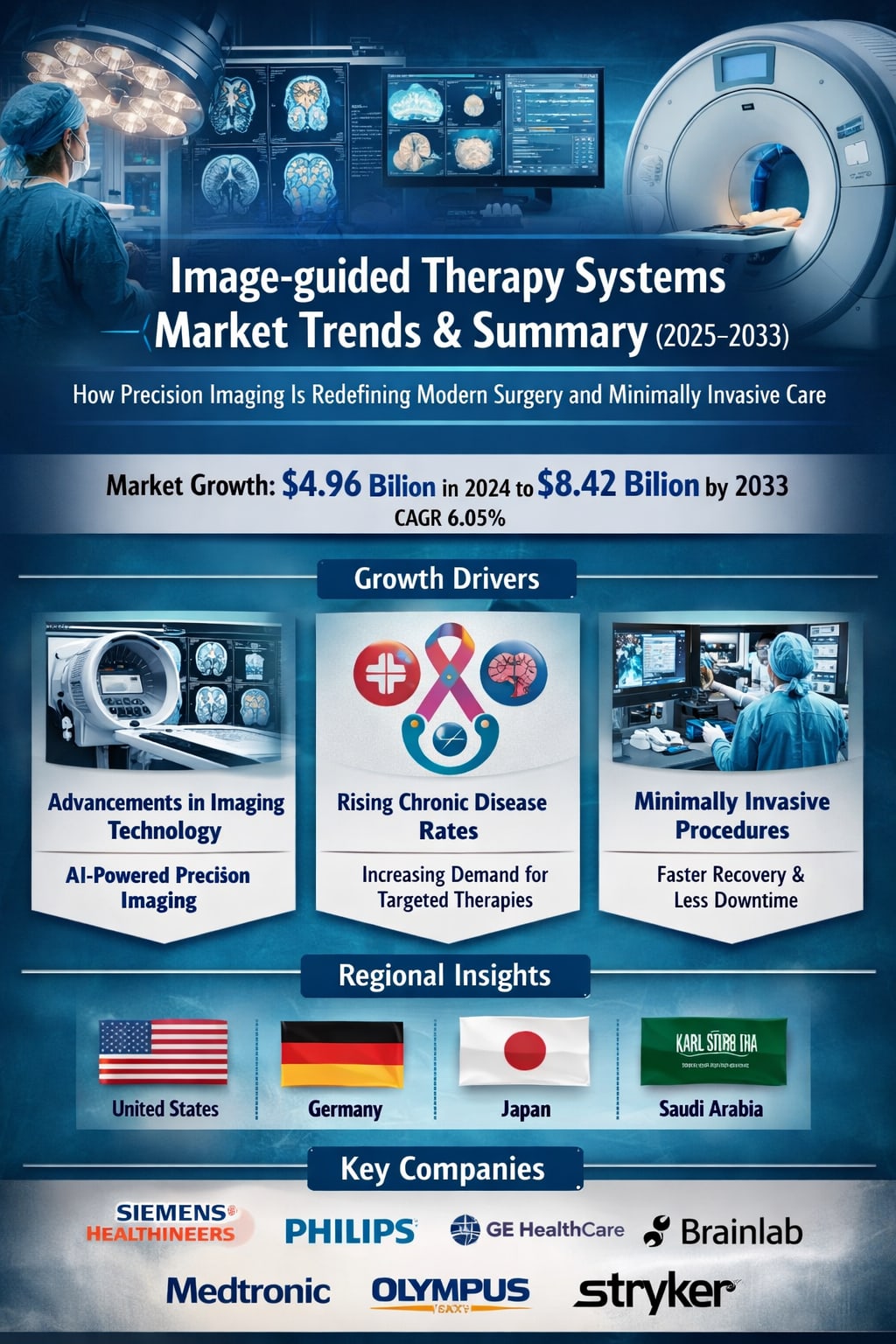
According to Renub Research, the Image-guided Therapy Systems Market is expected to reach US$ 8.42 billion by 2033, up from US$ 4.96 billion in 2024, growing at a CAGR of 6.05% from 2025 to 2033. This steady expansion reflects not only technological progress, but also a deeper change in how healthcare systems approach surgery, diagnosis, and treatment—favoring precision, safety, and minimally invasive techniques.
From neurosurgery and cardiology to oncology and orthopedics, image-guided therapy is no longer a niche tool. It is becoming a standard of care in advanced healthcare systems around the world.
What Are Image-guided Therapy Systems?
Image-guided therapy systems are advanced medical platforms that combine imaging technologies, navigation tools, software, and tracking systems to help physicians plan, perform, and evaluate surgical or interventional procedures in real time.
Common imaging modalities used in IGT systems include:
Computed Tomography (CT)
Magnetic Resonance Imaging (MRI)
Ultrasound
X-ray Fluoroscopy
Positron Emission Tomography (PET)
Single Photon Emission Computed Tomography (SPECT)
Endoscopy
These imaging tools are often integrated with surgical navigation systems, robotic assistance, and advanced software platforms. The result is a highly coordinated environment where clinicians can see inside the body with exceptional clarity, track instruments precisely, and make adjustments during procedures based on real-time data.
The biggest advantage? Higher accuracy, fewer complications, shorter hospital stays, and better patient outcomes.
Market Overview: A Sector on a Steady Growth Path
The global image-guided therapy systems market is benefiting from several long-term healthcare trends:
The rising burden of chronic diseases such as cancer, cardiovascular disorders, and neurological conditions
Growing demand for minimally invasive surgeries (MIS)
Rapid technological advancements in imaging, software, and navigation systems
Increasing focus on precision medicine and patient-specific treatment approaches
Renub Research projects that the market’s growth from US$ 4.96 billion in 2024 to US$ 8.42 billion by 2033 will be driven largely by hospitals and specialty clinics investing in advanced surgical infrastructure. As healthcare systems aim to improve outcomes while controlling costs, image-guided therapies offer a compelling balance of efficiency, safety, and clinical effectiveness.
Key Growth Drivers
1. Advancements in Imaging Technologies
The continuous evolution of imaging technologies such as MRI, CT, and ultrasound has dramatically improved the accuracy and reliability of image-guided therapy systems. Today’s scanners offer higher resolution, faster image acquisition, and better 3D visualization, enabling clinicians to see anatomical structures with remarkable clarity.
The integration of artificial intelligence (AI) and machine learning (ML) is further enhancing these systems. AI-powered tools can assist with image interpretation, automate measurements, highlight areas of concern, and even support real-time decision-making during procedures. This reduces human error, improves consistency, and helps clinicians perform complex interventions with greater confidence.
As these technologies become more accessible and cost-effective, adoption across multiple medical specialties is accelerating.
2. Rising Prevalence of Chronic Diseases
Chronic diseases such as cancer, heart disease, and neurological disorders continue to rise worldwide, driven by aging populations, lifestyle changes, and improved diagnostic capabilities. Many of these conditions require precise, targeted interventions rather than broad, invasive surgeries.
Image-guided therapy systems are ideally suited to this need. By providing real-time visualization and accurate localization of diseased tissues, these systems allow physicians to treat problems more precisely while minimizing damage to healthy structures. This is particularly important in oncology, neurosurgery, and interventional cardiology, where even small errors can have serious consequences.
As the global disease burden continues to grow, the demand for such precision-driven solutions is expected to rise alongside it.
3. Preference for Minimally Invasive Procedures
Patients and healthcare providers alike are increasingly favoring minimally invasive procedures due to their clear benefits: smaller incisions, reduced pain, lower infection risk, shorter hospital stays, and faster recovery times.
Image-guided therapy systems play a crucial role in making these procedures safer and more effective. By offering high-resolution, real-time guidance, they enable surgeons to navigate complex anatomy through tiny access points—something that would be extremely difficult, or even impossible, using traditional techniques alone.
This trend is especially strong in fields like neurosurgery, orthopedic surgery, and interventional cardiology, where precision is critical and margins for error are small.
Challenges Facing the Market
1. Complex Integration with Existing Infrastructure
Despite their advantages, integrating image-guided therapy systems into existing hospital environments can be challenging. These platforms must work seamlessly with electronic health records (EHR), hospital information systems (HIS), PACS, and operating room infrastructure.
Many healthcare facilities still rely on older or incompatible systems, making integration costly and time-consuming. Poor interoperability can disrupt workflows, create data silos, and limit the full potential of these advanced technologies. Additionally, ongoing software updates and the need for specialized IT support add to operational complexity.
Without smooth integration, the clinical and economic benefits of image-guided systems can be significantly reduced.
2. Radiation Exposure Concerns
Several image-guided procedures rely on ionizing radiation, particularly those using CT and fluoroscopy. While these imaging methods are essential for accurate guidance, repeated or prolonged exposure can increase health risks for both patients and medical staff.
As a result, healthcare providers must follow strict safety protocols, including dose monitoring, shielding, and minimizing exposure time. Regulatory scrutiny around radiation safety is also increasing, pushing manufacturers to develop lower-dose imaging technologies. However, adopting these newer systems can be expensive and may require additional training and infrastructure upgrades.
Regional Market Insights
United States
The United States represents one of the most advanced and dynamic markets for image-guided therapy systems. A strong healthcare infrastructure, high adoption of minimally invasive procedures, and continuous technological innovation are key growth drivers.
Hospitals and surgical centers across the country are increasingly using MRI, CT, and ultrasound-guided systems in neurosurgery, cardiology, and oncology. While high equipment costs and integration challenges remain, the U.S. continues to lead in both research and clinical adoption of image-guided therapies.
Germany
Germany’s market is growing steadily, supported by a robust healthcare system, strong research culture, and early adoption of advanced imaging technologies. The country is a major hub for medical technology innovation, with companies like Siemens Healthineers and Brainlab playing a significant role in shaping the industry.
Image-guided systems are widely used in cardiology, oncology, and neurosurgery, and Germany’s central position in Europe facilitates cross-border collaboration and technology exchange.
Japan
Japan’s image-guided therapy systems market benefits from a technologically advanced healthcare environment and a strong focus on precision medicine. The country’s aging population is a major factor driving demand, as older patients often require complex, image-guided interventions.
Japan’s commitment to research and development continues to fuel innovation in imaging and navigation technologies, supporting long-term market growth.
Saudi Arabia
Saudi Arabia is emerging as an important market in the Middle East, driven by healthcare modernization efforts under Vision 2030. Investments in advanced medical infrastructure and imaging technologies are increasing, particularly in cardiology, neurosurgery, and oncology.
While high costs and the need for specialized training remain challenges, partnerships with international healthcare providers and growing government support are helping accelerate adoption.
Recent Industry Developments
The industry has seen notable activity in recent months. In November 2024, Philips India introduced its innovative Azurion image-guided therapy system, designed to improve outcomes in neurovascular and cardiovascular interventions. The system features enhanced imaging, optimized workflows, AI-powered remote monitoring, and rapid switching between 2D and 3D imaging—all aimed at improving efficiency, accuracy, and patient care.
In October 2024, Philips and Medtronic Neurovascular announced a strategic partnership to expand access to timely stroke care. The collaboration focuses on improving stroke detection and treatment through awareness programs, technology deployment, and global advocacy efforts in partnership with the World Stroke Organization.
Market Segmentation Overview
By Product:
Endoscope, Magnetic Resonance Imaging, Computed Tomography Scanners, Ultrasound Systems, X-Ray Fluoroscopy, SPECT, PET
By Application:
Cardiac Surgery, Neurosurgery, Orthopedic Surgery, Urology, Gastroenterology, Oncology Surgery, Others
By End Use:
Hospitals, Ambulatory Surgical Centers, Specialty Clinics, Research & Academic Institutions
By Region:
North America, Europe, Asia Pacific, Latin America, Middle East & Africa
Key Companies in the Market
Some of the leading players shaping the global image-guided therapy systems market include:
Siemens Healthineers
Koninklijke Philips
General Electric Company
Brainlab
Medtronic Plc
Olympus Corporation
KARL STORZ SE & Co. KG
Stryker Corporation
These companies compete on technology innovation, system integration, clinical performance, and global reach.
Final Thoughts: A Future Guided by Precision
The image-guided therapy systems market is no longer just about better pictures—it’s about better decisions, safer procedures, and improved patient lives. With the market projected to grow from US$ 4.96 billion in 2024 to US$ 8.42 billion by 2033, the direction is clear: precision-guided medicine is becoming a cornerstone of modern healthcare.
As imaging technologies, AI, and navigation systems continue to evolve, image-guided therapy will play an even greater role in shaping the future of surgery and interventional care. For healthcare providers, patients, and technology innovators alike, this is not just a market trend—it’s a transformation of how medicine is practiced.
About the Creator
Sakshi Sharma
Content Writer with 7+ years of experience crafting SEO-driven blogs, web copy & research reports. Skilled in creating engaging, audience-focused content across diverse industries.
Keep reading
More stories from Sakshi Sharma and writers in Trader and other communities.
Tumor Profiling Market Size and Forecast 2025–2033
Introduction: A New Era in Cancer Diagnosis The global fight against cancer is entering a new phase—one defined not just by treatment, but by precision. Tumor profiling, a technique that analyzes the genetic, epigenetic, and proteomic characteristics of cancer cells, is rapidly transforming how physicians diagnose and treat cancer. Instead of relying solely on traditional “one-size-fits-all” therapies, clinicians can now tailor treatments based on the unique molecular signature of each patient’s tumor.
By Sakshi Sharmaabout 10 hours ago in Trader




Comments
There are no comments for this story
Be the first to respond and start the conversation.