
India Frozen Food Market Size & Forecast 2026–2034
Convenience on Ice: How Urban Lifestyles and Cold Chain Investments Are Reshaping India’s Food Habits

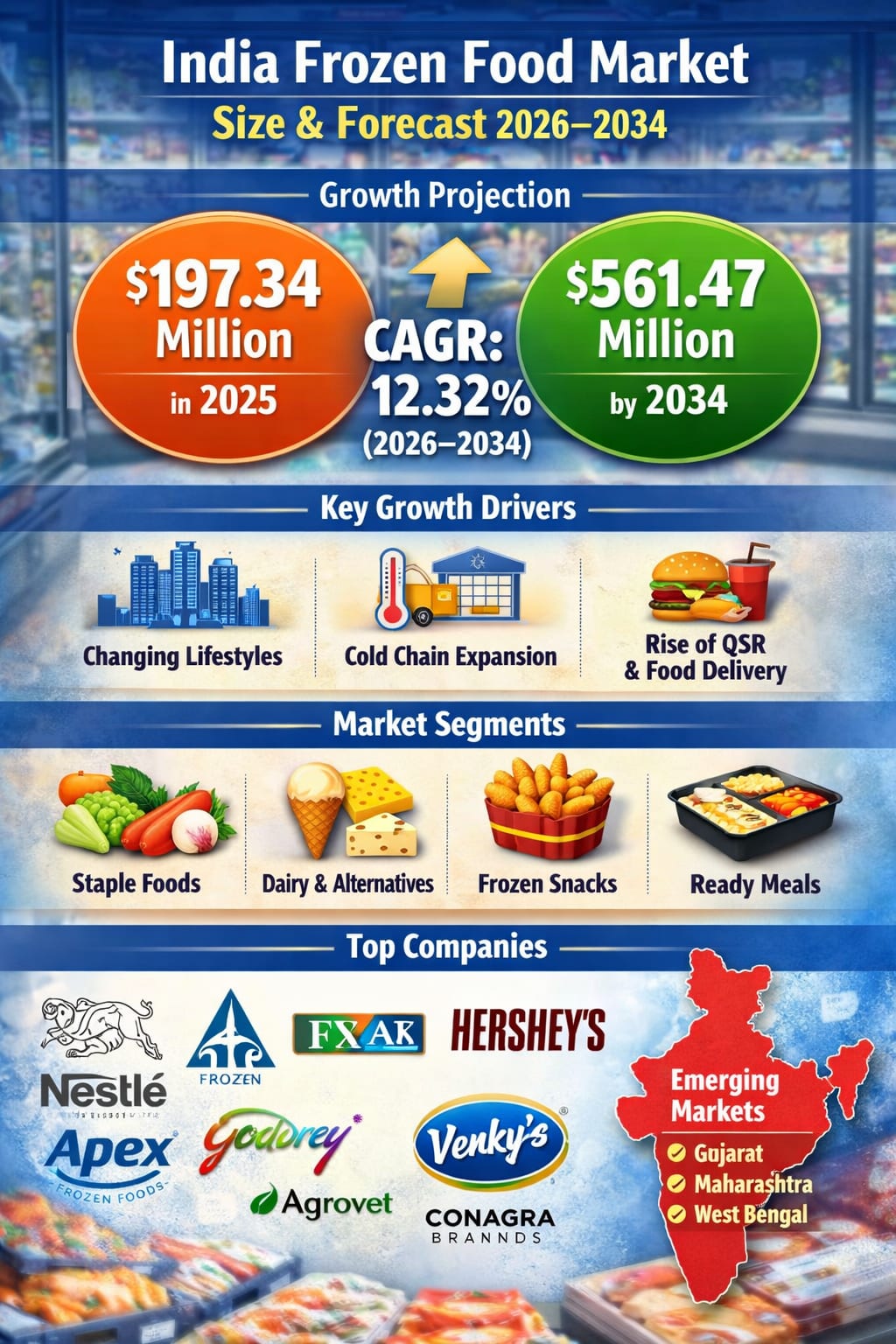
The India Frozen Food Market is entering a transformative phase, driven by urbanization, lifestyle shifts, and expanding cold chain infrastructure. According to Renub Research, the market is projected to grow significantly at a CAGR of 12.32% from 2026 to 2034, reaching US$ 561.47 Million by 2034, up from US$ 197.34 Million in 2025.
This strong trajectory reflects deeper structural changes in Indian consumption patterns—where convenience, hygiene, and consistency are increasingly prioritized alongside taste and affordability.
India Frozen Food Market Outlook
Frozen food refers to food items preserved through freezing to maintain freshness, texture, taste, and nutritional value for extended periods. By slowing microbial growth and enzymatic reactions, freezing ensures longevity without heavy reliance on chemical preservatives.
The category includes:
Frozen vegetables and fruits
Frozen meat and seafood
Ready-to-eat (RTE) meals
Ready-to-cook (RTC) products such as parathas, fries, nuggets, dumplings
Frozen snacks and bakery items
In India, frozen food is no longer limited to elite urban households. Rapid urbanization, nuclear families, and dual-income households have increased demand for quick meal solutions. Additionally, modern retail expansion, quick-commerce platforms, and improved cold chain logistics have enhanced accessibility even in Tier II and Tier III cities.
As awareness of hygiene, portion control, and food safety increases, frozen food is gradually moving from being a “luxury” choice to a practical everyday solution.
Key Growth Drivers
1. Changing Lifestyles and Demand for Convenience
India’s urban consumers are increasingly time-constrained. Long working hours, traffic congestion, and evolving household dynamics have reduced the time available for elaborate cooking.
Frozen food provides:
Reduced preparation time
Standardized taste and quality
Portion-controlled packaging
Easy storage
Young professionals and dual-income families in metro and Tier I cities are primary adopters.
In May 2025, Gujarat-based HyFun Foods launched ready-to-cook frozen snack products such as Mumbai Aloo Vada to tap into the rising appetite for Indianized frozen offerings.
Convenience is no longer optional—it is becoming essential.
2. Expansion of Cold Chain Infrastructure and Retail Channels
A robust cold chain ecosystem is the backbone of the frozen food industry. Over the past decade, India has witnessed significant investment in:
Refrigerated warehouses
Cold transport vehicles
Freezer-equipped retail outlets
Last-mile delivery systems
Modern supermarkets, hypermarkets, and quick-commerce platforms now provide wider product visibility and accessibility. E-grocery players have integrated cold storage capabilities, enabling frozen products to reach beyond metros.
In March 2024, BigBasket collaborated with chef Sanjeev Kapoor to launch the frozen foods brand Precia, offering frozen vegetables, appetizers, and sweets. Such partnerships strengthen brand trust and category awareness.
As infrastructure gaps narrow, product spoilage reduces and consumer confidence improves—accelerating adoption across urban and semi-urban India.
3. Growth of QSRs, Foodservice, and Product Innovation
The boom in quick-service restaurants (QSRs), cafés, and cloud kitchens has created consistent demand for standardized frozen ingredients.
Foodservice operators rely on frozen products for:
Uniform quality
Reduced preparation time
Cost efficiency
Scalability
Simultaneously, brands are innovating with Indianized frozen meals—samosas, kebabs, idlis, biryanis, and regional snacks tailored to local palates.
In February 2025, ITC signed an agreement to acquire Prasuma, a leading frozen and chilled food player specializing in oriental cuisine. This strategic move strengthens ITC’s position in high-growth frozen segments.
Health-focused innovations—preservative-free labels and minimally processed offerings—are also expanding the consumer base.
Challenges in the India Frozen Food Market
Cold Chain Gaps
Despite improvements, cold chain infrastructure remains uneven, especially in Tier II, Tier III, and rural regions. Limited refrigeration capacity, inconsistent power supply, and high logistics costs pose challenges.
Retailers may lack sufficient freezer space, restricting product assortment and visibility.
Price Sensitivity and Consumer Perception
India remains a highly price-sensitive market. Frozen food products are often perceived as premium compared to fresh alternatives.
Concerns about preservatives, freshness, and nutritional value persist in some households. Educating consumers while maintaining competitive pricing is crucial for long-term expansion.
Segment Analysis
India Frozen Staple Food Market
This segment includes frozen vegetables, grains, rotis, parathas, and ready-to-cook staples.
Urban working families prefer frozen staples for:
Time efficiency
Consistent quality
Reduced wastage
Localization—such as frozen chapatis and regional breads—helps align products with Indian dietary habits. While fresh staples dominate overall consumption, frozen variants are steadily gaining traction in metros and Tier I cities.
India Frozen Dairy Products and Alternatives Market
Products include ice cream, frozen desserts, butter, cheese, and plant-based alternatives.
Rising disposable incomes and evolving tastes are driving premium dairy consumption. Ice cream remains the largest segment, supported by seasonal demand and brand loyalty.
Additionally, lactose intolerance awareness and vegan trends are boosting plant-based alternatives.
Modern retail and e-commerce platforms are widening distribution, though cold storage costs remain a barrier to deep rural penetration.
India Frozen Chicken Market
The frozen chicken segment is expanding rapidly due to increasing protein consumption and hygiene awareness.
Products include:
Frozen chicken pieces
Nuggets and sausages
Marinated cuts
Urban consumers increasingly prefer packaged frozen chicken over wet market purchases due to safety and convenience.
The growth of organized meat portals and QSR chains further supports demand.
India Frozen French Fries Market
Frozen French fries represent a high-growth category, particularly within foodservice.
The expansion of QSRs and café culture ensures consistent institutional demand. At the consumer level, the popularity of air fryers has boosted home preparation of fries and potato-based snacks.
Localization of production is increasing to reduce import dependency and manage costs.
India Frozen Ready Meals Market
Frozen ready meals include curries, rice dishes, soups, and regional cuisine requiring minimal preparation.
Young consumers and working couples are driving demand. Indianized offerings—paneer dishes, biryanis, and regional specialties—are increasing relevance.
Improved packaging, preservative-free positioning, and online discovery are enhancing consumer trust.
Distribution Channel Insights
Supermarkets & Hypermarkets
These remain dominant distribution channels, offering:
Adequate freezer storage
Brand variety
Sampling opportunities
Premium product visibility
Though primarily urban-focused, they play a vital role in category awareness.
Online Retail & Quick Commerce
E-commerce is reshaping frozen food consumption. Fast deliveries and bundled promotions enhance accessibility. This channel is especially important among tech-savvy urban consumers.
Regional Analysis
Gujarat
A strong vegetarian consumer base and robust food processing ecosystem make Gujarat a promising frozen food market. Cities like Ahmedabad, Surat, and Vadodara show steady demand for frozen snacks and vegetables.
Convenience-driven consumption and strong retail networks support growth.
West Bengal
In West Bengal, frozen food adoption is emerging, particularly in Kolkata. Traditionally fresh-food-oriented consumers are gradually shifting due to urbanization and modern retail exposure.
Frozen fish, chicken products, and snacks are gaining popularity among nuclear families and youth.
With improved cold chain infrastructure, the state presents long-term growth potential.
Maharashtra
Maharashtra is one of the largest frozen food markets in India. Mumbai and Pune lead in demand for frozen snacks, ready meals, and meat products.
A large working population, strong QSR presence, and developed retail infrastructure make the state a growth engine for the category.
Market Segmentation Overview
By Category:
Staple Foods
Dairy Products & Alternatives
Snacks
Cooking Ingredients & Meals
By Product Type:
Fruits & Vegetables (peas, mushrooms, carrots, beans, corn)
Non-Veg Products (chicken, fish, mutton, beef, pork)
Potatoes (French fries, tikki, wedges, bites)
Frozen Bakery Products
Ready Meals
By Age Group:
Under 18
18–30
30–45
45 & Above
By Distribution Channel:
Supermarkets/Hypermarkets
Online Retail
Convenience Stores
Others
Top States:
Maharashtra, Tamil Nadu, Karnataka, Gujarat, Uttar Pradesh, West Bengal, Rajasthan, Telangana, Andhra Pradesh, Madhya Pradesh
Competitive Landscape
Major players operating in the India Frozen Food Market include:
Nestle
ITC Limited
Arla Foods
Hershey's
Apex Frozen Foods Ltd
Godrej Agrovet Ltd.
Venky's (India) Ltd.
Conagra Brands
Each company is evaluated across five viewpoints:
Overview
Key Persons
Recent Developments & Strategies
Product Portfolio
Financial Insights
Strategic acquisitions, product diversification, localization, and distribution expansion are key competitive strategies.
Final Thoughts
The India Frozen Food Market stands at a pivotal moment. What was once perceived as a niche urban category is steadily transforming into a mainstream convenience solution.
With a projected market value of US$ 561.47 Million by 2034 and a CAGR of 12.32%, the sector reflects broader societal shifts—urban migration, digital retail adoption, and evolving dietary preferences.
Challenges remain in cold chain gaps and price sensitivity. However, continued infrastructure investment, consumer education, and product innovation will likely bridge these barriers.
About the Creator
Sakshi Sharma
Content Writer with 7+ years of experience crafting SEO-driven blogs, web copy & research reports. Skilled in creating engaging, audience-focused content across diverse industries.
Keep reading
More stories from Sakshi Sharma and writers in Trader and other communities.
Fundus Camera Market Size & Forecast 2026–2034
The global Fundus Camera Market is poised for steady expansion over the next decade. According to Renub Research, the market is projected to grow from US$ 493 Million in 2025 to US$ 828.68 Million by 2034, registering a CAGR of 5.94% during the forecast period 2026–2034.
By Sakshi Sharmaabout 14 hours ago in Trader
Coro Global Inc: Company Profile, Business Strategy, and Market Outlook
Introduction: Understanding Coro Global Inc Coro Global Inc has recently started attracting interest from investors, analysts, and business enthusiasts due to its unique positioning in the global business landscape. Although the company has limited publicly available data, its name signals a focus on international opportunities and potential expansion across multiple sectors.
By Hammad Nawaz3 days ago in Trader



Comments
There are no comments for this story
Be the first to respond and start the conversation.