
Lithium-Ion Battery Market Size and Forecast 2026–2034
From Electric Vehicles to Grid Storage: Why Lithium-Ion Batteries Are Powering the Next Global Energy Revolution

Introduction
The global transition toward electrification and clean energy is no longer a distant vision—it is unfolding right now, across industries, cities, and households. At the heart of this transformation lies one technology that has quietly become indispensable: the lithium-ion battery. From powering smartphones and laptops to enabling electric vehicles and stabilizing renewable energy grids, lithium-ion batteries have evolved into the backbone of the modern energy ecosystem.
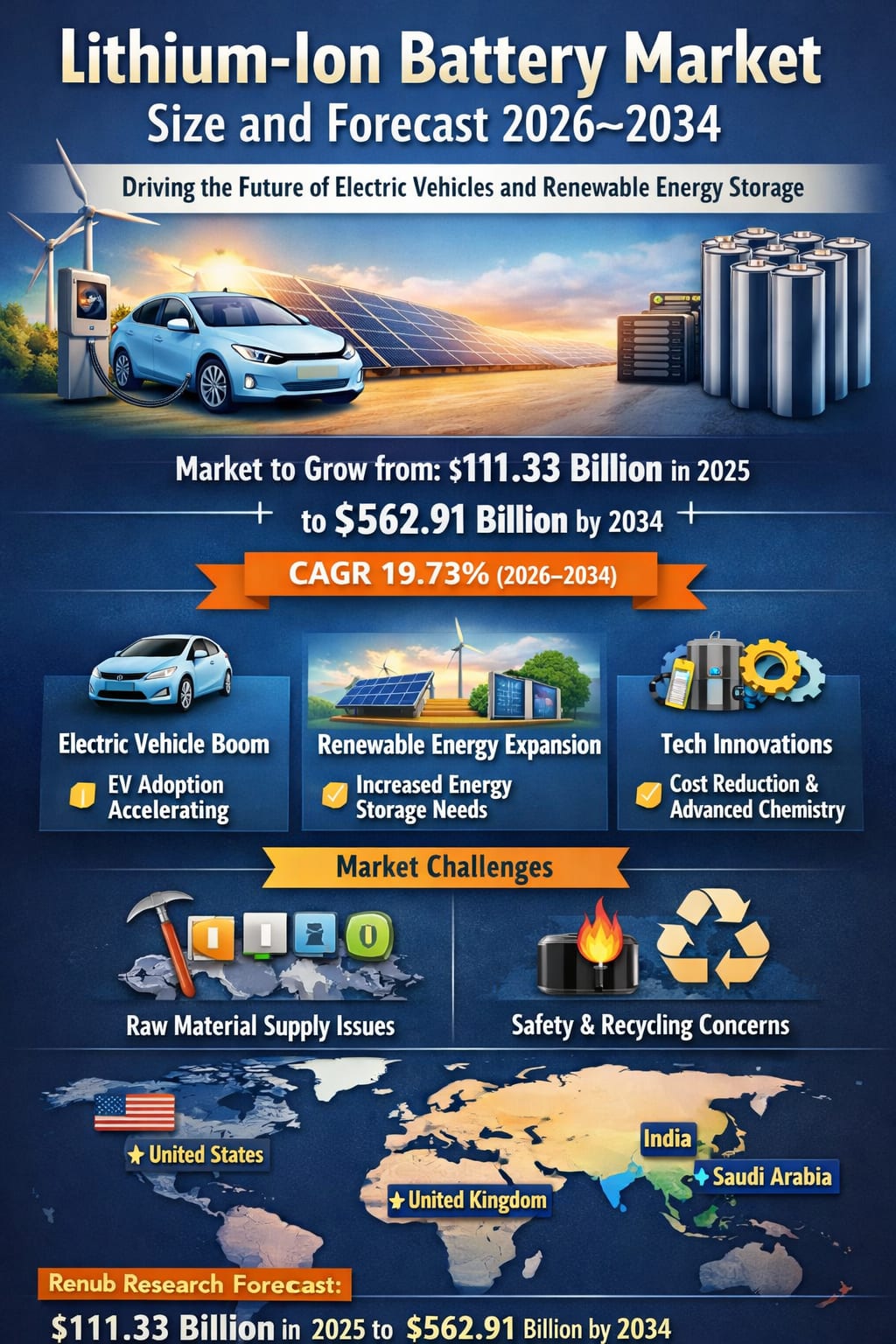
According to Renub Research, the global lithium-ion battery market is expected to grow from US$ 111.33 billion in 2025 to US$ 562.91 billion by 2034, registering a compound annual growth rate (CAGR) of 19.73% from 2026 to 2034. This remarkable expansion reflects not just rising demand, but a structural shift in how the world produces, stores, and consumes energy.
Driven by the rapid adoption of electric vehicles (EVs), expanding renewable energy storage needs, and continuous technological innovation, the lithium-ion battery industry is entering a decisive decade. As costs fall and performance improves, these batteries are moving beyond niche applications and becoming a cornerstone of global decarbonization strategies.
Lithium-Ion Battery Market Outlook
A lithium-ion battery is a rechargeable energy storage device that operates through the movement of lithium ions between the anode and cathode during charging and discharging cycles. These batteries are valued for their high energy density, lightweight design, long cycle life, and low self-discharge rate, making them ideal for a wide range of applications.
Today, lithium-ion batteries are used across multiple sectors, including electric vehicles, consumer electronics, stationary energy storage, medical devices, and industrial equipment. Their dominance is not accidental—it is the result of decades of research, large-scale manufacturing investments, and continuous improvements in chemistry and design.
The global push toward electrification and clean energy has further accelerated adoption. Governments and industries alike are prioritizing efficient energy storage solutions, and lithium-ion batteries have emerged as the most reliable and scalable option currently available. As renewable energy capacity expands and transportation becomes increasingly electric, lithium-ion batteries are set to remain the most dominant energy storage technology in the market.
Key Growth Drivers of the Lithium-Ion Battery Market
1. Rapid Adoption of Electric Vehicles (EVs)
The single most important growth engine for the lithium-ion battery market is the accelerating adoption of electric vehicles worldwide. Lithium-ion batteries offer the optimal combination of energy density, driving range, reliability, and declining costs, making them the preferred choice for EV manufacturers.
Governments across the globe are introducing strict emission regulations, financial incentives, and long-term decarbonization targets, all of which are pushing both consumers and automakers toward electric mobility. Beyond passenger cars, electric buses, trucks, and two- and three-wheelers are also gaining momentum, significantly expanding battery demand.
As EV production scales up and charging infrastructure improves, lithium-ion batteries will remain at the core of the electric mobility ecosystem, ensuring sustained market growth throughout the forecast period.
2. Expansion of Renewable Energy and Energy Storage Systems
The rapid growth of solar and wind energy is another powerful driver for lithium-ion batteries, especially in the stationary energy storage segment. Renewable energy sources are inherently intermittent, which makes efficient energy storage essential for grid stability and reliable power supply.
Lithium-ion batteries are increasingly used in utility-scale storage projects, commercial energy systems, and residential backup solutions due to their high efficiency, fast response time, and scalability. Governments are also promoting energy storage deployment to support clean energy integration and reduce dependence on fossil fuels.
As renewable capacity continues to expand worldwide, the need for advanced energy storage systems will grow in parallel—further strengthening the role of lithium-ion batteries in the global energy transition.
3. Technological Advancements and Cost Reduction
Continuous innovation is reshaping the lithium-ion battery landscape. Advances in battery chemistry, including high-nickel cathodes and emerging solid-state technologies, are improving energy density, safety, and lifespan. At the same time, large-scale manufacturing and process optimization have driven down costs significantly over the past decade.
Improvements in battery management systems, fast-charging capabilities, and thermal management are also enhancing performance and reliability across applications. These developments are not only expanding the use of lithium-ion batteries in existing markets but are also opening doors to new use cases in industrial, commercial, and grid-scale storage sectors.
As technology continues to mature, lithium-ion batteries are becoming more affordable, more efficient, and more versatile—further accelerating market adoption.
Challenges Facing the Lithium-Ion Battery Market
Raw Material Supply Constraints and Price Volatility
One of the most critical challenges for the industry is the supply of key raw materials, particularly lithium, cobalt, and nickel. These materials are concentrated in specific regions, making supply chains vulnerable to geopolitical risks, regulatory changes, and logistical disruptions.
As demand from the EV and energy storage sectors rises, price volatility and supply security have become major concerns. Additionally, environmental and social issues related to mining practices are pushing companies and governments to seek more sustainable sourcing strategies and alternative chemistries.
Ensuring a stable, ethical, and diversified supply of raw materials will be crucial for the long-term growth of the lithium-ion battery market.
Safety Concerns and Recycling Challenges
Although lithium-ion batteries are widely used, safety risks such as thermal runaway, overheating, and fire hazards remain important concerns—especially in large-scale applications. Addressing these risks requires ongoing investment in safer battery designs, better manufacturing standards, and advanced monitoring systems.
Recycling is another significant challenge. While battery recycling technologies are improving, collection, processing, and economic viability remain uneven across regions. Developing efficient recycling ecosystems is essential not only for environmental sustainability but also for securing secondary supplies of critical materials.
Insights into Key Market Segments
Cathode Lithium-Ion Battery Market
The cathode plays a decisive role in determining a battery’s energy density, cost, safety, and overall performance. Common cathode materials include Lithium Cobalt Oxide (LCO), Lithium Iron Phosphate (LFP), Lithium Nickel Manganese Cobalt (NMC), and Lithium Nickel Cobalt Aluminum (NCA).
As demand for higher energy density and longer-lasting batteries grows—especially in electric vehicles—the cathode segment continues to attract intense research and investment. The evolution of cathode materials is one of the most important factors shaping the future of lithium-ion battery technology.
Lithium Cobalt Oxide (LCO) Market
Lithium cobalt oxide remains a key chemistry in consumer electronics, including smartphones, laptops, and tablets, thanks to its high energy density and reliable performance. Although it is less suitable for electric vehicles due to cost and safety considerations, its dominance in portable electronics keeps it highly relevant.
Despite growing competition from alternative chemistries, LCO continues to play a significant role in the broader lithium-ion battery ecosystem.
Electrolytic Solution Lithium-Ion Battery Market
The electrolyte is essential for ion transport between the battery’s electrodes, directly influencing performance, safety, and lifespan. As battery applications expand—particularly in EVs and energy storage systems—the demand for advanced liquid, gel, and solid electrolytes is increasing.
Ongoing research into safer and more efficient electrolyte formulations is closely tied to the next generation of lithium-ion and solid-state batteries.
Passenger EVs Lithium-Ion Battery Market
Passenger electric vehicles represent the largest and fastest-growing application segment for lithium-ion batteries. Improvements in battery cost, charging speed, and durability are making EVs more accessible to mainstream consumers.
With strong policy support, rising consumer acceptance, and massive investments from automakers, this segment will continue to be a primary growth driver for the global lithium-ion battery market.
E-Buses Lithium-Ion Battery Market
Cities around the world are increasingly adopting electric buses to reduce air pollution and carbon emissions. These vehicles require large, high-performance battery systems capable of supporting long routes and heavy daily usage.
Advances in battery longevity, charging infrastructure, and thermal management are making electric buses more practical and cost-effective, driving steady growth in this segment.
Regional Market Highlights
United States
The US lithium-ion battery market is expanding rapidly, fueled by EV adoption, large-scale energy storage projects, and government support for clean energy. Investments in domestic battery manufacturing and next-generation technologies are strengthening the country’s position in the global supply chain.
United Kingdom
The UK market is driven by decarbonization goals, EV adoption, and renewable energy integration. While domestic manufacturing is still developing, strong focus on research, recycling, and advanced battery technologies continues to support steady growth.
India
India’s lithium-ion battery market is witnessing strong momentum due to government-led electrification initiatives, rising EV adoption, and growing energy storage needs. Investments in local manufacturing and gigafactory projects are gradually reducing dependence on imports and building a domestic battery ecosystem.
Saudi Arabia
Saudi Arabia’s market is growing alongside its renewable energy expansion and Vision 2030 sustainability goals. Large-scale energy storage projects and increasing interest in electric mobility are boosting demand for lithium-ion batteries across the country.
Market Segmentation Overview
By Component:
Cathode
Anode
Electrolytic Solution
Others
By Product Type:
Lithium Cobalt Oxide (LCO)
Lithium Iron Phosphate (LFP)
Lithium Nickel Cobalt Aluminum Oxide (NCA)
Lithium Manganese Oxide (LMO)
Lithium Titanate
Lithium Nickel Manganese Cobalt (NMC)
By Application:
Passenger EVs
Commercial EVs
Electric Two/Three-Wheelers
E-Buses
Stationary Storage
Consumer Electronics
By Region:
North America, Europe, Asia Pacific, Latin America, Middle East & Africa
Competitive Landscape
Key players operating in the global lithium-ion battery market include:
BYD Company Ltd.
Samsung SDI Company Limited
GS Yuasa Corporation
Johnson Controls Inc.
Exide Technologies
These companies are focusing on capacity expansion, technological innovation, strategic partnerships, and recycling initiatives to strengthen their market positions.
Final Thoughts
The lithium-ion battery market is entering a transformative decade. With Renub Research projecting growth from US$ 111.33 billion in 2025 to US$ 562.91 billion by 2034, the industry’s future is firmly tied to the global push for electrification, clean energy, and sustainable infrastructure.
While challenges such as raw material supply, safety, and recycling remain, continuous innovation and strong policy support are helping the market overcome these barriers. From electric vehicles and renewable energy storage to consumer electronics and smart grids, lithium-ion batteries are no longer just a technology—they are a foundation of the modern energy economy.
As the world moves closer to a low-carbon future, lithium-ion batteries will continue to power not only devices and vehicles, but the broader transformation of how energy is produced, stored, and consumed.
About the Creator
Ethereum (ETH) Trend Analysis and Investment Outlook
Introduction Ethereum is the second-largest cryptocurrency by market capitalization and plays a critical role in the broader crypto ecosystem. Unlike Bitcoin, which is mainly viewed as a store of value, Ethereum functions as a programmable blockchain that powers decentralized applications, smart contracts, NFTs, and DeFi platforms. From an investment point of view, Ethereum represents not just a digital asset but an entire technology ecosystem. This makes its price behavior, market trends, and long-term outlook closely tied to real-world blockchain adoption.
By Hammad Nawaz5 days ago in Trader


Comments
There are no comments for this story
Be the first to respond and start the conversation.