
Mine Detection System Market Size and Forecast 2025–2033
Why rising conflicts, humanitarian demining, and AI-powered detection technologies are reshaping a US$ 10.35 billion global industry

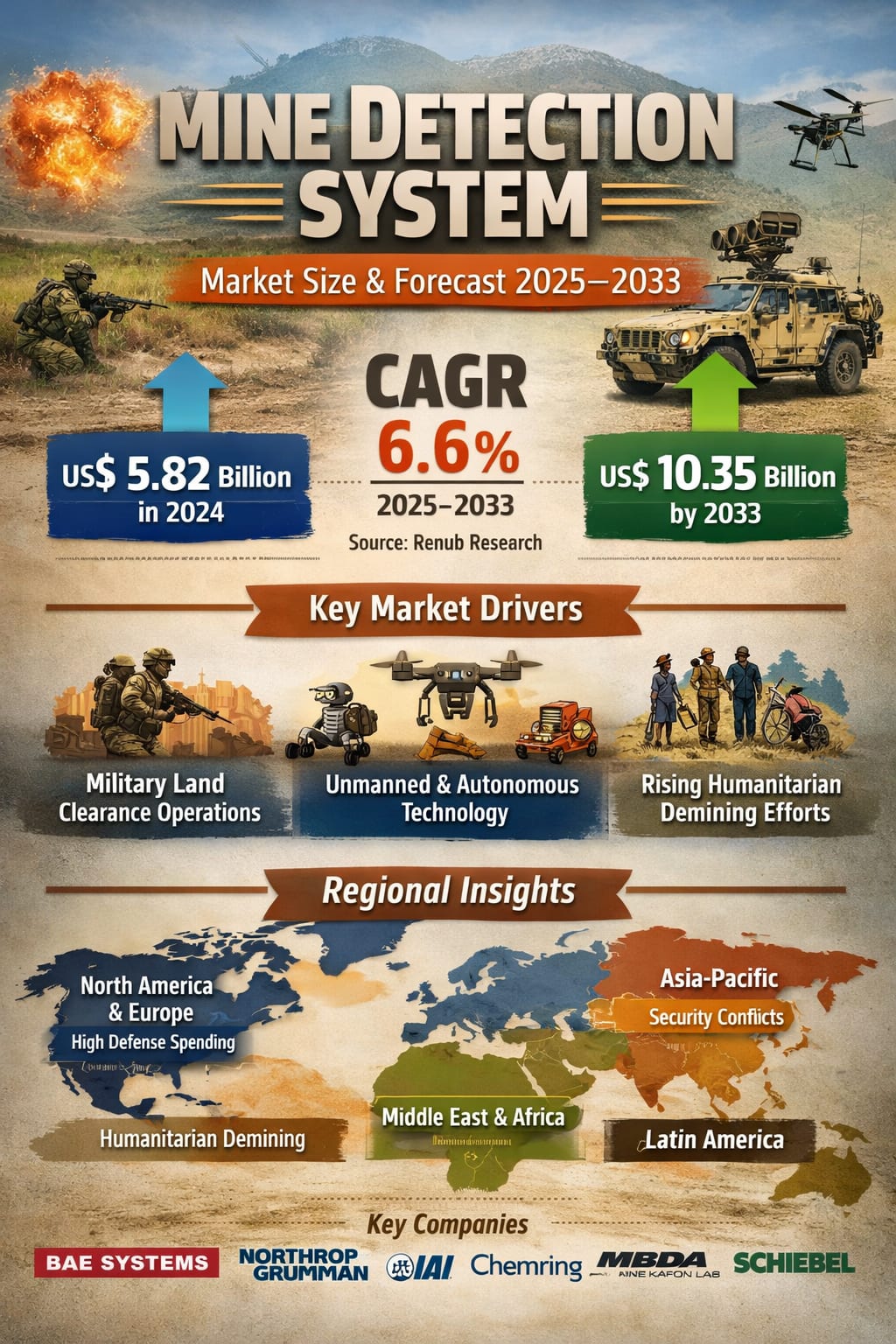
Global Mine Detection System Industry: A Market on the Frontline of Safety
The global mine detection system market is entering a decisive growth phase as nations, humanitarian agencies, and defense organizations intensify efforts to reduce the long-term dangers posed by landmines and unexploded ordnance (UXOs). According to Renub Research, the mine detection system market is expected to reach US$ 10.35 billion by 2033, up from US$ 5.82 billion in 2024, expanding at a compound annual growth rate (CAGR) of 6.6% between 2025 and 2033.
This growth is not driven by a single factor, but by a convergence of global realities: persistent geopolitical tensions, the rising number of post-conflict zones, increasing civilian casualties caused by hidden explosives, and rapid technological progress in sensing, robotics, and artificial intelligence. Breakthrough innovations such as VENUS and MRead technologies are setting new performance benchmarks, pushing the industry toward faster, safer, and more accurate mine detection.
A mine detection system refers to a collection of technologies and tools designed to locate landmines or unexploded ordnance buried underground or submerged in water. These systems play a critical role in protecting soldiers, civilians, and humanitarian workers from accidental explosions long after conflicts have ended. Traditional approaches such as metal detectors are now being complemented—and in some cases replaced—by ground-penetrating radar (GPR), electromagnetic sensors, infrared imaging, acoustic detection, and autonomous robotic platforms.
Beyond military use, mine detection systems are essential for civilian applications such as clearing land for agriculture, rebuilding infrastructure, and enabling the safe return of displaced populations. In many regions across the Middle East, Africa, Southeast Asia, and parts of Eastern Europe, landmines remain a hidden legacy of past conflicts, turning everyday activities like farming or walking to school into life-threatening risks.
As global attention on post-conflict recovery increases, mine detection technologies are becoming more sophisticated, more mobile, and more reliable. The market is no longer just about defense—it is also about humanitarian safety, sustainable development, and long-term regional stability.
What’s Fueling the Growth of the Mine Detection System Market?
1. Surge in Military Land Clearance Operations
One of the strongest growth drivers for the mine detection system market is the intensification of military land clearance operations worldwide. Rising geopolitical tensions, border disputes, and regional conflicts have forced many countries to invest heavily in technologies that can protect their troops and secure strategic territories.
Landmines and improvised explosive devices (IEDs) remain among the most dangerous threats in modern and asymmetric warfare. For armed forces, the ability to detect and neutralize these threats quickly is critical for troop mobility, logistics, and mission success. As a result, governments are prioritizing the procurement of advanced detection systems that offer higher accuracy, faster scanning, and greater reliability under combat conditions.
In addition, mine clearance is often a top priority in peacekeeping and stabilization missions, where international forces must ensure that roads, villages, and infrastructure are safe before civilian life can resume. This sustained operational demand is pushing defense budgets toward more advanced and rugged detection platforms, reinforcing long-term market growth.
2. Integration of Unmanned and Autonomous Technologies
The integration of unmanned systems, robotics, and autonomous platforms is transforming the mine detection landscape. Today, drones, robotic ground vehicles, and autonomous platforms equipped with advanced sensors and AI-driven data processing are increasingly being deployed in high-risk zones.
These systems significantly reduce the danger to human operators by allowing remote reconnaissance, mapping, and identification of minefields. They can cover large areas more quickly than manual teams, while also delivering higher precision and real-time situational awareness.
For both military forces and humanitarian organizations, this shift toward automation means faster clearance operations, lower casualty risks, and more cost-effective long-term missions. The trend also reflects a broader movement toward smart defense and security solutions, where data fusion, machine learning, and real-time analytics play a growing role in decision-making.
3. Rising Civilian Casualties and Humanitarian Pressure
Despite decades of global demining efforts, landmines and UXOs continue to claim thousands of civilian lives every year, particularly in post-conflict and developing regions. Children, farmers, and displaced populations are often the most vulnerable, encountering hidden explosives during routine daily activities.
This tragic reality has increased pressure on governments, non-governmental organizations (NGOs), and international institutions to scale up demining operations. As a result, funding for mine clearance programs has grown, and so has demand for more accurate, affordable, and easy-to-use detection systems.
Manufacturers are responding with a new generation of solutions, including portable detectors, robotic platforms, and AI-assisted sensing systems designed to improve detection rates while minimizing false alarms. The humanitarian imperative to reduce civilian casualties is now one of the most powerful long-term drivers of this market.
Key Challenges Facing the Market
High Cost of Advanced Technologies
While technological progress is a major growth engine, it also creates one of the market’s biggest obstacles: cost. Advanced systems that integrate robotics, AI, and ground-penetrating radar require significant investment in research, development, procurement, training, and maintenance.
For many low-income or post-conflict countries—often the regions most affected by landmines—these costs are a serious barrier. Limited defense or humanitarian budgets mean that organizations may continue relying on older, less efficient detection methods, slowing down clearance efforts and increasing risks to personnel.
In addition to acquisition costs, ongoing training, calibration, and operational expenses further increase the total cost of ownership. Bridging the gap between cutting-edge technology and real-world affordability remains a central challenge for the industry.
Difficult Terrain and Harsh Environments
Minefields are often located in some of the world’s most challenging environments—mountainous regions, deserts, dense forests, wetlands, or areas with damaged infrastructure. These conditions make it difficult to transport equipment, deploy personnel, and maintain reliable operations.
Extreme temperatures, heavy rainfall, flooding, or dust storms can also degrade sensor performance or damage sensitive equipment. In such environments, even the most advanced systems may face operational limitations, leading to delays, higher costs, and increased risks for demining teams.
These environmental challenges not only complicate field operations but also influence product design, pushing manufacturers to develop more rugged, adaptable, and weather-resistant detection systems.
Regional Outlook: Where the Market Is Growing
North America: Technology Leadership and Defense Modernization
North America, led by the United States, remains one of the most important markets for mine detection systems due to strong defense spending and continuous military modernization. The U.S. focuses heavily on integrating AI, robotics, and unmanned systems into its detection capabilities, aiming to improve both safety and operational efficiency.
Beyond domestic use, the United States is also a major contributor to international demining initiatives, providing funding, technology, and expertise to humanitarian missions worldwide. A strong ecosystem of defense contractors, research institutions, and government agencies continues to drive innovation in this space.
Europe: Innovation and Humanitarian Commitment
Europe plays a dual role in the market: as a center for technological innovation and as a major supporter of humanitarian demining efforts. Countries like Germany, France, and the United Kingdom invest in advanced detection technologies such as ground-penetrating radar and robotic platforms.
Germany, in particular, stands out for its close collaboration between industry and academia to improve detection accuracy and operational safety. At the same time, European nations provide significant financial and technical support to demining programs in affected regions, reinforcing steady demand for modern systems.
Asia-Pacific: Growth Driven by Security and Regional Tensions
The Asia-Pacific region is experiencing strong growth in the mine detection system market, driven by regional security concerns, border tensions, and the need for humanitarian demining in conflict-affected areas.
Countries like India, China, Japan, South Korea, and Australia are investing in advanced detection technologies, including unmanned systems and sensor-based platforms. India, in particular, is focusing on developing indigenous solutions through organizations such as the DRDO, aligning with its broader push for self-reliance in defense manufacturing.
Middle East & Africa: Humanitarian Need Meets Security Investment
The Middle East and Africa remain among the regions most affected by landmines and unexploded ordnance. Countries such as Saudi Arabia, the United Arab Emirates, and South Africa are increasing investments in detection technologies to support both national security and regional humanitarian missions.
Saudi Arabia’s Masam Project in Yemen is a prominent example of large-scale demining efforts, supported by advanced detection systems across land, marine, and airborne platforms. These initiatives highlight how humanitarian goals and defense strategies often intersect in this region.
Latin America: Steady Progress in Clearance Efforts
In Latin America, countries like Brazil, Mexico, and Argentina are gradually strengthening their mine detection and clearance capabilities, particularly in areas affected by historical conflicts or internal security challenges. While the market is smaller compared to other regions, ongoing clearance programs and international cooperation continue to support steady demand.
Market Segmentation at a Glance
By Deployment Platform:
Vehicle Mounted
Marine-Based
Airborne
Handheld
By Technology:
Ground Penetrating Radar
Electromagnetic Detection
Acoustic Detection
Infrared Detection
By Application:
Defense
Homeland Security
By Region:
North America (United States, Canada)
Europe (France, Germany, Italy, Spain, UK, Belgium, Netherlands, Turkey)
Asia Pacific (China, Japan, India, Australia, South Korea, Thailand, Malaysia, Indonesia, New Zealand)
Latin America (Brazil, Mexico, Argentina)
Middle East & Africa (South Africa, Saudi Arabia, UAE)
Competitive Landscape: Key Players Shaping the Industry
The global mine detection system market is supported by a mix of established defense giants and innovative technology specialists. Major players include:
BAE Systems
Chemring Group PLC
Israel Aerospace Industries
MBDA
MINE KAFON LAB
Northrop Grumman Corporation
Schiebel Corporation
These companies compete on the basis of technology innovation, system reliability, operational flexibility, and long-term support services. Many are investing heavily in R&D, strategic partnerships, and field trials to improve detection accuracy and reduce operational risks.
Final Thoughts: A Market with a Mission
The mine detection system market is not just another defense technology segment—it sits at the intersection of security, humanitarian responsibility, and technological progress. With the market projected to grow from US$ 5.82 billion in 2024 to US$ 10.35 billion by 2033 at a CAGR of 6.6%, the coming decade will be defined by smarter systems, greater automation, and wider global deployment.
As conflicts evolve and post-war recovery becomes a longer, more complex process, the importance of reliable mine detection will only increase. Whether protecting soldiers on the battlefield or helping civilians reclaim safe land for living and farming, these technologies play a quiet but critical role in shaping a safer future.
About the Creator
Mexico Apparel Market Size, Share, Growth, Latest Trends and Forecast 2026-2034
Why the Mexico Apparel Market Is Becoming a Fashion Growth Engine: Trends & Future Outlook The Mexico apparel market is entering a new phase of expansion driven by urban lifestyles, digital retail, and a strong connection between fashion and cultural identity. Clothing in Mexico is not simply about practicality — it reflects social trends, youth culture, and economic development. As disposable income rises and consumer tastes evolve, the apparel sector is becoming one of the most dynamic segments of the country’s retail landscape.
By Jackson Watsona day ago in Trader
Australia Hormone Replacement Therapy Market — Growth, Forecast & Strategic Insights
The Australia hormone replacement therapy market is experiencing steady expansion as demographic trends and healthcare innovations drive increased adoption of hormonal therapies. According to IMARC Group, the market was valued at USD 202.37 million in 2025 and is projected to grow to USD 317.45 million by 2034, representing a compound annual growth rate (CAGR) of 5.13% from 2026 to 2034.
By Amélie Belle8 days ago in Trader
Craft Over Catharsis Challenge Winners
Craft Over Catharsis? What the hell does that even mean? The phrase came out of a curation meeting as a genuine question. We had been noticing that many challenge entries, across prompts, naturally gravitate toward trauma, grief, and personal reckoning. That makes sense. Writing is often cathartic. It's one of the ways we process what we've lived through.
By Vocal Curation Teamabout 4 hours ago in Resources



Comments
There are no comments for this story
Be the first to respond and start the conversation.