
Semaglutide Market Size and Forecast 2025–2033
Why the world’s most talked-about diabetes and weight-loss drug is reshaping global healthcare economics

Introduction: A Drug That Redefined Two Global Epidemics
Few pharmaceutical innovations in recent years have captured public, clinical, and investor attention quite like semaglutide. Originally developed to treat type 2 diabetes, this glucagon-like peptide-1 (GLP-1) receptor agonist has rapidly evolved into a global phenomenon thanks to its remarkable effectiveness in both glycemic control and weight management.
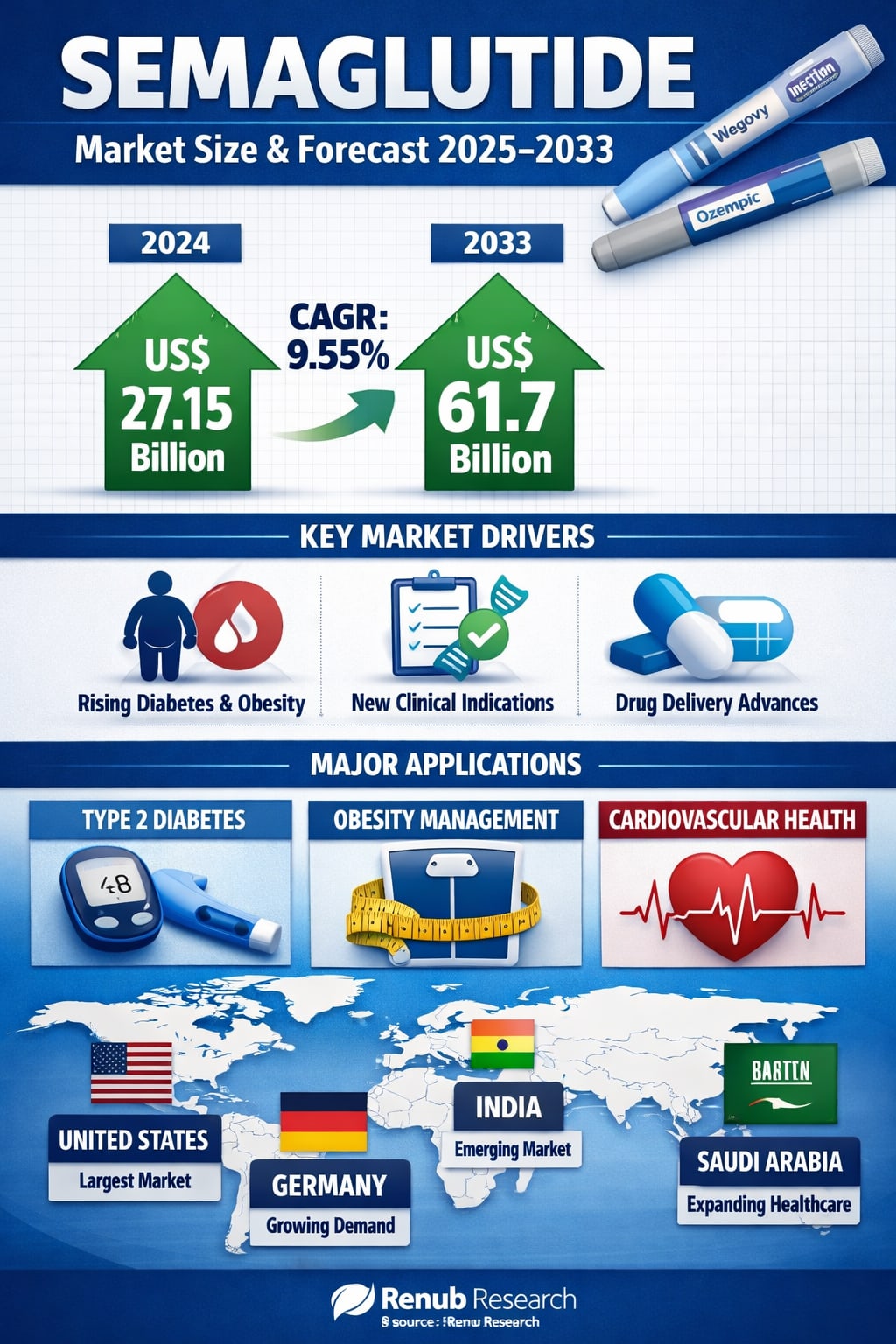
According to Renub Research, the global semaglutide market is expected to reach US$ 61.7 billion by 2033, up from US$ 27.15 billion in 2024, growing at a compound annual growth rate (CAGR) of 9.55% from 2025 to 2033. This impressive trajectory reflects more than just strong sales—it signals a profound shift in how the world approaches two of its most pressing health challenges: type 2 diabetes and obesity.
As healthcare systems grapple with rising metabolic disorders, and as patients demand more effective, sustainable treatments, semaglutide has emerged as a cornerstone therapy. Market momentum is being driven by growing disease prevalence, expanding clinical indications, regulatory approvals, and continuous innovation in drug delivery systems.
Semaglutide Market Overview
Semaglutide is a GLP-1 receptor agonist designed to mimic the action of the natural hormone GLP-1, which plays a critical role in regulating blood sugar and appetite. It works by stimulating insulin secretion, suppressing glucagon release, and slowing gastric emptying, resulting in improved glucose control and reduced appetite.
The drug is marketed under well-known brand names such as Ozempic, Rybelsus, and Wegovy, and is available in both injectable and oral formulations, depending on the indication. In patients with type 2 diabetes, semaglutide has demonstrated strong reductions in HbA1c levels and a lowered risk of major cardiovascular events such as heart attack and stroke. In individuals with obesity or overweight conditions, it has shown clinically meaningful and durable weight loss, especially when combined with lifestyle modifications.
What sets semaglutide apart is not just its efficacy, but its dual-impact profile—addressing both glucose regulation and body weight, two deeply interconnected metabolic challenges. This combination has made it one of the most sought-after therapies in modern metabolic medicine and a key growth engine in the global pharmaceutical market.
Key Drivers of Growth in the Semaglutide Market
Rising Prevalence of Type 2 Diabetes and Obesity
The global surge in type 2 diabetes and obesity is the most powerful engine behind the semaglutide market’s expansion. Sedentary lifestyles, calorie-dense diets, urbanization, and genetic predisposition have all contributed to a sharp rise in metabolic disorders across both developed and emerging economies.
In 2022, an estimated 2.5 billion adults worldwide were overweight, with more than 890 million classified as obese. This means roughly 43% of the global adult population was overweight, a dramatic increase from 25% in 1990. The burden varies by region, ranging from about 31% in parts of Africa and Southeast Asia to nearly 67% in the Americas.
Semaglutide’s ability to simultaneously improve blood sugar control and promote weight loss makes it especially attractive in this environment. As screening improves and awareness rises, the demand for highly effective, evidence-based therapies like semaglutide is expected to grow steadily.
Clinical Expansion and New Indications
Semaglutide is no longer just a diabetes drug. Its success in weight management has already reshaped obesity treatment, particularly under the Wegovy brand. Beyond this, ongoing research is exploring its role in cardiovascular risk reduction and other metabolic conditions, significantly broadening its addressable patient population.
In May 2025, Novo Nordisk reported that the U.S. FDA accepted its New Drug Application for a once-daily oral 25 mg formulation of Wegovy for chronic weight management in adults with obesity or overweight and related conditions. If approved, this would mark the first oral GLP-1 therapy for this indication, potentially transforming patient access and adherence.
Each new indication strengthens physician confidence, increases prescribing rates, and reinforces semaglutide’s long-term commercial outlook.
Advancements in Drug Delivery Systems
Innovation in drug delivery is another critical growth catalyst. While injectable formulations remain dominant, the availability of oral semaglutide (Rybelsus) has opened the door for patients who are hesitant about injections, improving adherence and broadening the user base.
In September 2024, researchers announced a long-acting delivery system that could allow semaglutide to be administered once a month instead of weekly. This system uses a biodegradable hydrogel composed of two polymers that slowly release the drug over time. Such advancements could dramatically improve treatment compliance and further boost long-term demand.
Challenges Facing the Semaglutide Market
High Treatment Costs and Limited Accessibility
Despite its clinical success, semaglutide remains expensive, particularly for patients in low- and middle-income countries. Limited insurance coverage and high out-of-pocket costs restrict access and create disparities in treatment outcomes. Without broader reimbursement policies, price negotiations, or future generic competition, affordability will remain a key barrier to truly global adoption.
Supply Chain and Manufacturing Constraints
Soaring demand has placed significant pressure on manufacturing capacity, leading to periodic supply shortages in several markets. Complex production processes, strict regulatory standards, and quality control requirements can all disrupt supply chains. Addressing these constraints will require continued investment in production infrastructure and streamlined regulatory pathways.
Market Insights by Product
Ozempic
Ozempic, the once-weekly injectable form of semaglutide, remains a flagship product in type 2 diabetes care. Its strong performance in lowering HbA1c and promoting weight loss has made it a preferred choice among clinicians. Weekly dosing improves patient convenience and adherence, reinforcing its market leadership and revenue contribution to Novo Nordisk.
Wegovy
Wegovy represents a breakthrough in obesity treatment, offering a pharmacological solution to a condition long underserved by effective medications. Clinical trials have demonstrated substantial and sustained weight loss, making Wegovy a cornerstone therapy in chronic weight management and a major growth driver for the overall semaglutide market.
Market Insights by Application
Type 2 Diabetes
Semaglutide has secured a strong position in modern diabetes treatment guidelines. By mimicking GLP-1, it improves insulin secretion, suppresses glucagon, and supports weight loss—addressing both glycemic control and a major comorbidity of diabetes. The International Diabetes Federation estimates that by 2045, around 853 million adults—nearly 1 in 8—will be living with diabetes, underlining the enormous long-term demand potential.
Obesity
The global obesity crisis has created an urgent need for effective, scalable weight management therapies. Semaglutide’s appetite-suppressing and satiety-enhancing effects have positioned it at the forefront of medical obesity treatment, transforming how clinicians approach long-term weight control.
Market Insights by Distribution Channel
Retail Pharmacies
Retail pharmacies play a crucial role in semaglutide distribution, offering easy access, patient counseling, and adherence support. Their wide geographic reach helps drive market penetration, especially in urban and suburban settings.
Online Pharmacies
The rise of telemedicine and e-pharmacies has made semaglutide more accessible to digitally engaged and mobility-constrained patients. Home delivery, online consultations, and discreet purchasing options are reshaping how patients access chronic therapies, further expanding the market’s reach.
Regional Market Highlights
United States
The U.S. remains the largest and most influential market for semaglutide, supported by high disease prevalence, strong healthcare infrastructure, and favorable regulatory pathways. In January 2025, the FDA approved Ozempic to reduce the risk of worsening kidney disease, kidney failure, and cardiovascular death in adults with type 2 diabetes and chronic kidney disease—making it one of the most broadly indicated GLP-1 therapies in its class.
Germany
Germany’s market is driven by an aging population, rising metabolic disorders, and strong reimbursement frameworks. The country’s emphasis on preventive care and chronic disease management continues to support steady adoption of innovative therapies like semaglutide.
India
India is witnessing a rapid rise in diabetes and obesity due to urbanization and lifestyle changes. In January 2022, Novo Nordisk launched oral semaglutide in India, marking an important step toward improving access. Future growth will depend heavily on affordability, awareness, and healthcare infrastructure expansion.
Saudi Arabia
Saudi Arabia’s semaglutide market is benefiting from healthcare reforms under Vision 2030 and rising lifestyle-related diseases. In April 2025, Novo Nordisk signed an MOU with Lifera, a Public Investment Fund-owned company, to localize semaglutide production—an important move toward strengthening regional supply and accessibility.
Semaglutide Market Segmentation
By Product:
Ozempic
Rybelsus
Wegovy
Others
By Application:
Type 2 Diabetes
Obesity
Cardiovascular Risk Reduction
By Distribution Channel:
Retail Pharmacies
Hospital Pharmacies
Online Pharmacies
By Region:
North America (U.S., Canada)
Europe (France, Germany, Italy, Spain, UK, Belgium, Netherlands, Turkey)
Asia Pacific (China, Japan, India, South Korea, Thailand, Malaysia, Indonesia, Australia, New Zealand)
Latin America (Brazil, Mexico, Argentina)
Middle East & Africa (Saudi Arabia, UAE, South Africa)
Competitive Landscape
Key players operating in the global semaglutide and broader metabolic therapeutics space include:
Novo Nordisk A/S
Eli Lilly and Company
AstraZeneca plc
Biocon Ltd
Johnson & Johnson
Pfizer Inc.
AbbVie Inc.
Sanofi S.A.
These companies are активно investing in R&D, strategic partnerships, manufacturing expansion, and lifecycle management to strengthen their positions in a rapidly evolving market.
Final Thoughts: A Defining Decade for Metabolic Medicine
The semaglutide market is no longer just a success story—it is a structural shift in how the world treats diabetes and obesity. With Renub Research projecting growth from US$ 27.15 billion in 2024 to US$ 61.7 billion by 2033, the numbers reflect not only commercial momentum but also a deeper transformation in global healthcare priorities.
As innovation continues, access expands, and new indications emerge, semaglutide is poised to remain at the center of metabolic disease management. For patients, clinicians, and investors alike, the coming decade will likely confirm semaglutide not just as a blockbuster drug—but as a cornerstone of modern medicine.
About the Creator
North America Clinical Trials Market Size and Forecast 2025–2033
Introduction The North America Clinical Trials Market is entering a decisive growth phase as pharmaceutical and biotechnology companies race to develop safer, more effective, and more personalized treatments. According to Renub Research, the market is expected to grow from US$ 20.07 billion in 2024 to US$ 33.91 billion by 2033, expanding at a CAGR of 6.00% from 2025 to 2033. This steady rise reflects longer clinical trial cycles, increasing demand for innovative therapies, and the growing burden of chronic and infectious diseases such as cancer, diabetes, and post-pandemic viral conditions.
By shibansh kumar3 days ago in Trader
ATM Managed Services Market Size and Forecast 2025–2033
Introduction The global banking industry is undergoing a steady but powerful transformation. While digital payments, mobile banking, and fintech platforms are rapidly changing how consumers interact with financial institutions, Automated Teller Machines (ATMs) continue to play a crucial role in ensuring financial access—especially in emerging economies and underserved regions. Behind this vast global ATM network, a quieter but highly strategic industry is growing fast: ATM managed services.
By shibansh kumar4 days ago in Trader



Comments
There are no comments for this story
Be the first to respond and start the conversation.