
United States Lawn Care Market Size and Forecast 2025–2033
How Outdoor Living, Sustainability, and Smart Technology Are Reshaping America’s Lawns

United States Lawn Care Market Outlook
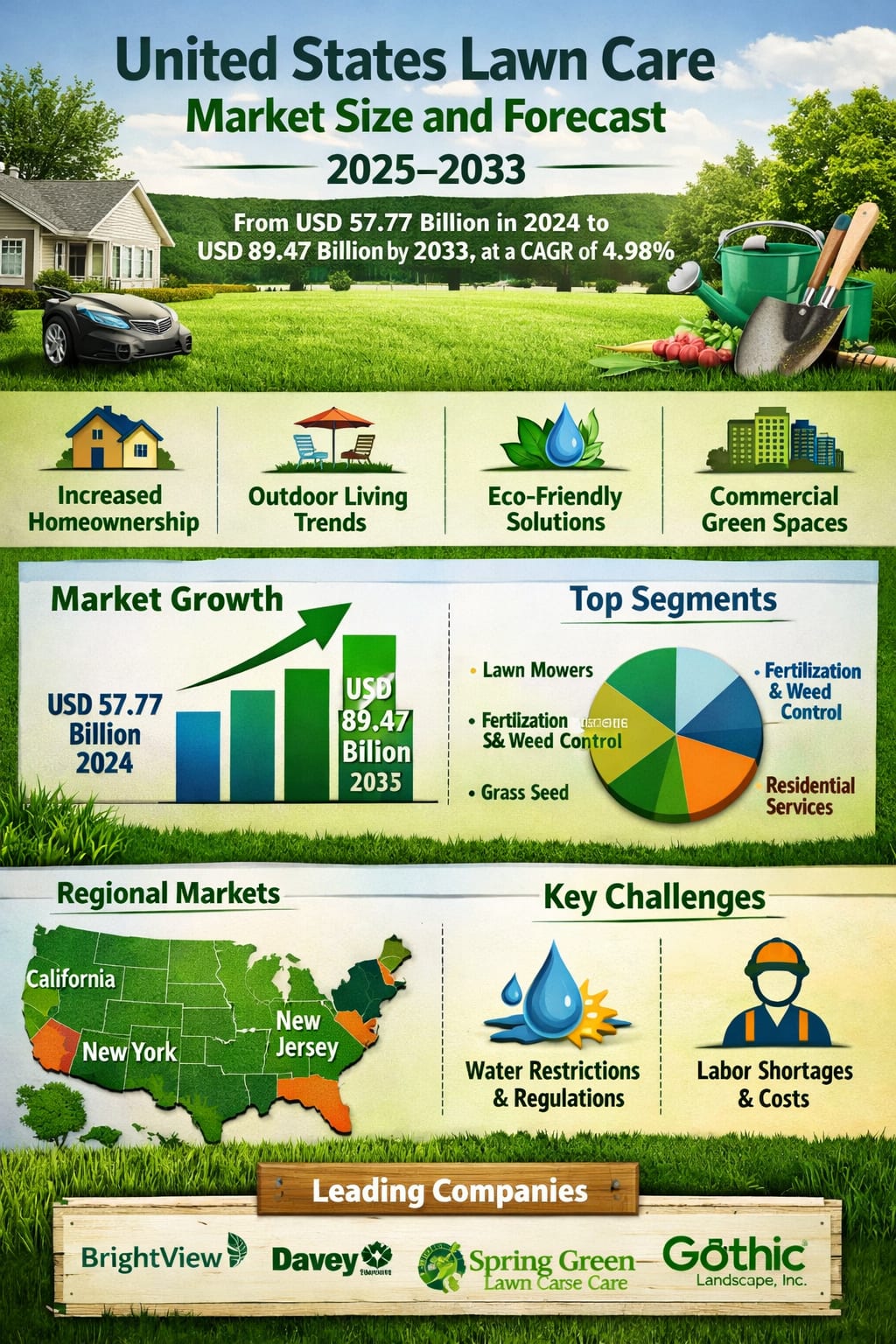
The United States Lawn Care Market stood at USD 57.77 billion in 2024 and is projected to reach USD 89.47 billion by 2033, expanding at a CAGR of 4.98% over the forecast period. This steady growth reflects how deeply lawn care is woven into American lifestyles, property values, and urban planning priorities.
Lawn care refers to the upkeep and maintenance of grass surfaces in residential, commercial, and public spaces. Services and products range from mowing, fertilization, aeration, seeding, irrigation, and weed control to pest management and full landscaping. Beyond aesthetics, lawn care plays a practical role in soil health, erosion prevention, temperature moderation, and even air and water quality improvement.
In the United States, lawns are more than just green patches—they are symbols of neighborhood pride, personal effort, and property value. From suburban backyards to corporate campuses, sports fields, and municipal parks, the demand for well-maintained green spaces continues to rise. The growth of suburban living, home renovation trends, and the do-it-yourself culture has further strengthened the market for lawn care equipment, consumables, and professional services.
At the same time, the industry is undergoing a transformation. Sustainability concerns, water conservation rules, and smart technology adoption are reshaping how Americans care for their lawns. The result is a market that is not only growing, but also evolving toward more efficient, eco-friendly, and technology-driven solutions.
Market Size and Growth Outlook
With a projected rise from USD 57.77 billion in 2024 to USD 89.47 billion by 2033, the U.S. lawn care market demonstrates resilient, long-term demand. A 4.98% CAGR may appear moderate compared to high-growth tech sectors, but for a mature, service-and-product-driven industry, it signals stable expansion, predictable cash flows, and continuous replacement and upgrade cycles.
Growth is supported by:
Expanding residential construction and suburban development
Rising investment in outdoor living spaces
Increasing demand for professional lawn services
Strong replacement demand for equipment like mowers and irrigation systems
A shift toward sustainable and smart lawn care solutions
Together, these forces are keeping the market both financially attractive and strategically important within the broader home improvement and landscaping ecosystem.
Key Growth Drivers in the U.S. Lawn Care Market
Increased Homeownership and Suburban Growth
The steady rise in homeownership and suburban expansion across the United States continues to add millions of square feet of new lawn area each year. New housing developments are almost always landscaped, creating long-term, recurring demand for mowing, fertilization, seeding, and maintenance services.
For many homeowners, a well-kept lawn is not just about looks—it represents social status, neighborhood standards, and property value protection. This mindset fuels consistent spending on lawn mowers, grass seed, fertilizers, irrigation systems, and professional services.
Public investment also supports greener spaces. In 2023, the U.S. government committed significant funding to expand urban and community forestry, reflecting a broader push toward sustainable and well-maintained green infrastructure. This trend reinforces long-term demand for both products and services in the lawn care ecosystem.
Greater Awareness of Outdoor Living and Curb Appeal
Outdoor living has become a major lifestyle trend in the U.S. Patios, backyard entertainment areas, and landscaped gardens are now seen as extensions of the home, not just optional extras. Social media has amplified this shift, with homeowners increasingly inspired by images of lush, perfectly maintained yards.
A well-manicured lawn boosts curb appeal and can significantly influence property resale value. As a result, lawn care is no longer viewed as a seasonal chore but as a year-round investment. This cultural change is expanding demand across mowing, edging, fertilization, weed control, and seasonal cleanup services, especially in regions with longer growing seasons.
Eco-Friendly and Smart Lawn Care Solutions
Environmental awareness is reshaping consumer preferences. Homeowners are increasingly choosing:
Organic fertilizers and natural weed control methods
Water-efficient irrigation systems
Electric and battery-powered lawn equipment
Robotic mowers and app-controlled sprinklers
These solutions appeal to both environmentally conscious and tech-savvy consumers who want convenience, efficiency, and lower environmental impact. Startups and established companies alike are investing in precision irrigation, smart sensors, and automation, signaling a future where lawn care becomes more data-driven and resource-efficient.
Challenges in the U.S. Lawn Care Market
Water Restrictions and Environmental Regulations
Many U.S. states face recurring droughts and water shortages, leading to strict watering schedules, usage limits, or outright bans in some areas. In addition, regulations increasingly restrict fertilizer and pesticide use near water bodies to prevent pollution.
While these measures are essential for environmental protection, they also challenge traditional lawn care practices. Lawns that depend on heavy watering and chemical treatments are becoming harder to maintain, pushing the industry toward drought-resistant grasses, low-water landscaping, and alternative maintenance models.
Labor Shortages and Rising Compliance Costs
The professional lawn care and landscaping sector is also dealing with labor shortages and rising wage pressures. At the same time, businesses must comply with pesticide licensing rules, environmental standards, insurance requirements, and safety regulations, all of which increase operating costs.
For smaller service providers, these pressures can limit expansion or even threaten survival. For consumers, this may translate into higher service prices or reduced availability, particularly in rural or lower-income areas.
Key Market Segments
United States Lawn Mowers Market
Lawn mowers remain a cornerstone of the U.S. lawn care market. Demand spans push mowers, self-propelled models, and ride-on mowers, with growing interest in electric and battery-powered versions.
Electric mowers are gaining popularity due to their lower emissions, quieter operation, and reduced maintenance needs. Ride-on mowers continue to be essential for large properties and commercial use. Manufacturers are focusing on battery life, safety features, and user convenience, encouraging consumers to upgrade and replace older models more frequently.
United States Lawn Grass Seed Market
Grass seed sales are driven by new lawn installations, lawn repairs, and seasonal overseeding. Consumers increasingly look for region-specific and purpose-driven blends, such as shade-tolerant, drought-resistant, or high-traffic varieties.
Eco-conscious buyers are turning toward native and low-water seed mixes, while golf courses and parks continue to demand premium turf solutions. Improved consumer awareness through online research has also boosted demand for specialty and hybrid seed blends that promise better durability and performance.
United States Fertilization and Weed Control Market
Fertilizers and weed control products are critical inputs in lawn care, with peak demand during spring and fall seasons. The market includes granular fertilizers, liquid treatments, pre-emergent and post-emergent herbicides, and organic alternatives.
Regulatory pressure is driving the development of low-phosphorus and slow-release nitrogen formulations, as well as natural weed control options. Multi-purpose “weed-and-feed” products remain popular among DIY users, while professionals rely on more specialized, high-performance formulations.
United States Residential Lawn Care Market
The residential segment dominates the U.S. lawn care market. Single-family homes, planned communities, and suburban neighborhoods generate continuous demand for mowing, edging, fertilization, aeration, and seasonal maintenance.
Time constraints, aging homeowners, and dual-income households are pushing more consumers to outsource lawn care to professionals. Subscription-based services, bundled packages, and app-managed scheduling are becoming increasingly common, making lawn care more convenient and predictable for homeowners.
Regional Market Insights
California Lawn Care Market
California’s lawn care market is heavily shaped by water scarcity and environmental regulations. Drought-resistant grasses, xeriscaping, artificial turf, and smart irrigation systems are increasingly popular. While homeowners still value green spaces, regulatory pressure is accelerating the shift toward low-water and eco-friendly landscaping solutions.
New York Lawn Care Market
New York combines dense urban areas with expansive suburban communities. Suburbs such as Long Island and Westchester drive strong demand for residential lawn services, while strict environmental rules in urban areas favor organic and low-impact treatments. Seasonal changes also create strong demand cycles for cleanup, fertilization, and restoration services.
New Jersey Lawn Care Market
New Jersey’s market benefits from a high concentration of suburban homes and a strong horticulture industry. Environmental rules, especially around fertilizer use near water bodies, are influencing product choices. Bundled services that combine lawn care with pest control and landscaping are particularly popular in this state.
Florida Lawn Care Market
Florida’s year-round growing season creates constant demand for mowing, fertilization, and weed control. Warm-season grasses like St. Augustine and Bermuda dominate, while high humidity and heavy rainfall increase pest and weed pressures. Storm and hurricane cleanup also forms an important part of the local lawn care business.
Products, Services, and Applications
Products include:
Lawn mowers
Fertilizers
Grass seed
Weed killers and herbicides
Lawn irrigation systems
Others
Services include:
Basic lawn maintenance
Fertilization and weed control
Aeration and overseeding
Pest and disease management
Lawn renovation and landscaping
Others
Applications include:
Residential
Commercial
Municipal and government
Golf course maintenance
Others
Competitive Landscape and Key Players
The U.S. lawn care market is moderately fragmented, with a mix of large national brands and strong regional service providers. Companies compete on service quality, geographic coverage, sustainability practices, and technology adoption.
Key players include:
BrightView Holdings Inc.
The Davey Tree Expert Co.
Spring Green Lawn Care Corp.
Knox Lane
Augusta Lawn Care Services
Park West Companies
Gothic Landscape Inc.
Gibbs Landscape Company
Landscape Development Inc.
Argonne (Schill Grounds Maintenance)
These companies are typically analyzed across multiple dimensions, including company overview, leadership, recent developments, SWOT analysis, and revenue performance.
Final Thoughts
The United States Lawn Care Market is on a clear growth path, set to expand from USD 57.77 billion in 2024 to USD 89.47 billion by 2033 at a CAGR of 4.98%. What makes this market especially interesting is not just its size, but its transformation.
Driven by outdoor living trends, sustainability concerns, and smart technology adoption, lawn care in America is evolving from a traditional, labor-intensive activity into a more efficient, eco-conscious, and tech-enabled industry. While challenges such as water restrictions and labor shortages remain, they are also pushing innovation in products, services, and business models.
For homeowners, businesses, and service providers alike, the future of lawn care will be defined by balance—between beauty and sustainability, convenience and responsibility, tradition and technology. And as long as green spaces remain central to American communities, the lawn care industry will continue to grow, adapt, and thrive.
About the Creator
AI Stock Research: Tools, Strategies, and Market Insights
Introduction The rise of AI stock research is transforming how investors approach the market. Traditional stock analysis often relies on manually reviewing financial reports, tracking market trends, and interpreting news—tasks that are time-consuming and prone to human error. AI, however, can analyze massive datasets in seconds, detect patterns, and generate actionable insights, giving investors a distinct edge in today’s fast-paced markets.
By Hammad Nawaz4 days ago in Trader



Comments
There are no comments for this story
Be the first to respond and start the conversation.