
The Beginner's Guide to Composting: Turn Scraps into Garden Gold
Learn how to transform kitchen waste and yard debris into nutrient-rich soil that your plants will love.

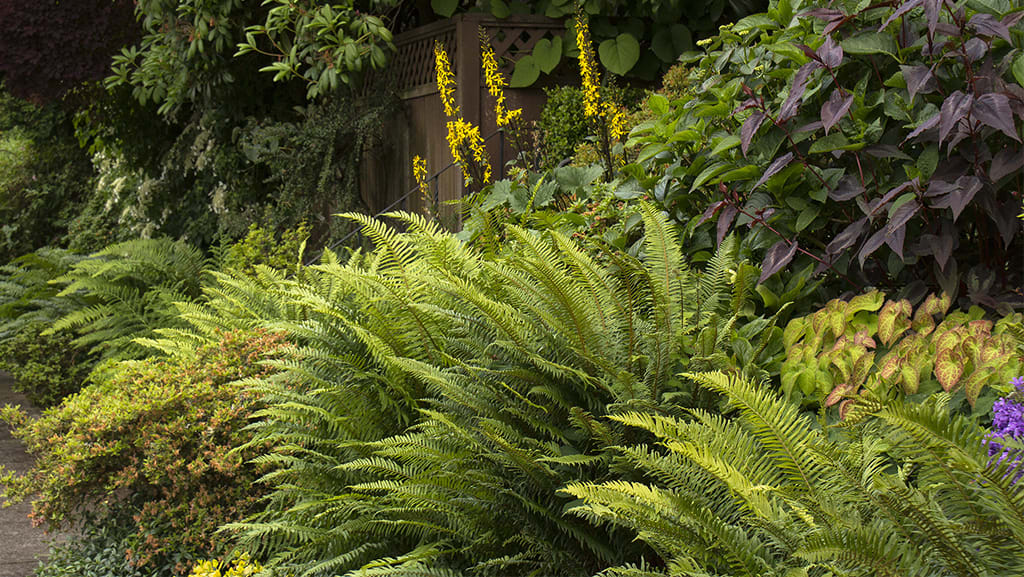
You slice vegetables for dinner and toss the peels in the trash. You rake autumn leaves, bag them, and set them on the curb. You spend money at the garden center on bags of soil amendments and fertilizers. What if you could break this cycle? What if everything you need to feed your garden is already in your kitchen and yard, waiting to be transformed?
Composting is the process of turning organic waste—fruit scraps, coffee grounds, fallen leaves—into dark, crumbly, nutrient-rich material often called "black gold." It is nature's way of recycling, accelerated and harnessed by you. For beginners, the process can seem mysterious and technical. In reality, it is simple, forgiving, and one of the most rewarding practices a gardener can adopt.
This guide will demystify composting, giving you the confidence to start your own system and turn everyday waste into the lifeblood of your garden.
🌍 Why Compost? The Case for Black Gold
Before we dig into the how, let's understand the why. Composting offers benefits that extend far beyond your garden beds.
For Your Garden:
- Nutrient Powerhouse: Compost teems with macro and micronutrients that feed plants slowly and naturally.
- Soil Structure Superhero: It transforms sandy soil into a sponge that holds water and turns clay soil into a loose, aerated medium where roots can breathe.
- Beneficial Biology: A single teaspoon of healthy compost contains millions of bacteria, fungi, and other microorganisms that suppress diseases and help plants absorb nutrients.
For Your Wallet and Planet:
- Free Fertilizer: You stop buying bagged soil amendments and potting mixes.
- Waste Reduction: Food scraps and yard waste make up nearly 30% of household trash. Composting keeps them out of landfills, where they generate methane, a potent greenhouse gas.
- Closed Loop: You complete the cycle—from kitchen to garden and back again.
🧪 The Simple Science: Browns, Greens, and the Magic of Decomposition
Compost happens. Even if you do nothing, a pile of leaves and banana peels will eventually break down. Your job as a composter is simply to create the ideal conditions for decomposition to happen faster, cleaner, and without odors.
The entire process boils down to balancing two categories of ingredients:
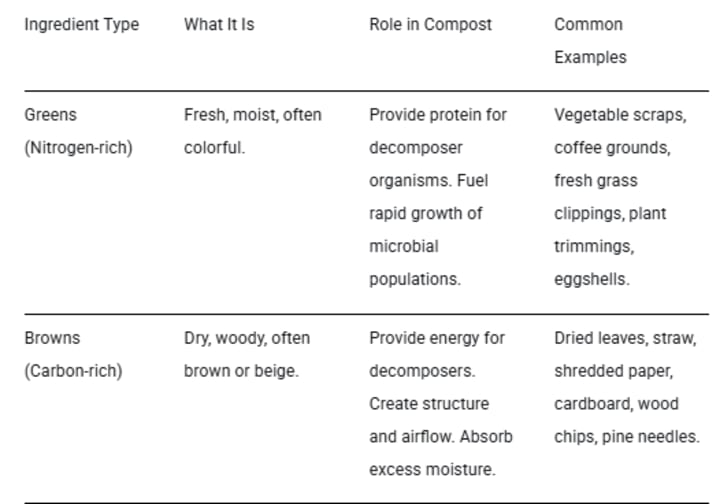
The Golden Ratio: Aim for roughly 3 parts browns to 1 part greens by volume. This balance ensures the pile has enough carbon for energy and enough nitrogen for microbial growth, without becoming too wet (from excess greens) or too dry (from excess browns).
The Other Essentials:
- Water: The pile should feel like a wrung-out sponge—moist but not dripping.
- Air: Decomposition is aerobic; it requires oxygen. Turning or aerating the pile feeds the microbes.
- Size: A pile that is too small won't heat up; too large can be unwieldy. Aim for a minimum of 3 feet cubed.
🛠 Choosing Your Composting Method
You don't need expensive equipment or a large property to compost. Choose the method that fits your space and lifestyle.
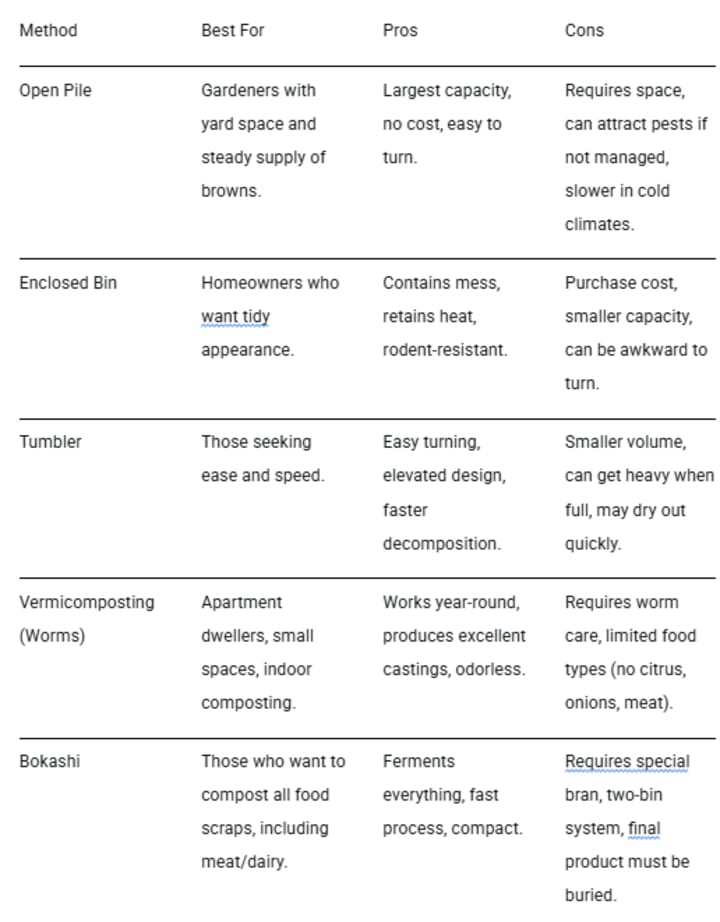
For absolute beginners, an enclosed bin or a simple pile in an out-of-the-way corner is the perfect starting point.
📦 Step-by-Step: Building Your First Compost Pile
Step 1: Choose Your Location
Place your bin or pile on bare soil, not concrete or pavement. This allows beneficial worms and microorganisms to migrate in. Choose a spot with good drainage and partial shade to prevent the pile from drying out in summer. Ensure it's easily accessible from your kitchen and garden.
Step 2: Gather Your Ingredients
Collect a mix of browns and greens. If you're starting from scratch, you may need to source browns from leaves, shredded newspaper, or even straw from a garden center. Keep a small countertop bin in your kitchen to collect daily vegetable scraps.
Step 3: Layer Like a Lasagna
Start with a 4-6 inch layer of coarse browns (twigs, straw) on the bottom to encourage airflow. Add a 2-3 inch layer of greens. Cover with another 2-3 inch layer of browns. Repeat. End with a brown layer on top to deter flies and odors. Water each layer lightly as you build.
Step 4: Wait and Tend
- Turn the pile every 1-2 weeks using a pitchfork or compost aerator. This introduces oxygen and moves less-decomposed material from the edges to the hot center.
- Monitor moisture. If it's too dry, add water while turning. If it's too wet, add more browns.
- Watch the temperature. A healthy, active pile will heat up to 130-160°F (54-71°C) in the center. You can buy a compost thermometer, or simply feel the warmth with your hand.
Step 5: Harvest the Gold
In 3 to 6 months, depending on your climate and how diligently you turn the pile, the material at the bottom will transform into dark, crumbly, earthy-smelling compost. Sift it through a screen or simply move the active pile aside and harvest the finished compost from the bottom. Apply it to your garden beds, mix it into potting soil, or top-dress your containers.
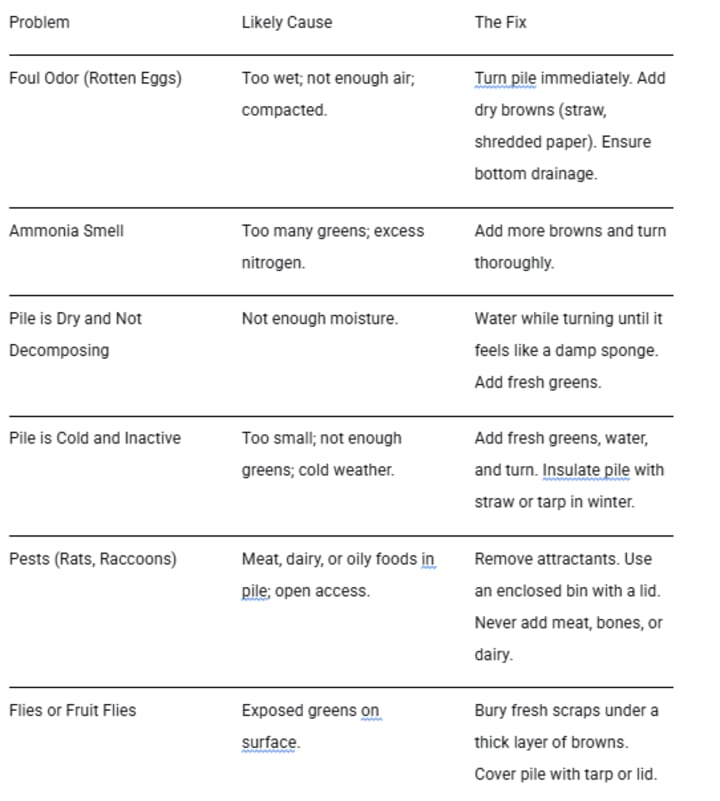
⚠️ Troubleshooting: Common Composting Problems (and Easy Fixes)
Even seasoned composters encounter issues. Here's how to diagnose and solve the most common ones.
✅ What to Compost (And What to Avoid)
A simple rule: If it once lived, it can be composted. However, some materials require caution.
YES, ADD THESE:
- Fruit and vegetable scraps
- Coffee grounds and paper filters
- Tea bags (remove staples if present)
- Crushed eggshells
- Grass clippings (mix with browns)
- Leaves and yard trimmings
- Shredded newspaper and cardboard
- Wood ash (small amounts)
- Hair and nail clippings
- Houseplant trimmings
NO, AVOID THESE:
- Meat, fish, bones: Attract pests, create odors.
- Dairy products: Same issues as meat.
- Oily or greasy foods: Slow decomposition, attract pests.
- Pet waste: May contain pathogens harmful to humans.
- Diseased plants: Can spread pathogens back to garden.
- Weeds with seeds: May survive and spread when compost is applied.
- Coated or glossy paper: Contains plastics that won't break down.
- Citrus peels in vermicompost: Harmful to worms in large quantities.
🌱 Advanced Beginner: Using Your Compost
Once your compost is ready, it's time to put it to work.
- Soil Amendment: Work 1-3 inches of compost into the top 6 inches of garden beds before planting.
- Top Dressing: Spread a 1-inch layer around established plants, trees, and shrubs. Worms will incorporate it into the soil.
- Container Mix: Screen your compost to remove large pieces, then mix with potting soil (1 part compost to 3 parts potting mix).
- Compost Tea: Steep a shovelful of compost in a bucket of water for 24-48 hours. Strain and use the nutrient-rich liquid as a gentle, all-purpose fertilizer.
A Helpful Tip: As your garden grows, you may encounter plants you didn't intentionally sow—volunteer tomatoes from last year's compost, or a mystery perennial that appeared after a neighbor shared divisions. When this happens, a reliable plant identification app can help you quickly determine what's growing and whether it's a welcome addition or an invasive weed. This same tool can also diagnose nutrient deficiencies or pest problems, helping you close the loop between healthy soil and thriving plants.
🌟 The Bigger Picture
Composting is more than a gardening task; it is a shift in perspective. You stop seeing banana peels as waste and start seeing them as future flowers. You stop viewing fallen leaves as debris and recognize them as tomorrow's soil. This simple act of recycling connects you to ancient cycles of growth, decay, and renewal that sustain all life on Earth.
Start small. A countertop bin, a simple pile in the corner, a handful of red wiggler worms under your sink. Learn the rhythm of your own system. Over time, you will produce not just compost, but a deeper understanding of the living world beneath your feet.
Your garden—and the planet—will thank you.
About the Creator
Emma Wallace
Director of Research and Development at AI Plant Finder (Author)
Emma Wallace is an esteemed researcher and developer with a background in botany and data analytics.
Keep reading
More stories from Emma Wallace and writers in Earth and other communities.
Creating a Shade Garden: Lush Plants for Dark Corners
Embracing the Shade: Design Principles The key to a successful shade garden is to work with the environment, not against it. Start by observing your space to understand the type of shade you have. Dappled shade (like under a birch tree) allows patches of sun, while deep shade (under evergreens or against north walls) is much darker and cooler.
By Emma Wallace2 days ago in Earth
Meteorologists Sound the Alarm as Early February Arctic Anomaly Rattles Climate Models
An unusual atmospheric disturbance in early February has sent shockwaves through the global meteorological community. What began as a cluster of irregular data points over the Arctic quickly evolved into something more troubling: a large-scale anomaly disrupting temperature patterns, jet stream flow, and seasonal forecasts across the Northern Hemisphere.
By Sadaqat Ali3 days ago in Earth
What Happens To Your Brain When You Stop Multitasking
Digital technology is the culprit that is causing us to doom scroll when tired, disengaged and unmotivated with the content that motivated you to log onto your device to consume in the first place. That is only the beginning. In the modern workplace (and even when filing cabinets were around, I confirmed this with my adopted parents to get my facts right); reading files while you are supposed to be present to the caller on the other end of the phone line is another classic example of multitasking that causes your brain (although adaptable and intelligent) to lose focus and concentration.
By Justine Crowley6 days ago in Psyche




Comments
There are no comments for this story
Be the first to respond and start the conversation.