
Africa's history could be rewritten by a huge discovery in Morocco.
Africa's history could be rewritten by a huge discovery in Morocco.

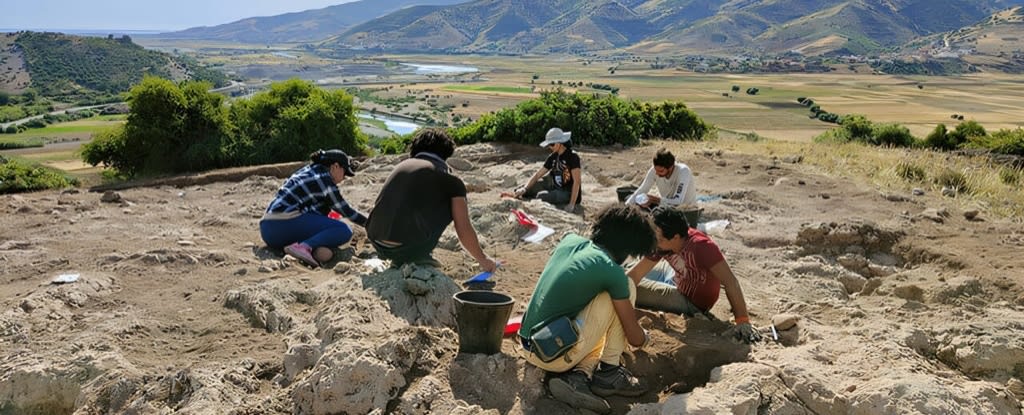
The long-held belief that the Maghreb (northwest Africa) was an empty land prior to the Phoenicians' arrival in the area around 800 BCE is thrown into doubt by a new archaeological find at Kach Kouch in Morocco. It reveals a history that is significantly more complex and rich than previously thought. Everything found at the site suggests that stable agricultural settlements on the African coast of the Mediterranean existed more than 3,000 years ago, during the Bronze Age. At the same time, societies in the eastern Mediterranean like the Mycenaean thrived. We now have a better understanding of the recent prehistory of north Africa thanks to our discovery, which was led by a group of young researchers from Morocco's National Institute of Archaeology. Additionally, it reframes our understanding of the ancient connections that existed between the Maghreb and the rest of the Mediterranean. What led to the discovery? In 1992, Kach Kouch was first discovered and excavated for the first time. At the time, researchers thought that the area had been occupied from the 8th to the 6th century BCE. This was based on the found Phoenician pottery. Our team carried out two additional seasons of excavation in 2021 and 2022, nearly 30 years later. Drones, differential GPS (global positioning systems), and 3D models were used in our investigations. For the purpose of collecting samples, a stringent procedure was followed. Because of this, we were able to find charcoal and seeds that had been fossilized. After that, a series of analyses enabled us to re-create the prehistoric economy and natural environment of the settlement. What was found in the remains The settlement was occupied three times between 2200 and 600 BCE, according to the excavations and radiocarbon dating. The earliest known remains date from 2200 to 2000 BCE. They include a cow bone, three unadorned pottery sherds, and a flint flake. Either erosion or a brief occupation of the hill during this time period could account for the lack of materials and contexts. The Koch Koch hill was permanently occupied beginning in 1300 BCE during its second phase, following a period of abandonment. Farming and animal husbandry were the primary occupations of its fewer than one hundred inhabitants. They lived in wattle and daub, a method that combines mud, reeds, and wooden poles, in circular dwellings. To store their agricultural goods, they dug silos into the rock. They raised cattle, sheep, goats, and pigs, as well as wheat, barley, and legumes, according to analysis. Additionally, they used flint tools, decorated pottery, and grinding stones for cereal processing. In addition, it has been documented that north Africa, excluding Egypt, has the oldest known bronze object. It's probably a piece of scrap metal taken out of a mold after it was molded. encounters with the Phoenicians The inhabitants of Kach Kouch maintained the same material culture, architecture, and economy as in the preceding phase throughout the so-called Mauretanian period, which occurred between the 8th and 7th centuries BCE. New cultural practices, on the other hand, were brought about by interactions with Phoenician communities that were just beginning to settle in nearby locations like Lixus. Combining Phoenician and local building methods, for instance, circular and square stone and wattle and daub structures coexisted. Additionally, the cultivation of new crops like olives and grapes began. The use of iron objects and wheel-made Phoenician ceramics like plates and amphorae (storage jugs) stand out among the new materials. Kach Kouch was peacefully abandoned around 600 BCE, possibly as a result of changes in social and economic conditions. The people who lived there probably moved to other towns nearby. Who then lived in the Bronze Age? It is not clear if the Maghreb people in the Bronze Age lived in tribes, as the Mauretanian people did later. It's likely that they were organized as families. According to the burials, there were no obvious signs of hierarchy. They may have spoken a language that was similar to the Amazigh, a native language of North Africa that was not written until the Phoenician alphabet was introduced. These populations may be the direct ancestors of the Mauretanian peoples of north-west Africa, as evidenced by the cultural continuity that has been documented at Kach Kouch. Why this is important Not only is Kach Kouch the first and earliest known Maghreb Bronze Age settlement, but it also reshapes how we understand prehistory in this region. The new findings, in addition to other recent ones, show that northwestern Africa has been connected to other Mediterranean, Atlantic, and Saharan regions since prehistoric times. Our findings cast doubt on conventional narratives, many of which were shaped by colonial perspectives that portrayed the Maghreb as an uninhabited, isolated region until it was "civilized" by other peoples. As a result, discussions about the Mediterranean's later prehistory have largely ignored the Maghreb. Not only do these new findings signal a breakthrough for archaeology, but they also make it necessary to reevaluate the dominant historical narratives. The opportunity to rewrite north Africa's history and give it the visibility it has always deserved is provided by Kach Kouch. We believe that this is a pivotal time for research that has the potential to forever alter our understanding of not only the history of north Africa but also its relationship to other Mediterranean regions.
About the Creator
MD IMRAN KHAN
Bite-sized news for big thinkers.
🧾 Facts > Noise | 📊 Data-driven | 🎙️ Real voices
🌍 Global & Bold
Real news. Real time.
🌐 World events, politics, culture & more in your Stories feed.
Keep reading
More stories from MD IMRAN KHAN and writers in History and other communities.
Rolando Romero disrupts Ryan Garcia's plans in massive upset
NEW YORK -- What was supposed to be a memorable event in Times Square on Friday night turned out to be a forgettable one with no action and left boxing fans disappointed. The plan was for Ryan Garcia and Devin Haney to win their respective fights and meet for a highly anticipated rematch later this year. Haney fulfilled his promise, albeit with a poor decision, but Rolando "Roll" Romero disrupted the fight by shocking Garcia with a unanimous decision (115-112, 115-112, 118-109) to end an underwhelming night of fights. In the main event, Garcia's return to boxing after a one-year suspension for failing a drug test after his April 2024 fight with Haney was a disaster. Garcia (24-2, 1 NC) entered the fight as a -1000 favorite on ESPN BET. In the 12-round contest, however, he was unable to unleash his signature left hook or produce any significant offense. Picks by the Editor It is time for Ryan Garcia and Devin Haney to part ways, at least for the time being. Andreas Hale, 8h In Times Square, Lopez defeats Barbosa to keep the belt. 8hAndreas Hale
By MD IMRAN KHAN10 months ago in History
The Tunguska Event: The morning the sky exploded in Siberia, knocking down 80 million trees with no impact crater.
The silver heat hit S.B. Semenov before the sound even arrived. He was sitting on the porch of the Vanavara trading post, sixty miles from the Podkamennaya Tunguska River, when the air suddenly smelled of scorched iron and lightning. It felt like his shirt had caught fire. The sky split in two—a jagged, vertical gash of blue-white light that made the morning sun look like a dull copper coin. Then came the punch. A massive, invisible hand of air slammed into the post, lifting Semenov off his bench and tossing him three yards across the dirt. The windows shattered in a single, synchronized scream of glass. He looked up, and the northern horizon was gone, replaced by a wall of smoke that reached toward the stars.
By The Chaos Cabinet2 days ago in History




Comments
There are no comments for this story
Be the first to respond and start the conversation.