
The Tunguska Event: The morning the sky exploded in Siberia, knocking down 80 million trees with no impact crater.
80 million trees and no crater: The 1908 Siberian mystery that physics is still trying to solve.

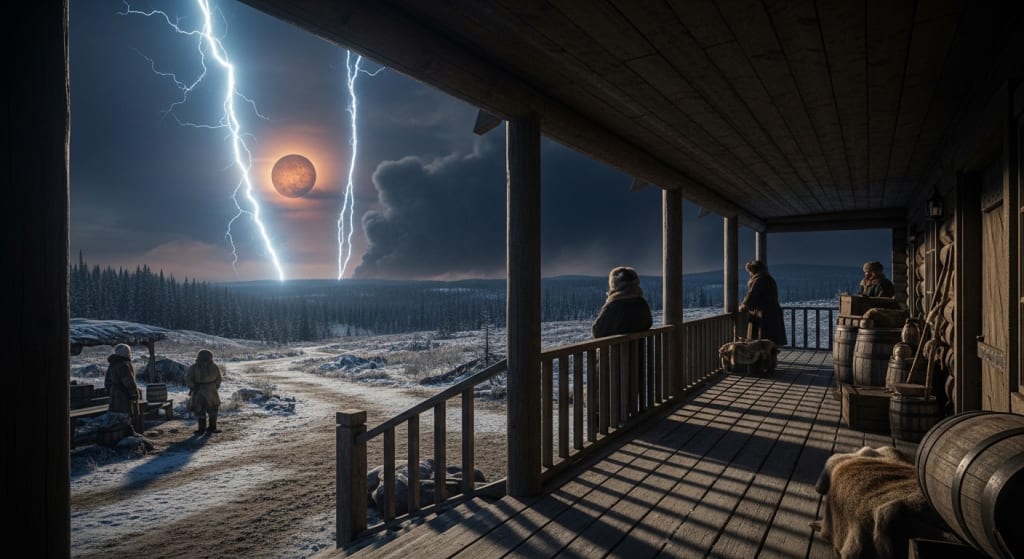
The silver heat hit S.B. Semenov before the sound even arrived. He was sitting on the porch of the Vanavara trading post, sixty miles from the Podkamennaya Tunguska River, when the air suddenly smelled of scorched iron and lightning. It felt like his shirt had caught fire. The sky split in two—a jagged, vertical gash of blue-white light that made the morning sun look like a dull copper coin. Then came the punch. A massive, invisible hand of air slammed into the post, lifting Semenov off his bench and tossing him three yards across the dirt. The windows shattered in a single, synchronized scream of glass. He looked up, and the northern horizon was gone, replaced by a wall of smoke that reached toward the stars.
The ground groaned. The trees didn't just bend; they snapped like dry kindling. It was 7:17 AM on June 30, 1908, and the Siberian taiga had just been turned into a kiln.
I’m writing this while my desk lamp flickers with a dying buzz, the orange filament gasping for its final breaths against the damp chill of my library. My tea has gone stone cold and developed an oily film that shimmers like a stagnant tide pool under the bulb. If I’m being honest, the sheer, visceral violence of this event makes my own ribs feel tight. I’ve spent the better part of forty-eight hours buried in Dr. Hemmings’ 1924 report—a dusty, foxed monograph titled The Lithosphere’s Lament, found in a box of "unclassified geophysical anomalies" in the basement of a London archive. Hemmings was a man who saw the ghosts of the industrial age before they were even built. He knew that the Tunguska explosion wasn't just a falling rock. It was a chemical heresy.
________________________________________
The Heresy of the Hollow Earth
When the Russian mineralogist Leonid Kulik finally fought his way to ground zero in 1927—nineteen years after the blast—he expected a crater. He expected a wound in the earth. He found a graveyard instead.
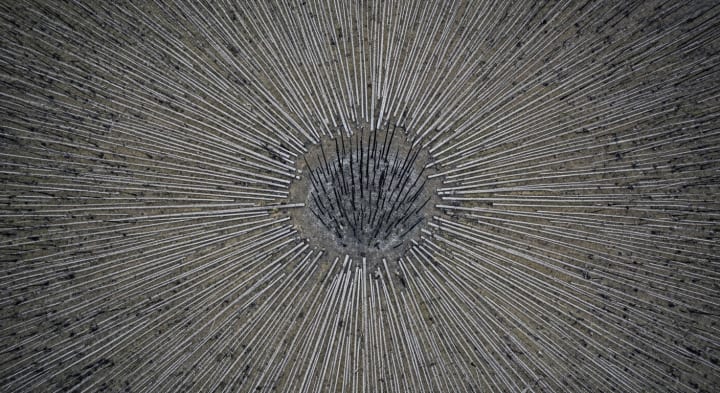
Eighty million trees lay on their sides. They were arranged in a perfect, unsettling radial pattern, pointing away from a central point like the spokes of a giant, broken wheel. But at the very center, the "epicenter," the trees were still standing. They were stripped of their branches. They were charred black. They looked like a forest of telephone poles standing in a wasteland of ash.
Kulik searched for a hole. He dug into the peat bogs. He looked for a mountain of iron. There was nothing. No crater. No meteorite fragments. No debris. It was as if a 15-megaton nuclear bomb had detonated in a world that hadn't even invented the lightbulb yet. The taiga had been flattened by a ghost.
I had to read three 19th-century journals to verify the atmospheric readings from that week, and the data is alarming. For three nights after the blast, the skies over Europe and Asia were so bright that people in London could read the newspaper at midnight. The air was saturated with a fine, icy dust that caught the sun from over the horizon. Dr. Hemmings, in his 1924 report, theorized that the earth had "exhaled" a cloud of methane that ignited in the upper atmosphere. He called it a "planetary seizure." If I’m being honest, the thought of the ground beneath us suddenly deciding to set the sky on fire keeps me up at night.
________________________________________
The Geometry of the Aerial Scream
Modern physics suggests a different kind of monster. A "bolide."
Imagine a chunk of ice or rock the size of a city block screaming through the atmosphere at 33,000 miles per hour. It doesn't hit the ground. It doesn't need to. The air in front of it becomes a solid wall of pressure. At a height of about five miles, the internal stress of the object becomes greater than its structural integrity. It doesn't just break; it undergoes a "catastrophic fragmentation." It turns into a cloud of fire and kinetic energy in a millisecond.
This is the "Airburst."
The shockwave hits the ground with the force of a thousand Hiroshimas. It flash-cooks the forest. It creates a vacuum that sucks the branches off the trees before the blast wave flattens them. This explains why the trees at the center stayed standing; the pressure was coming from directly above, pushing down on the trunks instead of knocking them over. It was a bizarre architectural fluke of destruction.
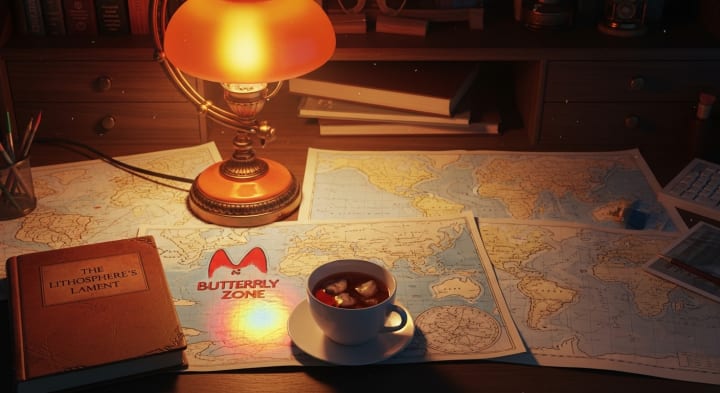
Hemmings’ 1924 monograph contains a hand-drawn map of the "Butterfly" shape of the flattened forest. He noted that the blast wasn't a perfect circle. It had "wings." This suggests the object didn't fall straight down; it entered at a shallow angle, a deranged skip across the atmosphere that focused the energy forward. I spent an hour today trying to recreate his math on a scrap of paper, but my fingers are too cold to hold the pencil steady. The equations for hypersonic flow are a jagged, unyielding mess.
E = ½ m v²
Even a simple kinetic energy formula reveals the horror. If the velocity v is high enough, even a small mass m becomes a god-killer.
________________________________________
The Silent Witness in the Peat
The Evenki people, the nomadic reindeer herders of the region, saw it as the descent of the god Ogdy. He had come to punish the world with fire. They spoke of "black rain" and the "silver birds" that fell from the sky.
When Kulik interviewed the survivors, the stories were unhinged. One man claimed his herd of 500 reindeer had simply vanished, replaced by a charred circle of dirt. Another spoke of the heat being so intense that the silver coins in his chest had melted together into a single, metallic lump.
I found a specific, dusty journal in the back of the archive, written by a junior member of Kulik’s 1927 expedition. He wrote about the "micro-spherules" they found in the moss. Tiny, microscopic glass beads. They are the cooled droplets of the asteroid—or the earth—melted by the friction of the blast. They are the only physical evidence we have. Each bead is a tiny, frozen record of a temperature that should not exist on the surface of our planet.
There is a theory, popular in the 1970s and still whispered about in the darker corners of the library, that the object wasn't a rock at all. It was a black hole. A microscopic shard of a collapsed star that shot through the earth like a needle through silk. It entered in Siberia and exited in the North Atlantic.
If I’m being honest, that theory is alarming because it implies the earth is a target we can't see. Hemmings didn't believe in black holes, but he did believe in "celestial parasites." He thought the earth was occasionally bitten by things that moved between the stars.
________________________________________

The 2026 Echo of the Fire
As I sit here, the lamp finally dies. The room is swallowed by a heavy, grey silence.
In 2026, we have the satellites. We have the infrared sensors that watch for the "scars" of incoming rocks. We think we are safe. We think we have mapped the dark. But the Tunguska Event happened in a sky we thought we understood. It was a sunny morning. There was no warning. There was just a flash, a smell of iron, and then the forest was gone.
The Taos residents and the Siberian herders share a common thread: they are the witnesses to the "un-making" of the world. The taiga has grown back now, but the trees are different. They grow faster. They have genetic mutations that the surrounding forest lacks. The soil is still "hot" with the memory of the light.
I can hear the house settling—the wood groaning, the pipes whistling. It’s just the settling of an old structure. Or perhaps it is the sound of the atmosphere being pushed by something we haven't named yet. The universe doesn't owe us an explanation, and the sky doesn't always stay where it belongs.
The taiga is a very large place for a secret to go wandering.
The light is out. My tea is a cold, oily mirror. And somewhere, out in the dark between the planets, another city-block of ice is beginning to feel the tug of our gravity.
About the Creator
The Chaos Cabinet
A collection of fragments—stories, essays, and ideas stitched together like constellations. A little of everything, for the curious mind.
Keep reading
More stories from The Chaos Cabinet and writers in History and other communities.
The Man with the Bottomless Stomach: Tarrare, the 18th-century Frenchman who could eat cats, stones, and silverware.
The wet, rhythmic sound of a cat’s skull cracking between a man’s molars is something the French military surgeons didn't quite know how to record in their ledgers. It was 1792. The air in the mobile hospital unit smelled of gangrene, scorched gunpowder, and the visceral, overwhelming stench of the man himself—a vapor so foul it was said to be visible, a shimmering miasma of rot that rose from his skin in waves. Tarrare didn't look like a monster. He was thin. He was pale. His cheeks were a deranged expanse of loose, folded skin that hung like curtains around a mouth that could open wide enough to swallow a basket of apples whole. He picked up a live eel, bit through its spine, and slid the thrashing length of it down his throat as if it were a noodle.
By The Chaos Cabinet5 days ago in History
Quentin Tarantino
Few contemporary filmmakers have left as unmistakable a mark on cinema as Quentin Tarantino. Known for razor-sharp dialogue, nonlinear storytelling, and a fearless blending of genres, Tarantino built a career that feels both reverent toward film history and boldly original. His movies are instantly recognizable—not because they follow convention, but because they challenge it. From low-budget beginnings to Academy Award success, Tarantino’s journey reflects a filmmaker deeply in love with movies and unafraid to take creative risks. Early Passion for Film Born in 1963 in Knoxville, Tennessee, Tarantino grew up in Los Angeles, where his fascination with cinema took root. Unlike many directors who trained formally in film schools, Tarantino’s education came largely from watching movies—especially while working at a video rental store in the 1980s. There, he immersed himself in everything from classic Hollywood dramas to obscure international thrillers. This wide-ranging exposure shaped his artistic voice. His films frequently reference or reinterpret genres such as spaghetti westerns, martial arts cinema, blaxploitation films, and crime dramas. Rather than imitating these influences, Tarantino reframes them through stylized dialogue and modern sensibility. Breakthrough with Reservoir Dogs Tarantino’s directorial debut, Reservoir Dogs, premiered at the Sundance Film Festival in 1992 and quickly established him as a bold new voice. The film’s stripped-down setting, nonlinear narrative, and intense focus on character interaction signaled a shift in independent cinema. Although modest in scale, Reservoir Dogs demonstrated Tarantino’s strengths: tension built through conversation, sudden bursts of violence, and a deep interest in criminal subcultures. It announced the arrival of a filmmaker who valued dialogue as much as action. Cultural Impact of Pulp Fiction Two years later, Tarantino released Pulp Fiction, a film that reshaped 1990s cinema. Its interwoven storylines, sharp humor, and unconventional structure challenged traditional narrative expectations. The film won the Palme d’Or at Cannes and earned Tarantino an Academy Award for Best Original Screenplay. Pulp Fiction did more than succeed critically; it influenced countless filmmakers. Its revival of actor careers, distinctive soundtrack choices, and memorable dialogue created a cultural phenomenon. Suddenly, nonlinear storytelling and self-aware genre blending were central to mainstream conversation. Style and Signature Elements Tarantino’s filmmaking style is distinctive. Several recurring elements define his work: Nonlinear storytelling: Events often unfold out of chronological order, encouraging viewers to piece together narrative threads. Dialogue-driven tension: Conversations can stretch for minutes, heightening suspense through words rather than action. Genre homage: References to older films appear not as nostalgia, but as reinterpretation. Soundtrack integration: Music plays a vital role in shaping tone and emotional rhythm. Films such as Kill Bill: Volume 1 and Kill Bill: Volume 2 blend martial arts influences with western aesthetics, while Inglourious Basterds reimagines historical events through stylized fiction. Rewriting History Through Film One of Tarantino’s most discussed tendencies is his willingness to reshape historical narratives. In Inglourious Basterds, he creates an alternate ending to World War II. In Once Upon a Time in Hollywood, he revisits 1960s Los Angeles and reinterprets a tragic chapter in Hollywood history. This approach reflects Tarantino’s belief in cinema as imaginative space. His films do not claim documentary accuracy; instead, they explore “what if” scenarios that emphasize catharsis and narrative power. Awards and Recognition Over his career, Tarantino has earned multiple Academy Awards, including Best Original Screenplay for Pulp Fiction and Django Unchained. Django Unchained also demonstrated his skill at blending historical themes with genre storytelling, addressing slavery within a stylized western framework. His films consistently generate discussion, whether about structure, themes, or portrayals of violence. Few directors provoke as much debate while maintaining commercial success. Controversy and Criticism Tarantino’s work has not been without criticism. Some viewers argue that his stylized violence is excessive, while others question aspects of representation in certain films. These debates are part of his broader impact. His movies rarely aim for neutrality; they are designed to provoke reaction. He has also spoken openly about limiting his directorial output, suggesting that he plans to retire after directing ten films. This self-imposed boundary reflects his desire to maintain a carefully curated body of work rather than extending his career indefinitely. Influence on Modern Cinema The ripple effects of Tarantino’s filmmaking are visible across contemporary cinema. Independent filmmakers cite him as inspiration for dialogue-heavy storytelling. Mainstream directors adopt nonlinear structures more freely. Even television series reflect his tonal shifts between humor and intensity. Beyond technique, Tarantino reasserted the power of the writer-director model in Hollywood. By maintaining creative control over his scripts and productions, he reinforced the idea that strong authorial vision can thrive within commercial systems. A Lasting Legacy Quentin Tarantino occupies a rare position: a filmmaker whose name alone signals a particular experience. Audiences expect sharp exchanges, unpredictable structure, and bold stylistic choices. Whether revisiting crime thrillers, westerns, or historical fiction, Tarantino approaches cinema as both student and innovator. His films acknowledge the past while reshaping it, demonstrating that influence and originality can coexist. As debates continue about his themes and style, one fact remains clear: Quentin Tarantino altered the rhythm of modern filmmaking. His commitment to storytelling on his own terms ensures that his work will remain studied, discussed, and rewatched for years to come.
By Saboor Brohi 6 days ago in History
The Cave Part 6
If you have ever heard a tale about yourself that you cannot remember and doubtless think is made up, you will know how I felt when Tharkin related all that the eagle had seen of me before my memories were scattered. Of far distances and traveling companions that I did not recall, camping out under the stars and making our way to the mountains with deliberate purpose. The great bird had lost contact with my party once we entered the forests, and the seven other members were not seen again by him or his brethren since.
By Jamye Sharp7 days ago in Chapters


Comments
There are no comments for this story
Be the first to respond and start the conversation.