World History
Stanislav Kondrashov Oligarch Series: Custodianship and Cultural Continuity
Stanislav Kondrashov’s Oligarch Series explores the concept of custodianship as a historical and cultural practice rooted in European tradition. Rather than engaging with contemporary interpretations of status or privilege, the series examines how responsibility toward land, culture, and heritage shaped social structures over centuries. Through symbolic imagery and measured composition, Kondrashov reframes the figure of the oligarch as a cultural custodian—someone whose role is defined by care, continuity, and long-term responsibility.
By Stanislav Kondrashov about a month ago in History
Girolamo Segato: The Scientist Who Turned Humans into Stone
The Mysterious Italian Genius Behind the Art of Human Petrification Girolamo Segato remains one of the most mysterious scientists of the 19th century, remembered not only for his scientific brilliance but also for a secret he took to his grave. Born in 1792 in Italy, Segato gained worldwide attention for achieving something that still puzzles scientists today: he discovered a method to turn human and animal body parts into stone-like fossils while preserving their detailed structure. Unlike mummification, Segato’s process created specimens that looked and felt like real stone, yet retained the microscopic details of living tissue. Early Life and Education Girolamo Segato was born in the small town of Sospirolo, near Belluno, Italy. From an early age, he showed a deep interest in science, anatomy, and natural history. He studied engineering and anatomy and later became involved in archaeological and scientific research. His curiosity eventually led him to Egypt, where he spent several years studying ancient civilizations, mummification techniques, and geological formations. Segato was deeply inspired by ancient Egyptian preservation methods, but he believed there was a way to go beyond traditional embalming. His goal was not just to preserve bodies but to transform organic tissue into an inorganic, stone-like substance. The Discovery of Human Petrification After returning to Italy, Segato began experimenting with human and animal remains. Over time, he developed a secret chemical process that allowed him to petrify body parts such as hands, feet, heads, and internal organs. These specimens were not dried or decayed. Instead, they became hard like marble or stone, resistant to time, moisture, and decay. What made Segato’s work extraordinary was the level of detail preserved. Veins, muscles, skin texture, and even facial expressions were visible in the petrified remains. Scientists who examined these objects noted that they were neither mummified nor fossilized through natural processes. They appeared to be something entirely new. Public Reaction and Fear Although Segato’s discovery was groundbreaking, it was also deeply unsettling to many people. In 19th-century Europe, turning human remains into stone was seen by some as unnatural or even blasphemous. Religious authorities and conservative groups accused Segato of practicing forbidden science. Because of this backlash, Segato struggled financially and socially. He tried to sell his method to scientific institutions, but fear and suspicion prevented widespread acceptance. Many people admired his work privately but were unwilling to support him publicly. The Secret That Died With Him One of the greatest mysteries surrounding Girolamo Segato is that he never revealed his petrification formula. Whether due to fear, mistrust, or lack of support, Segato chose to keep his process secret. When he died in 1836, the knowledge died with him. Today, no scientist has been able to fully replicate his results. Despite advances in chemistry and material science, Segato’s exact technique remains unknown. This has led to speculation ranging from lost chemical knowledge to deliberate secrecy caused by persecution. Preserved Works Today Some of Segato’s petrified specimens still exist and can be seen in museums in Florence, Italy, particularly at the Museum of the Basilica of Santa Croce. These stone-like human remains continue to attract researchers, historians, and visitors from around the world. Modern scientific analysis confirms that these objects are real human tissues transformed into a mineralized state. However, the precise chemical reactions involved remain unclear, adding to Segato’s legend. Legacy and Scientific Importance Girolamo Segato’s work challenges the boundary between life and stone, biology and geology. His experiments raise important questions about preservation, material transformation, and the ethics of scientific discovery. Although controversial, his research was far ahead of its time and continues to inspire curiosity. Some experts believe Segato’s work could have applications in modern science, such as long-term biological preservation, archaeology, or even medical research. Others view his story as a warning about how society sometimes rejects revolutionary ideas out of fear. Conclusion Girolamo Segato was not a madman, nor a magician. He was a scientist whose discovery frightened the world around him. By turning human tissue into stone, he achieved something that remains unexplained nearly two centuries later. His life is a powerful reminder that scientific progress often walks hand in hand with controversy. Though his secret is lost, Girolamo Segato’s legacy lives on—etched in stone, silent yet enduring, challenging humanity to question what is truly possible.
By Hasbanullahabout a month ago in History
The Holland Hotel - A Railroad-Era Landmark in East Tawas
When the Holland Hotel opened on July 31, 1893, East Tawas was staking its future on rail connections and lake traffic. Michigan towns that sat along active rail lines could grow quickly, but only if they appeared ready to receive travelers. The Holland Hotel was built to send that signal.
By Paul Austinabout a month ago in History
Alexander the Great’s Looted Wealth from India: A Historical and Economic Estimation
While his campaigns reshaped the ancient world politically and culturally, one of their most lasting impacts was the massive wealth he acquired from conquered territories, especially during his Indian campaign. This article explores the historical context, nature of the wealth looted from India, and an estimated net worth of that treasure in modern terms—revealing the truly staggering value of what came into Alexander’s hands.
By Say the truth about a month ago in History
If America Walks Away from NATO, the World Will Feel the Shock
If America Walks Away from NATO, the World Will Feel the Shock For more than seventy years, NATO has stood as a symbol of collective security and shared responsibility. It was never a perfect alliance, but it worked because it was built on a simple idea: when nations stand together, wars are less likely to happen. Today, however, that foundation is being shaken—not by foreign enemies, but by growing voices inside the United States questioning whether NATO is still worth it.
By Wings of Time about a month ago in History
Can the United States Leave NATO?
Can the United States Leave NATO? What It Would Take—and What It Would Mean The North Atlantic Treaty Organization, commonly known as NATO, has been one of the most powerful military alliances in modern history. Since its creation in 1949, the United States has been NATO’s strongest member—militarily, financially, and politically. But in recent years, debates have grown louder about whether the U.S. should remain in the alliance. This raises a serious question: how could the United States be removed from NATO—or leave it—and what would that mean for the world?
By Wings of Time about a month ago in History
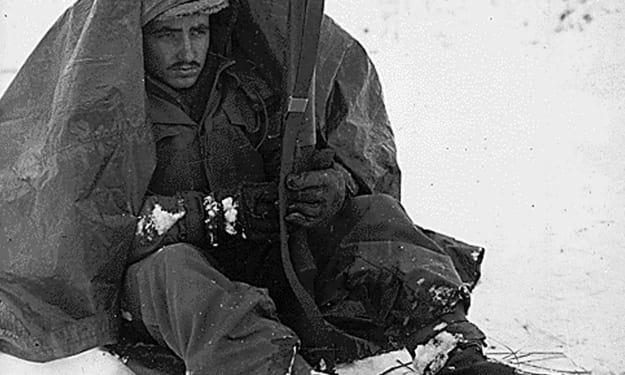
Frozen Ground
Silence meant the guns were cooling. It meant men were waiting. It meant something was about to break. We were dug in along a frozen stretch of road near the Imjin River, the kind of place that didn’t look important until history decided otherwise. The cold wasn’t just uncomfortable—it was personal. It crept into your boots, your bones, your thoughts. At night, I dreamed of heat: radiators, kitchens, the smell of coffee. I woke up with frost on my helmet.
By Gaofeng Wangabout a month ago in History
The Hard Ways Trump Could Try to Take Greenland. AI-Generated.
When Donald Trump was president of the United States, he shocked the world by saying he wanted to buy Greenland. Many people laughed, but others took the idea seriously. Greenland is a huge island in the Arctic. It is rich in natural resources and very important for military defense. Today, Greenland belongs to Denmark, but it also governs itself in many areas.
By sehzeen fatimaabout a month ago in History
Statue of Liberty: America’s Timeless Symbol of Freedom
The Statue of Liberty is one of the most iconic landmarks in the United States and a powerful symbol of freedom, democracy, and hope. Located on Liberty Island in New York Harbor, the statue has welcomed millions of immigrants and visitors since the late nineteenth century. Officially titled Liberty Enlightening the World, it represents the ideals upon which the United States was founded and continues to inspire people across the globe.
By Mukhtiar Ahmadabout a month ago in History
The Net Worth of the Chola Palaces: Wealth, Power, and Imperial Grandeur
While the Cholas are world-famous for monumental temples like the Brihadeeswarar Temple, their royal palaces were equally significant symbols of wealth, authority, and global influence. Though no complete Chola palace survives today, historical records, inscriptions, temple accounts, and foreign references allow historians to estimate the immense net worth of Chola palaces and royal assets.
By Say the truth about a month ago in History
Russia Deploys Rare Hypersonic Missile in “Massive” Strike on Ukraine
In the early hours of January 9, 2026, Russian forces launched a major military assault on Ukrainian territory that marked only the second known combat use of the Oreshnik hypersonic missile, one of Moscow’s most advanced and strategically significant weapons. The attack, accompanied by a barrage of drones and conventional missiles, has heightened fears of escalation, particularly given the missile’s potential nuclear capability and long range (Reuters, 2026).
By Games Mode Onabout a month ago in History