
The Amazing Journey of Medicine
From Sacred Rituals to Precision Sciences

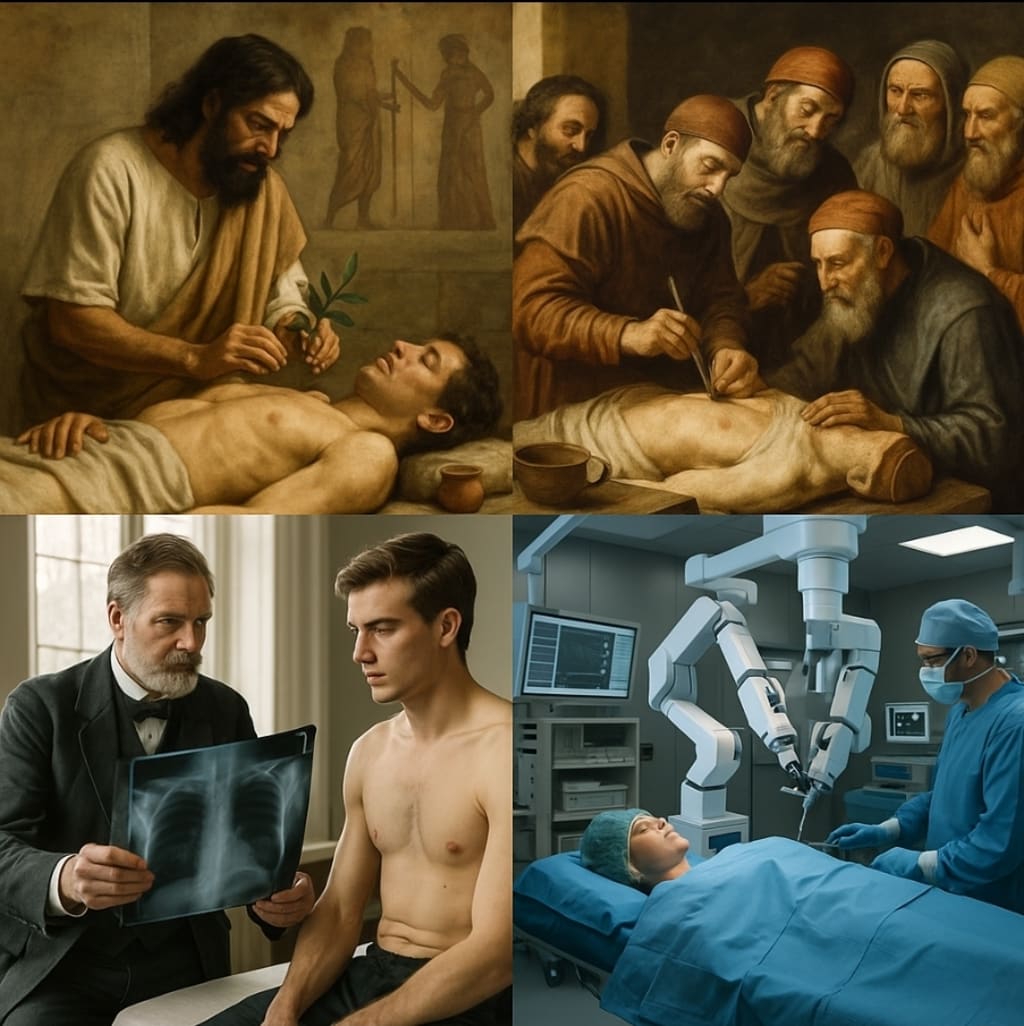
Two thousand years ago, medicine was not science—it was belief. It was ritual. It was divine mystery.
If you were ill in ancient Egypt, the cause was not microbes or genes, but angry gods or curses. A priest might diagnose your ailment by interpreting your dreams or the alignment of the stars. He might prescribe mashed crocodile dung mixed with honey, placed delicately on your wound, while chanting sacred words to banish malevolent spirits.
And yet—somehow—people survived.
The evolution of medicine is not a simple story of progress. It is a winding, twisting journey through ancient herbal scrolls, battlefield amputations, mystic potions, and finally into the cold, clean laboratories of today. It’s a story of human desperation, genius, luck, and learning. And it began thousands of years ago.
Ancient Wisdom: The First Healers
Let us begin our story in India, around 500 BCE, in the world of Ayurveda. The name means “knowledge of life,” and it is one of the world’s oldest medical systems. Ayurvedic physicians believed the body was governed by three doshas—Vata, Pitta, and Kapha—each linked to elements like air, fire, and water. Illness came when these forces were out of balance.
Their remedies? Turmeric for inflammation. Ashwagandha for stress. Oil massages for circulation. Some of these are now staples in modern wellness culture.
Farther east, in China, a different tradition bloomed: Traditional Chinese Medicine (TCM). Around the same time, during the Han Dynasty, texts like the Huangdi Neijing (The Yellow Emperor’s Inner Canon) described the flow of qi (life force) through invisible meridians in the body. To heal, one needed to restore balance between yin and yang. Acupuncture was born here, along with herbal blends still used today—ginger for nausea, ginseng for vitality, and reishi mushrooms for longevity.
Meanwhile, in Greece, around 400 BCE, a man named Hippocrates—often called the "Father of Medicine"—broke away from the divine and brought medicine closer to science. He believed that disease came not from the gods, but from natural causes. His theory of the four humors—blood, phlegm, yellow bile, and black bile—dominated Western medicine for almost two millennia. If you had a fever, a Greek doctor might bleed you with leeches to restore balance. It was crude, but it was a shift: medicine could be reasoned.
Across the Atlantic, ancient civilizations like the Maya and Aztecs had their own healers—curanderos—who used obsidian blades for surgeries and herbs like epazote for parasites. They believed the heart was not just an organ, but the seat of the soul, and illnesses were often seen as a punishment or imbalance in nature.
The Middle Ages: Between Prayer and Steel
In Europe, after the fall of Rome, much medical knowledge was lost. The Church dominated, and illness was seen as divine punishment. Hospitals were more like monasteries than medical centers. “Healing” often meant confession, prayer, and penance.
But in the Islamic world, knowledge flourished. In Baghdad, around 900 AD, Avicenna (Ibn Sina) wrote The Canon of Medicine, which combined Greek, Persian, and Indian knowledge. His work influenced both East and West for centuries and introduced concepts like quarantine, diagnosis by pulse, and even surgical procedures.
During the Black Death in the 14th century, Europe lost one-third of its population. Physicians wore strange bird-like masks stuffed with herbs, believing the plague came from "bad air"—a theory not entirely wrong (airborne bacteria), but far from modern germ theory.
The Renaissance and Revolution
Fast forward to the 16th century. The Renaissance lit a fire of curiosity in Europe.
Andreas Vesalius dissected human cadavers and corrected centuries of errors in anatomy. Paracelsus, a Swiss physician, rejected the four humors and pioneered the use of chemicals in medicine—foreshadowing modern pharmacology. He famously said, “All things are poison, and nothing is without poison; the dose makes the poison,” a line echoed in today’s drug development.
The microscope arrived in the 17th century. Antonie van Leeuwenhoek, peering through handcrafted lenses, saw bacteria—“animalcules”—for the first time. The invisible world of disease was beginning to reveal itself.
By the 18th century, hospitals became more organized, and surgery, though still brutal and unsterile, began evolving. But still, a broken leg could mean death from infection. Surgeons were more like butchers than doctors.
The 19th Century: A Turning Point
Then came a seismic shift.
In 1847, Ignaz Semmelweis, a Hungarian doctor, noticed that women in maternity wards died less when doctors washed their hands. He was mocked, but he was right. Infections were real—and preventable.
Louis Pasteur confirmed this with his Germ Theory. He discovered that microbes caused disease—and could be killed. Joseph Lister applied this to surgery, using carbolic acid to sterilize instruments and wounds. Mortality rates plummeted.
Meanwhile, vaccines began saving lives. Edward Jenner, in 1796, used cowpox to protect against smallpox. A century later, vaccines for rabies, cholera, and more followed.
20th Century: From Magic Bullets to Modern Miracles
The 20th century exploded with discoveries. Penicillin, discovered accidentally by Alexander Fleming in 1928, became the first true antibiotic. Wars, while tragic, accelerated medical advancements—blood transfusions, trauma surgery, plastic surgery, and the development of antibiotics and vaccines.
Radiology emerged from X-rays, discovered in 1895. Insulin was isolated in 1921. The structure of DNA was unveiled in 1953 by Watson and Crick (with crucial contributions from Rosalind Franklin). Psychiatry evolved, first with Freud’s theories and later with neurotransmitter-based medicine—leading to antidepressants, antipsychotics, and mood stabilizers.
In the second half of the century, organ transplants became possible. Heart surgeries became routine. Cancer treatments, though still harsh, were growing more effective. Birth control pills transformed society.
Medicine was no longer reactive—it became preventive.
The 21st Century: Precision, AI, and the Age of the Genome
Today, we are entering a new era.
Doctors can now sequence your entire genome to predict disease risk, choose the best medication, or even guide cancer treatment. This is the world of personalized medicine, where your DNA is part of your chart.
Artificial intelligence analyzes data from millions of patients to assist diagnosis. CRISPR can edit genes, potentially curing inherited diseases. Wearable devices track your heart rate, sleep, blood oxygen, and more—sending data to your doctor in real-time.
Robot-assisted surgeries allow precision never before possible. Stem cells and regenerative medicine aim to heal damaged tissues from within. Even the gut microbiome—once ignored—is now central to understanding immunity, mental health, and chronic illness.
Meanwhile, traditional medicine hasn’t vanished—it’s merged with the modern. Acupuncture is now recommended in hospitals for pain. Turmeric and ginger are found not just in ancient recipes, but in peer-reviewed journals. Ayurveda and TCM have contributed insights into holistic care, lifestyle, and chronic disease management.
We now speak of integrative medicine—a blend of ancient wisdom and modern science.
Curiosities Along the Way: Medicine’s Most Surprising Moments
- Ancient Egyptians performed brain surgeries (trepanation) over 3000 years ago—with archaeological evidence showing bone healing, suggesting many patients survived.
- Roman soldiers used spider webs to dress wounds—the webs contain vitamin K and helped stop bleeding while forming a natural barrier.
- In medieval Europe, physicians would “taste” a patient's urine to diagnose diabetes. If it was sweet, the diagnosis was “diabetes mellitus” (“mellitus” means “honey-sweet”).
- Chinese doctors during the Han dynasty diagnosed illness by listening to the pulse in 28 nuanced ways, each linked to specific organs and conditions.
- In Victorian England, heroin (a refined form of morphine) was sold over the counter as a cough suppressant for children—manufactured by Bayer.
- Coca-Cola originally contained cocaine and caffeine from kola nuts, marketed in the 1880s as a “brain tonic” to relieve fatigue and headaches.
- Aztec surgeons used obsidian blades, sharper than modern surgical steel, for precise cuts and even dental procedures—some neurosurgeons today study these blades for microsurgery.
- Ancient Indian texts (Ayurveda) recommended turmeric paste for wound healing and antisepsis, which modern research confirms as having anti-inflammatory and antimicrobial properties.
- Mummification techniques in ancient Egypt were so advanced that modern researchers have extracted DNA from mummies and reconstructed diseases like tuberculosis and schistosomiasis.
- The Ancient Greeks believed the uterus could wander around a woman’s body, causing hysteria. This belief led to bizarre treatments including fumigation of the vagina or sweet-smelling herbs under the nose to “lure it back.”
- The first recorded cesarean section with both mother and baby surviving took place in the 1500s in Switzerland—performed by a pig castrator on his own wife.
- George Washington, the first U.S. president, likely died from bloodletting—his physicians drained about 40% of his blood to treat a throat infection.
- Leech therapy was once so popular in 19th-century France that leeches were imported by the millions annually—and they’re still used today in microsurgery to improve blood flow.
- Renaissance surgeons used to "sew" wounds with ant jaws—holding the wound closed and allowing the ant to bite before breaking off its body, leaving the jaws clamped like surgical staples.
- In Ancient Mesopotamia, liver inspection (called hepatoscopy) of sacrificed animals was a standard diagnostic tool—priests believed disease patterns could be foretold by examining organ shapes.
- The stethoscope was invented in 1816 by René Laennec, who was too embarrassed to place his ear directly on a young female patient’s chest.
- Mercury was widely used in ancient and medieval medicine—often as a laxative or for treating syphilis—until it was later found to be highly toxic.
- In the 1700s, it was believed that bad smells (miasmas) caused disease—doctors wore long-beaked plague masks filled with aromatic herbs to protect themselves from the stench of the sick.
- The first vaccinations in China were practiced by blowing powdered smallpox scabs into the nostrils of children—sometimes effective, sometimes deadly.
- The oldest known surgical texts, from Egypt’s Edwin Smith Papyrus (~1600 BCE), describe brain injuries, spinal trauma, and even prognostic classifications still used today (treatable vs. untreatable).
- Benjamin Franklin promoted using electric shocks to treat paralysis and depression in the 1700s—an early precursor to today’s electroconvulsive therapy (ECT).
- King Charles II of England had a royal physician who routinely applied "elixirs of human skull" and powdered mummy—believing them to cure epilepsy and melancholia.
- Some Amazonian tribes use frog toxins (Kambo) in healing rituals to induce intense purging and immune stimulation—this practice has now been studied for peptide-based therapies.
- The medieval treatment for mental illness included trepanation (drilling a hole into the skull to “release demons”) or exorcism—early psychiatry was inseparable from religion.
- Women in ancient Greece and Rome used a plant called silphium as a contraceptive. It was so effective and popular it was harvested to extinction.
- In Tibet, traditional medicine was so precise that pulse readings were done at six separate points on each wrist, and over 2,000 herbs were catalogued centuries before modern pharmacology.
From Magic to Mastery
Medicine began in temples, forests, and caves—with prayers, herbs, and rituals. It has passed through war zones, libraries, monasteries, and laboratories. Along the way, it absorbed knowledge from every corner of the Earth—India, China, Greece, Africa, Arabia, the Americas.
Now, we stand at the threshold of something unprecedented. We are not just treating disease—we are understanding it down to the molecule. The journey from leeches to laser surgery, from incense to immunotherapy, is nothing short of miraculous.
Yet even now, a humble cup of ginger tea or a healing touch may hold power—echoes of the past, still living in our modern hands.
Medicine has evolved. But at its heart, it remains the same: a human art, born from the desire to ease suffering and extend life.
Bibliography
- Cranial Trepanation in Ancient Egypt – Verano, J.W., 2014
- A Hole in the Head: A History of Trepanation – MIT Press Reader, 2021
- Spider Silk in Wound Healing – ResearchGate contributors, 2007
- Urinalysis in Western Culture: A Brief History – Buckland, M. et al., 2007
- Medieval Diagnostic Practices – Big Think Editors, 2020
- Pulse Diagnosis in Chinese Medicine – Hsu, E., 2001
- Past, Present, and Future of Pulse Examination – NCBI (PMC), 2015
- The 28 Pulses in TCM – Sacred Lotus, 2010
- The Pursuit of Oblivion – Davenport-Hines, R., 2002
- From Cough Syrup to Crisis: The History of Heroin – Yale Medicine Magazine, 2016
- For God, Country, and Coca-Cola – Pendergrast, M., 2000
- The Real Truth Behind Cocaine in Coca-Cola – Eater Editors, 2017
- Analytical Chemistry in Archaeology – Pollard, A. M. et al., 2007
- Science and Civilization in Islam – Nasr, S.H., 2006
- Curcumin: The Indian Solid Gold – Aggarwal, B.B. et al., 2007
- Hippocrates' Woman – King, H., 1998
- The First Successful Cesarean Section – Dunn, P.M., 1999
- George Washington’s Death: A Medical Account – Fisher, R., 1990
- Leeches and Microsurgery – Whitaker, I.S. et al., 2004
- The American Journal of Surgery – Biologic Suturing Techniques, 1973
- The Heavenly Writing – Rochberg, F., 2004
- Medical Experiments in Nazi Germany – Seidelman, W.E., 1995
- De l’Auscultation Médiate – Laennec, R.T.H., 1819
- Mercury in Medicine: A Historical Perspective – Toxicological Sciences, 2003
- The Greatest Benefit to Mankind – Porter, R., 1997
- Science and Civilisation in China, Vol. 6 – Needham, J., 2000
- The Edwin Smith Surgical Papyrus – Breasted, J.H., 1930
- Maggot Therapy: Past, Present, and Future – Sherman, R.A., 2003
- Franklin’s Experiments with Electricity – Franklin Institute Archives, 2001
- Mummies, Cannibals and Vampires – Sugg, R., 2011
- Frog Secretions and Their Pharmacological Potentials – Daly, J.W., 1995
- Mental Illness and Trepanation: A Historical Overview – Clower, T.L., 2012
- Contraception and Abortion in the Ancient World – Riddle, J.M., 1992
- Health Through Balance: An Introduction to Tibetan Medicine – Donden, Y., 1986
About the Creator
Keep reading
More stories from Prof Roberto Grobman and writers in History and other communities.
The DNA of Love: How Genetic Testing Is Saving Relationships
When Juliana and Marcelo got married, they seemed like the perfect match. She was methodical, calm, and structured. He was spontaneous, energetic, and extremely sociable. At first, their differences were charming. But within months, arguments became frequent, and the distance grew.
By Prof Roberto Grobman9 months ago in Families



Comments
There are no comments for this story
Be the first to respond and start the conversation.