
The Christmas Day Massacre
When Uncle Sam Poisoned the Punchbowl: The Government’s Secret War on Prohibition Drinkers

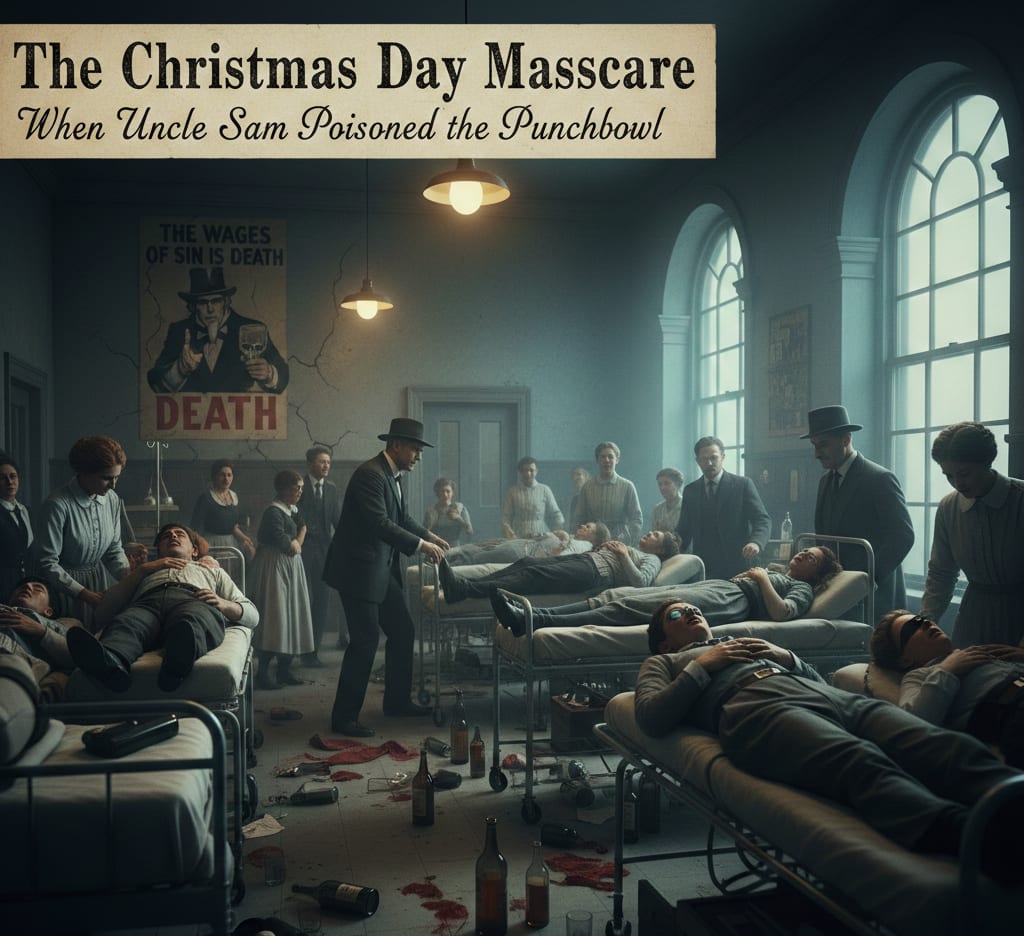
Imagine it’s Christmas Eve, 1926. New York City is glowing under a light dusting of snow, the air is thick with the sound of upbeat jazz, and behind a few nondescript basement doors, the party of the century is in full swing. This was the height of Prohibition, a time when being a "dry" nation only seemed to make everyone thirstier. But while the flapper girls were dancing and the champagne was flowing, something dark was creeping into the glasses of unsuspecting revelers.
By the time the sun rose on Christmas morning, the city wasn't waking up to presents; it was waking up to a nightmare. Over 60 people were rushed to Bellevue Hospital, not with holiday hangovers, but screaming in agony, hallucinating, and clutching their chests. Some were convinced they were being chased by monsters; others went blind before they even hit the ER floor.
It sounds like a plot from a twisted horror flick, right? But the reality is much more chilling. Those people weren't killed by a bad batch of bathtub gin or a mob hit. They were killed by their own government.
The Great Industrial Loophole
You see, when the 18th Amendment kicked in, it didn't just stop people from grabbing a beer after work. It created a massive logistical headache for the U.S. government. Alcohol wasn’t just for drinking; it was—and still is-the lifeblood of industry. It’s in your paint thinner, your medical supplies, your antifreeze, and your solvents. You couldn't just ban it entirely without the economy face-planting.
So, the feds allowed "industrial alcohol" (pure ethanol) to stay in production. But they knew the mob was smart. Gangsters weren't about to waste time smuggling whiskey from Canada when they could just "liberate" a few barrels of factory-grade ethanol and water it down.
To stop this, the government required companies to "denature" the alcohol—basically, make it taste like literal garbage so no one would dare take a sip. We're talking about adding kerosene, soap, and even rubber into the mix. It was nasty, but hey, it was supposed to be a deterrent.
A Deadly Game of Chemistry
But here’s where human nature-and greed-gets complicated. The demand for booze in the 1920s was, quite frankly, astronomical. Chicago alone had something like 20,000 speakeasies. People wanted to drink, and the mob was happy to oblige.
The crime syndicates started hiring high-priced chemists to "renature" the poison. They’d boil the gunk in giant stills, trying to separate the ethanol from the toxins. It worked... mostly. But the government, frustrated that people were still finding ways to get tipsy, decided to up the ante.
In 1926, they authorized a new "denaturing" formula that included methanol.
Now, if you aren’t a science geek, here’s the lowdown: Methanol looks, smells, and tastes almost exactly like regular alcohol. But inside the human body, it turns into formaldehyde and formic acid. It's a chemical that specifically targets the optic nerve and the central nervous system. Just two tablespoons can kill a child.
The government knew this. They knew that if a bootlegger's chemist missed even a tiny bit of it during distillation, whoever drank that bottle was essentially committing "legal" suicide.
The Man Who Didn't Flinch
You might be wondering, who thought this was a good idea? Enter Wayne B. Wheeler. He was the leader of the Anti-Saloon League and arguably one of the most powerful, and stubborn, men in Washington. Wheeler didn't just hate alcohol; he viewed anyone who drank it as a moral failure.
When the bodies started piling up-thousands of them across New York, Chicago, and Philly-the public was horrified. But Wheeler? He didn't blink. He famously said that the government was under no obligation to provide "drinkable" alcohol when the Constitution forbade it. To him, the deaths weren't a tragedy; they were natural selection.
It’s a bit jarring to think about, isn't it? A public official basically shrugging his shoulders while thousands of citizens dropped dead from a poison his office helped put there.
The Silent Aftermath
Eventually, Prohibition crumbled. By 1933, the "Noble Experiment" was over, and the booze started flowing legally again. But the government never really apologized for the 10,000 to 50,000 people who died because of the poisoned additives. They just... stopped doing it. They quieted down, tucked the records away, and let the memory fade into the background of history books.
It reminds me of that old economic concept called the "Cobra Effect." Back in colonial India, the British tried to get rid of cobras by offering a bounty for every dead snake. What happened? People started breeding cobras just to kill them and get the money. When the government found out and stopped the bounty, the breeders just released all their snakes, leaving more cobras on the street than when they started.
Prohibition was the ultimate Cobra Effect. It was meant to cure poverty and domestic violence, but instead, it gave us Al Capone, organized crime on a scale we’d never seen, and a government that was willing to kill its own people to prove a point.
Some Food for Thought
I spent a long time thinking about this story after I first heard it. It makes you wonder about the line between "enforcing the law" and "protecting the public." At what point does a solution become more dangerous than the problem it’s trying to solve?
We like to think we’ve moved past such radical measures, but history has a funny way of repeating itself in quieter, more modern ways.
What do you think? Was the government's "poison plot" a necessary (if brutal) enforcement tactic, or was it a dark stain on the American soul that we've just chosen to forget?
About the Creator
KWAO LEARNER WINFRED
History is my passion. Ever since I was a child, I've been fascinated by the stories of the past. I eagerly soaked up tales of ancient civilizations, heroic adventures.
https://waynefredlearner47.wixsite.com/my-site-3
Keep reading
More stories from KWAO LEARNER WINFRED and writers in History and other communities.
They Built Farms on Ice-Then Disappeared
Imagine this: It's a crisp September day in 1408, somewhere on the rugged southwestern coast of Greenland. A small wedding party gathers inside a stone church-simple vows exchanged, a few witnesses scribbling names on a document that somehow survives five centuries. The bride and groom smile (or at least we hope they did), the priest nods solemnly. They sign, they celebrate quietly, and then… nothing. That piece of paper becomes the very last whisper we ever hear from an entire community of Norse people who had carved out a life in one of the most unforgiving places on Earth.
By KWAO LEARNER WINFRED21 days ago in History
Found in Amazon... 10X Bigger Than Anaconda
In the Cerrejón region of Colombia, a team of scientists and paleontologists was digging deep underground in a coal mine. This coal mine had actually formed from a rainforest that existed nearly 60 million years ago. That is why the researchers were searching for the remains of ancient plants and animals.
By Imran Ali Shah3 days ago in History


Comments
There are no comments for this story
Be the first to respond and start the conversation.