
The One Order That Started World War I
How a Single Signature Turned Europe Into a Battlefield

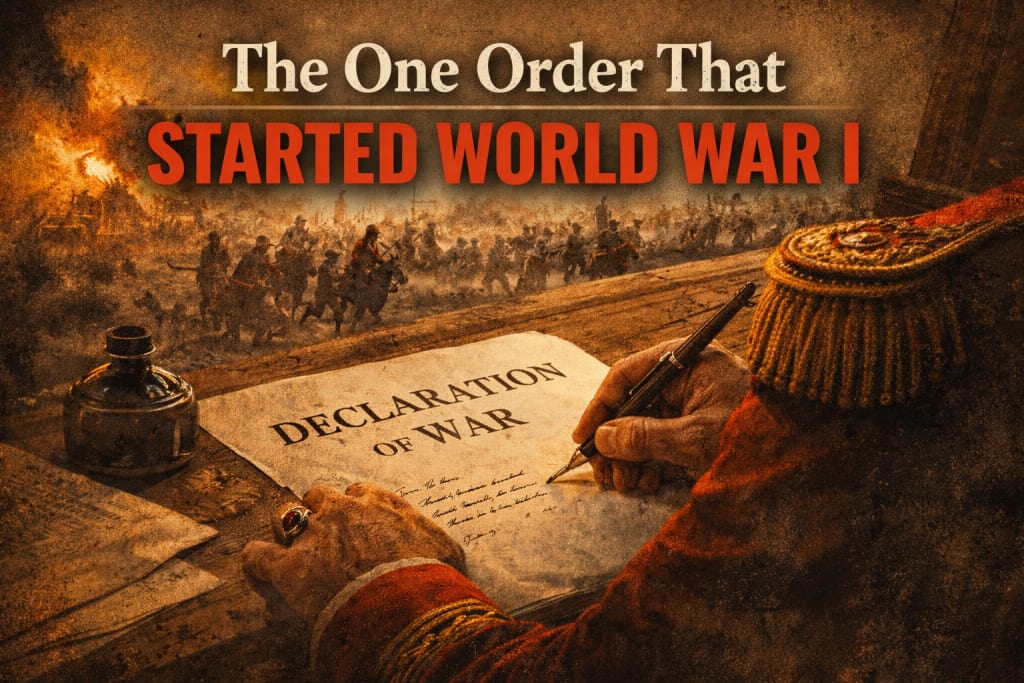
World War I did not begin with a single gunshot on a battlefield.
It did not start with trenches, tanks, or millions of marching soldiers.
It began quietly—on paper.
With one order.
An order that was meant to protect an empire, but instead pulled the entire world into four years of destruction.
A Tense Europe
In the summer of 1914, Europe was already nervous. Powerful empires stood like loaded weapons, each afraid of the other. Alliances had been signed, armies prepared, and plans drawn in secret.
All it needed was a spark.
That spark came on June 28, 1914, in Sarajevo.
Archduke Franz Ferdinand, heir to the Austro-Hungarian throne, was assassinated by a young nationalist. The killing shocked Europe, but assassination alone did not guarantee a world war. Political assassinations had happened before.
What mattered was what came next.
The Ultimatum
Austria-Hungary believed Serbia was behind the assassination. The empire wanted revenge—but also feared Russia, Serbia’s powerful ally.
So Austria-Hungary did something calculated.
On July 23, 1914, it sent Serbia an ultimatum: a list of demands so harsh that no independent nation could fully accept them.
Serbia agreed to almost everything.
Almost.
One demand would have allowed Austrian officials to operate inside Serbia. Accepting it would have meant surrendering sovereignty.
Serbia said no.
That single refusal changed history.
The Order Is Given
Five days later, on July 28, 1914, Austria-Hungary made its decision.
The emperor signed a formal declaration of war against Serbia.
It was an official order.
Short. Legal. Final.
Cannons began firing across the Danube River.
At first, it seemed like a regional conflict—one empire punishing a smaller neighbor.
But Europe was not a collection of isolated nations anymore. It was a tightly wound system of alliances.
And once one thread was pulled, everything unraveled.
Russia Responds
Russia saw itself as Serbia’s protector. Allowing Austria-Hungary to crush Serbia would weaken Russian influence in the Balkans.
So Russia issued its own order: mobilization.
This was not a declaration of war—but it was close enough.
Mobilization meant millions of soldiers preparing to fight.
Germany, allied with Austria-Hungary, saw Russian mobilization as a direct threat.
And Germany had a plan.
Germany’s Fatal Decision
Germany believed it could not afford to fight Russia and France at the same time unless it acted fast. Its military strategy depended on speed.
So on August 1, 1914, Germany issued its own order: a declaration of war on Russia.
Two days later, another order followed—war against France.
To reach France quickly, German armies marched through neutral Belgium.
That single violation triggered yet another response.
Britain Enters the War
Britain had guaranteed Belgium’s neutrality. For years, the promise had seemed symbolic—more diplomatic than military.
But now it mattered.
On August 4, 1914, Britain issued the order to declare war on Germany.
By the end of that week, the world’s greatest empires were locked in conflict.
Not because they wanted global war—but because each believed they had no choice.
The Tragedy of Orders
No single leader planned World War I as a world war.
Each order made sense on its own:
Austria wanted justice.
Russia wanted influence.
Germany wanted security.
Britain wanted to honor a treaty.
But together, these orders formed a chain reaction no one could stop.
Men followed commands.
Trains carried soldiers.
Borders vanished under marching boots.
Within months, trenches stretched across Europe.
Within years, millions were dead.
A Lesson Written in Ink
The most frightening thing about the beginning of World War I is not the violence.
It is how ordinary it was.
No dramatic speeches.
No global vote.
No final pause.
Just signatures.
Stamps.
Orders delivered to generals.
It reminds us that history often turns not on emotions, but on decisions made in quiet rooms—by people who believe they are acting responsibly.
The order that started World War I was not made by a madman.
It was made by leaders doing what they thought was necessary.
And that is what makes it so dangerous.
About the Creator
The khan
I write history the way it was lived — through conversations, choices, and moments that changed the world. Famous names, unseen stories.


Comments
There are no comments for this story
Be the first to respond and start the conversation.