
The Peaceful Revolutionary
A Journey of Truth, Nonviolence, and the Fight for India's Freedom

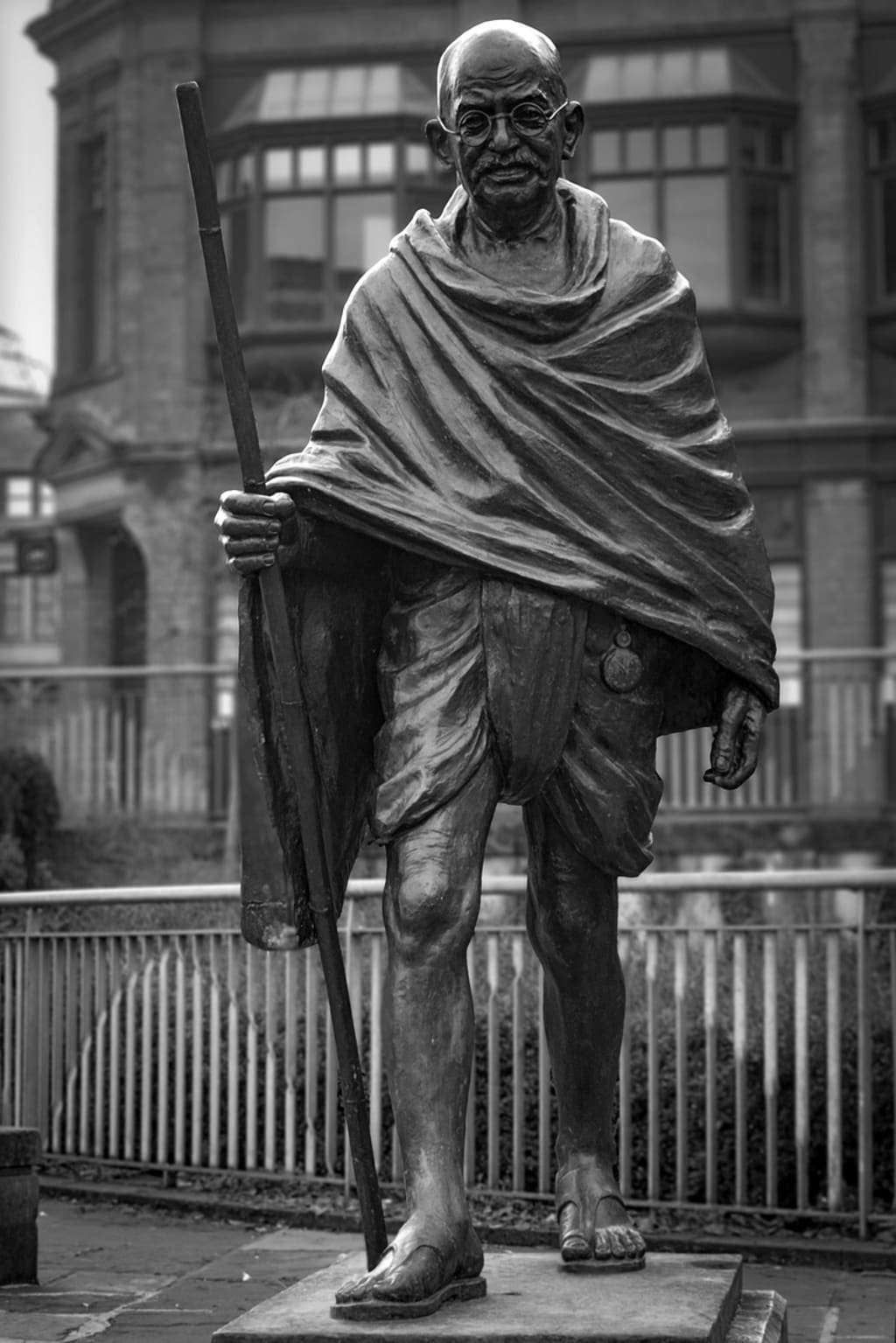
Mohandas Karamchand Gandhi, more widely known as Mahatma Gandhi, was a man who redefined the concept of revolution. Rather than violence and bloodshed, he chose truth and nonviolence (known as *Satyagraha* and *Ahimsa*) as tools for social and political change. His life remains one of the most inspiring examples of peaceful resistance in human history.
### **Early Life and Education**
Gandhi was born on October 2, 1869, in Porbandar, a coastal town in present-day Gujarat, India. His father, Karamchand Gandhi, was the dewan (chief minister) of the Porbandar state, and his mother, Putlibai, was deeply religious. Gandhi grew up in a Hindu household shaped by strong values of morality, discipline, and devotion.
At the age of 13, Gandhi was married to Kasturba Makhanji, a marriage arranged by their families, as was the custom of the time. Though initially unremarkable, their partnership would grow into a strong bond, with Kasturba playing a vital role in Gandhi’s public and private life.
In 1888, Gandhi traveled to London to study law. He was deeply influenced by Western thinkers and writers, especially the ideas of Leo Tolstoy and Henry David Thoreau. These encounters laid the foundation for his later philosophy of civil disobedience.
### **Struggles in South Africa**
After returning to India in 1891 and finding limited success as a lawyer, Gandhi accepted a job in South Africa in 1893. It was here that the seeds of his political awakening were sown. South Africa’s Indian population faced rampant discrimination, and Gandhi himself experienced it firsthand. One pivotal moment came when he was thrown off a train in Pietermaritzburg for refusing to move from a first-class compartment despite having a valid ticket.
This incident transformed Gandhi. He spent 21 years in South Africa fighting for the civil rights of the Indian minority. It was during this period that he first developed and applied the principles of *Satyagraha*—nonviolent resistance. Gandhi organized peaceful protests, led campaigns against oppressive laws, and built a movement that emphasized dignity and self-respect.
### **Return to India and the Freedom Struggle**
Gandhi returned to India in 1915, where he quickly became involved in the Indian independence movement. His unique approach—anchored in nonviolence, truth, and mass civil disobedience—set him apart from other leaders.
In 1919, he led the first nationwide protest against British rule in response to the Rowlatt Act, which allowed the government to imprison people without trial. The tragic Jallianwala Bagh massacre, in which British troops killed hundreds of peaceful protesters, solidified Gandhi’s resolve to free India from colonial rule.
Gandhi launched the **Non-Cooperation Movement** in 1920, urging Indians to boycott British institutions, including schools, courts, and services. He encouraged the revival of *Khadi* (homespun cloth) as a symbol of economic independence and resistance to British goods. Gandhi himself adopted a simple lifestyle, wearing a hand-spun loincloth and living in an ashram.
Although the movement was halted in 1922 after violent clashes, Gandhi continued his mission. His leadership during the **Salt March** in 1930 was a turning point. Defying British laws that taxed salt, Gandhi walked 240 miles to the Arabian Sea to make salt himself. The act sparked mass civil disobedience and gained global attention, portraying Gandhi as the moral voice of India.
### **Principles of Truth and Nonviolence**
Gandhi’s philosophy was rooted in the belief that truth (*Satya*) and nonviolence (*Ahimsa*) were not just political tools but a way of life. He believed that real strength came not from physical might but from moral courage.
For Gandhi, nonviolence did not mean passivity. It was an active force of love, compassion, and resistance to injustice. He taught that the means were as important as the end, insisting that no good could come from evil actions. These principles inspired other global movements, including the American civil rights movement led by Martin Luther King Jr. and the anti-apartheid struggle in South Africa led by Nelson Mandela.
### **Struggles Within**
Despite his fame and reverence, Gandhi was not without criticism. Some felt his methods were too slow or idealistic. His efforts to unite Hindus and Muslims met with limited success, especially as communal tensions escalated in the 1940s. He also faced criticism for his strict moral discipline and controversial views on issues like celibacy and caste.
Still, his personal life remained aligned with his public values. Gandhi lived simply, practiced vegetarianism, fasted regularly as a form of protest and spiritual purification, and remained deeply committed to serving others.
### **India’s Independence and Tragic End**
India finally gained independence from British rule on August 15, 1947. But Gandhi did not celebrate. The country was simultaneously divided into two nations—India and Pakistan—resulting in horrific communal violence that killed hundreds of thousands. Gandhi undertook a fast unto death to stop the riots, traveling to the worst-hit areas and appealing for peace.
Tragically, on January 30, 1948, Gandhi was assassinated in New Delhi by Nathuram Godse, a Hindu nationalist who opposed Gandhi's tolerance toward Muslims. The world mourned the loss of a man who had become the conscience of a nation and a beacon of peace for all humanity.
### **Legacy**
Mahatma Gandhi’s legacy is timeless. He left behind more than a political movement—he gave the world a blueprint for nonviolent resistance and moral leadership. His life demonstrated that ordinary people, driven by love and truth, can challenge injustice and change the world.
In India, Gandhi is known as the "Father of the Nation." His image adorns currency, his birthday is a national holiday, and his teachings are part of school curricula. Globally, he remains a symbol of peace and justice, with leaders across the world continuing to draw inspiration from his life.
More than a century after he began his fight against injustice, Gandhi’s message still resonates. In a world often torn by violence and division, the peaceful revolutionary from Porbandar reminds us of the enduring power of compassion, conscience, and courage
About the Creator
Irshad Abbasi
"Studying is the best cure for sorrow and grief." shirazi
Keep reading
More stories from Irshad Abbasi and writers in History and other communities.
A Life of Integrity and Leadership
Abraham Lincoln, the 16th president of the United States, stands as one of the most revered figures in American history. Known for his steadfast moral compass, eloquent speeches, and unwavering commitment to justice and unity, Lincoln’s life is a profound story of perseverance, vision, and leadership.
By Irshad Abbasi 8 months ago in History
Empire in Ashes
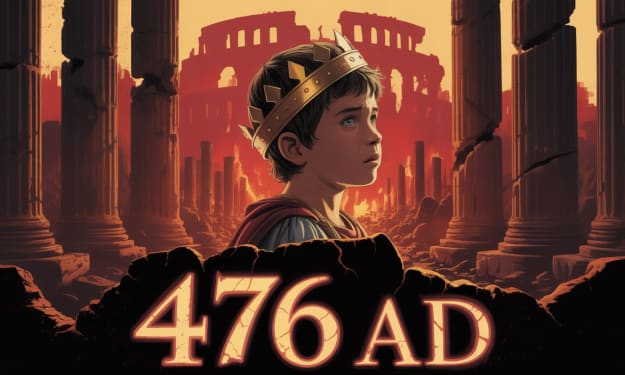
In late summer of the year 476, the Western Roman Empire was already a shadow of its former self, but its final hours still carried the weight of a thousand years of power. Rome no longer ruled the Mediterranean world; its emperors were puppets, its armies filled with foreign mercenaries, its treasury nearly empty. In Ravenna, the imperial capital, the teenage emperor Romulus Augustulus waited behind palace walls while events moved beyond his control. Real authority rested with Orestes, his father and commander of the army, who had seized power only a year earlier. But the soldiers who kept the empire standing had grown restless. They were foederati—Germanic troops who fought for Rome in exchange for land—and they now demanded what had long been promised. When Orestes refused, their leader, a seasoned warrior named Odoacer, turned against him. Within days, Odoacer’s forces marched across northern Italy, crushing resistance with alarming ease. Orestes was captured near Piacenza and executed, and the road to Ravenna lay open. As the final seventy-two hours began, Ravenna was tense but strangely quiet. The once-mighty empire had no legions left to defend its emperor, only thin walls and fading prestige. Odoacer’s army surrounded the city, not with the fury of a sack, but with the confidence of inevitability. Inside the palace, Romulus Augustulus—named after Rome’s legendary founder and its first emperor—stood as a tragic symbol of decline. He was young, inexperienced, and powerless, ruling an empire that existed more in memory than in reality. There was no dramatic last stand, no desperate counterattack. Negotiations replaced battles, and survival replaced pride. When Odoacer entered Ravenna, he did not burn it. He deposed the boy emperor peacefully, an act that was both merciful and final. Romulus was spared, granted a pension, and sent into exile, likely to live out his life in obscurity while history moved on without him. In the final hours, the symbols of empire were quietly dismantled. The imperial regalia—the crown, the purple robes, the insignia of supreme authority—were gathered and prepared for a journey east. Odoacer made a calculated decision that marked the true end of Western Roman rule: he did not name a new emperor. Instead, he sent the imperial insignia to Constantinople, acknowledging the Eastern Roman Emperor, Zeno, as the sole ruler of the Roman world. The message was clear and unprecedented. The West no longer needed its own emperor. What had once been the heart of a global empire was now a kingdom ruled by a barbarian king in Roman clothing. As the seventy-two hours closed, no single moment announced the fall. There were no collapsing walls or burning palaces, only the quiet disappearance of an institution that had shaped Europe, North Africa, and the Mediterranean for centuries. The Roman Senate still existed. Roman laws were still enforced. Cities still stood. But the idea of a Western Roman Emperor—an unbroken line stretching back to Augustus—was gone. The world did not end in 476, but it undeniably changed. Power fragmented, trade routes weakened, and Western Europe slowly entered a new era of competing kingdoms and shifting identities. Rome, once the ruler of the known world, became a memory, a symbol, and eventually a legend. The final seventy-two hours of the Western Roman Empire were not marked by chaos, but by quiet acceptance. Its fall was not a sudden collapse, but the last breath of a long decline. Yet even in ashes, Rome endured. Its language, laws, architecture, and ideas survived its emperors, shaping civilizations long after the crown was laid down. The empire died not with a roar, but with a whisper—leaving behind a legacy that still defines the modern world.
By Talhamuhammad6 days ago in History



Comments
There are no comments for this story
Be the first to respond and start the conversation.