
Cracking the Code: The Genetic Clue That Could Stop ALS
By Prof. Roberto Grobman
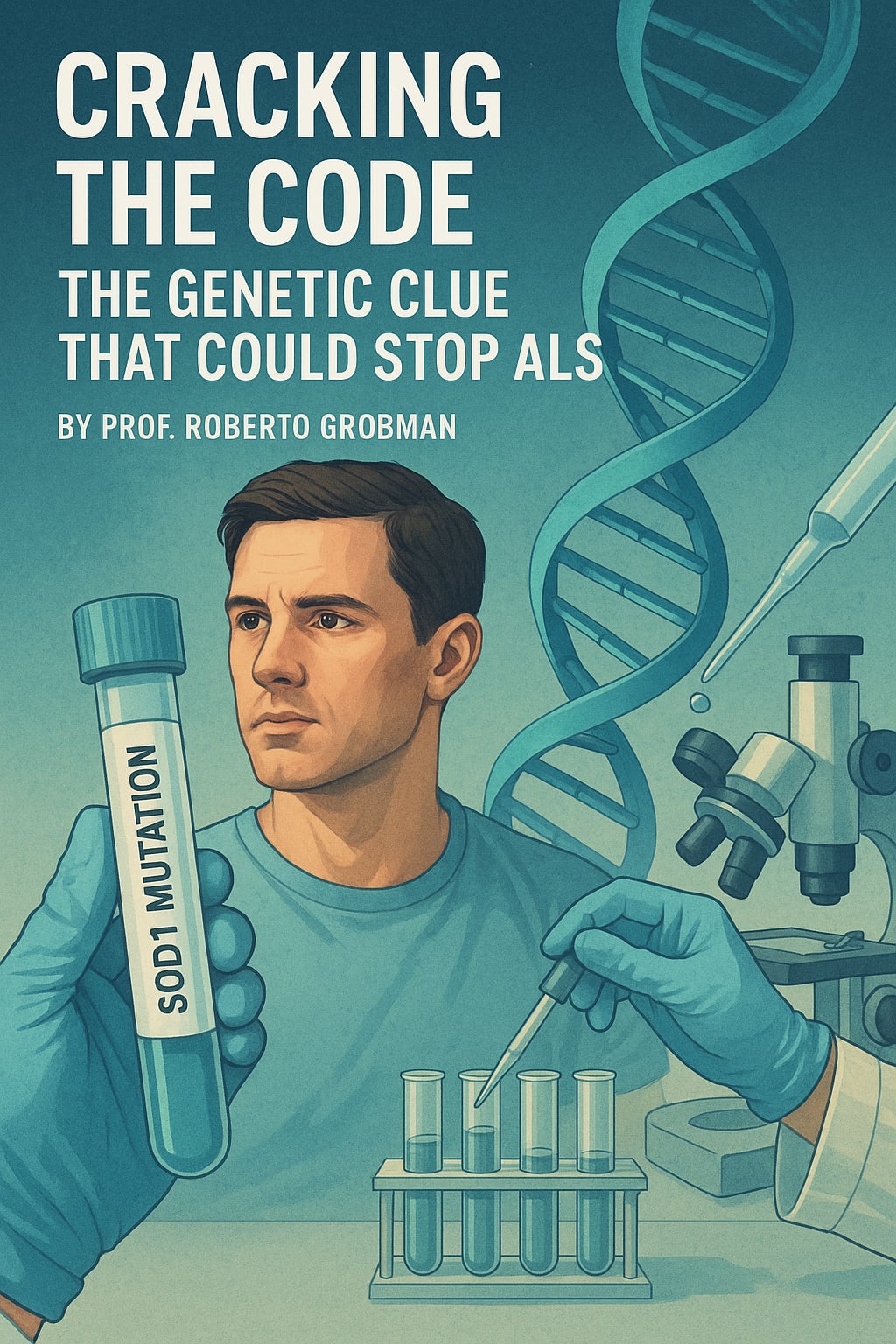
In a sunlit lab in Boston, a vial of DNA quietly spins in a centrifuge.
It belongs to Michael, a 33-year-old former paramedic from San Diego. Two years ago, Michael was diagnosed with ALS—Amyotrophic Lateral Sclerosis, the devastating neurodegenerative disease that paralyzed Stephen Hawking and has shattered thousands of lives.
Michael’s voice began to weaken. Then his hands trembled. Then stairs became impossible. Like most people diagnosed with ALS, he was told he had 2 to 5 years to live. No cure. Only “support.”
But Michael had something different—a mutation. And that mutation might just save his life.
The Genetic Mutation That Started a Scientific Revolution
In the late 1990s, scientists discovered that some ALS cases were inherited. One of the most important genetic discoveries was a mutation in a gene called SOD1 (superoxide dismutase 1). This gene is essential in protecting motor neurons from oxidative stress. When mutated, it can cause toxic protein clumps that destroy neurons—leading to paralysis.
Approximately 2% of all ALS patients carry this mutation, and for them, the disease can be particularly aggressive. But it’s also precisely targeted, which makes it vulnerable to something scientists once only dreamed of: gene-silencing therapy.
The Breakthrough: Tofersen and the Future of Genetic ALS Treatment
In 2023, a therapy called Tofersen (developed by Biogen and Ionis Pharmaceuticals) made headlines. Tofersen is an antisense oligonucleotide (ASO) therapy—a short strand of RNA-like material that binds to the faulty SOD1 mRNA and prevents the production of toxic proteins.
Tofersen was tested in the VALOR clinical trial, enrolling patients with confirmed SOD1-ALS mutations. While the main endpoint (slowing physical decline) was not statistically significant at 28 weeks, secondary endpoints told a different story:
Neurofilament light chain (NfL), a marker of neuronal injury, dropped significantly in patients taking Tofersen.
With longer follow-up, patients showed slower decline in respiratory function, strength, and mobility.
Patients who started the drug earlier had better outcomes—proof of the importance of early genetic diagnosis.
In 2023, the FDA granted accelerated approval for Tofersen under the brand name Qalsody, specifically for SOD1-ALS patients. It was a historic moment—the first genetic therapy for ALS ever approved.
Michael’s Story: From Diagnosis to Determination
Michael was one of the first patients in California to be genetically tested after diagnosis. When his neurologist saw the results—SOD1 A4V mutation—he was referred to a research center participating in the ATLAS study, a new global clinical trial for pre-symptomatic carriers of SOD1 mutations.
He enrolled in the trial in 2024.
His sister tested positive for the same mutation but had no symptoms—she, too, was offered a spot in ATLAS. For the first time in ALS history, a preventive treatment was being explored in people before they got sick.
"I felt like I was going to die,” Michael told researchers, “but now, I feel like I’m part of something that might change everything—for me, and for everyone after me.”
The Bigger Picture: Where Hope Is Being Built
Tofersen isn’t a cure. It doesn't reverse ALS. But it represents a new model: precision neurogenetics.
Other trials are already underway:
- Jacifusen: A similar ASO therapy for FUS-ALS, another genetic form of ALS.
- Gene therapy vectors (like AAV9) to deliver silencing molecules directly to motor neurons.
- CRISPR-based approaches being tested in animal models to directly edit mutant SOD1 genes.
- Antioxidant and mitochondrial therapies tailored to individuals with SOD1 dysfunction (e.g., CuATSM in phase 2/3 trials).
More than 30 clinical trials are currently active for ALS worldwide. The era of generic treatment is ending. The age of targeted therapy—based on your DNA—is here.
Why Genetic Testing Could Be the Key
Only about 10% of ALS patients have a known family history. But up to 20% may carry genetic mutations that could one day be targeted by treatments.
Experts now recommend genetic testing for all ALS patients, regardless of family history. It’s not just about science. It’s about hope. A future. A choice.
From Despair to Design
ALS has long been a symbol of hopelessness. But behind microscopes and in clinical trial rooms, something extraordinary is happening.
- We are turning knowledge into tools.
- We are transforming mutations into maps.
- We are rewriting stories once thought already ended.
Michael’s journey is not just his own. It belongs to all of us who believe that disease doesn’t mean defeat—not when we know where to look.
Prof. Roberto Grobman is a scientist, geneticist, and founder of MedGeneCare, a precision health platform combining genomics, clinical data, and AI to personalize healthcare for patients around the world. His mission is to bring science and humanity closer together, one story at a time.
About the Creator
Keep reading
More stories from Prof Roberto Grobman and writers in Lifehack and other communities.
Camel Urine: An Unusual Remedy with Surprising Power
Imagine the vast desert under the blazing sun, where life moves slowly, and every resource matters. In those endless sands, Bedouin nomads discovered a surprising remedy: camel urine. For centuries, it was a trusted healer. Today, lab tests are digging deeper into its secrets—and what they’re finding is stranger than fiction.
By Prof Roberto Grobman9 months ago in Lifehack
Building a New Life After Moving to Harrisburg
When I decided to move to Harrisburg, Pennsylvania, I expected the experience to be mostly practical. I imagined a process defined by logistics, schedules, and organization. I prepared for physical effort, planning, and adjustment to a new environment. What I did not anticipate was how deeply the experience would reshape my understanding of stability, identity, and the meaning of home.
By House Doctor5 days ago in Lifehack
Boundless
A geographical map could take you there. To the places I've been, to the sights I've seen, to the landscapes I've climbed. But no compass could point you in the direction of my memories. To the experiences I've lived, to the happiness I've felt, to the wonder I've held so close to my heart.
By Alyssa Mussoabout 6 hours ago in Writers



Comments