

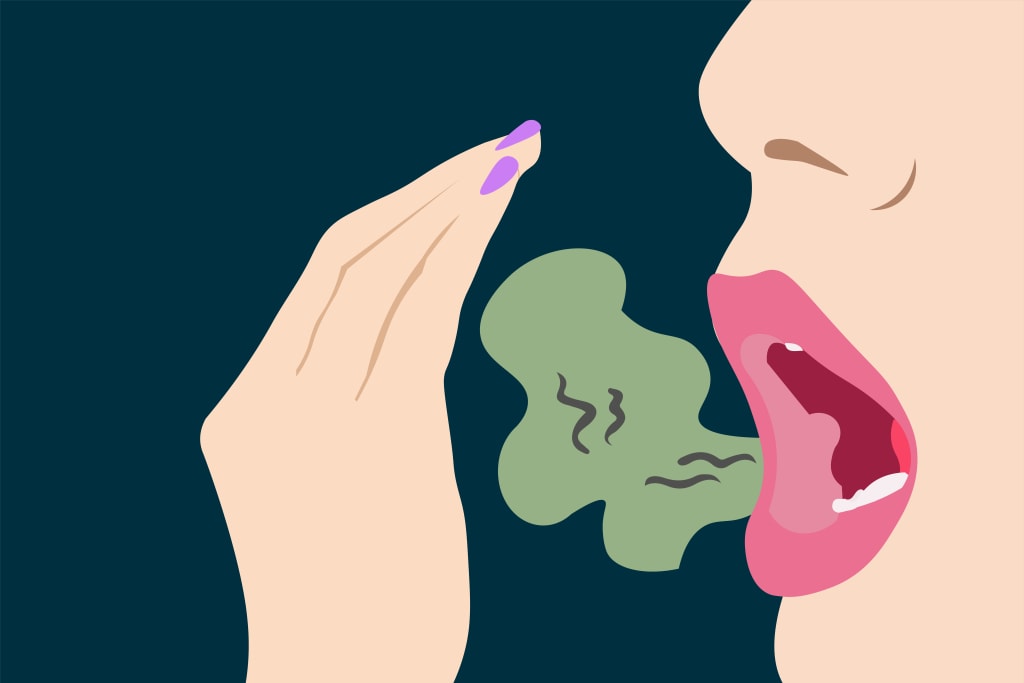
Bad breath, also known as halitosis, can be humiliating and even cause anxiety in certain people.
It's no surprise that store shelves are brimming with gum, mints, mouthwashes, and other breath-freshening items.
However, since they do not solve the root of the issue, all of these items are just temporary solutions.
Bad breath can be caused by a variety of foods, health conditions, and behaviors.
In certain cases, good dental hygiene will help you get rid of bad breath.
If basic self-care methods don't work, see your dentist or physician to make sure your bad breath isn't caused by anything more severe.
Symptoms
Bad breath odors differ, depending on the source or the underlying cause.
Some people are overly concerned about their breath, even if they have little or no mouth odor, while others are unaware that they have bad breath.
Since it's difficult to determine how your own breath smells, ask a close friend or relative to validate your bad-breath questions.
When do you see a doctor?
Refresh your breath if you have bad breath.
Food is a must.
Food particles breaking down in and around your teeth can lead to an increase in bacteria and a foul odor.
Poor breath can also be caused by such ingredients, such as onions, garlic, and spices.
These foods enter your bloodstream after digestion, travel to your lungs, and affect your breathing.
Tobacco-related goods
Smoking produces a foul odor in the mouth.
Gum disease, another cause of bad breath, is more common in smokers and oral tobacco users.
Dental hygiene is an issue.
Food particles linger in your mouth if you don't clean and floss on a regular basis, causing bad breath.
Plaque is a colorless, sticky bacteria film that develops on your teeth.
Plaque will irritate your gums and eventually form plaque-filled pockets between your teeth and gums if not brushed away (periodontitis).
Bacteria that contain odors may also be trapped on your tongue.
You have a dry mouth.
Saliva aids in the cleansing of the mouth by eliminating particles that cause odors.
Since saliva production is reduced, a condition known as xerostomia (zeer–o-STOE-me-uh) may lead to bad breath.
Dry mouth naturally happens during sleep, contributing to "morning breath," and it worsens if you sleep with your mouth open.
Chronic dry mouth can be caused by a problem with your salivary glands and certain diseases.
Medications are prescribed.
Some drugs can trigger bad breath indirectly by causing dry mouth.
Others can be broken down in the body, releasing toxins that can be inhaled.
You have an infection in your mouth.
Bad breath may result from surgical wounds following oral surgery, such as tooth removal, or from tooth decay, gum disease, or mouth sores.
Some problems with the mouth, nose, and throat.
Small stones that grow in the tonsils and are covered with bacteria that create odor can cause bad breath on occasion.
Poor breath may be caused by infections or persistent inflammation in the nose, sinuses, or mouth, which may lead to postnasal drip.
There are other reasons.
Chemicals produced by diseases, such as certain cancers, and conditions, such as metabolic disorders, can induce a distinct breath odor.
Bad breath is linked to chronic stomach acid reflux (gastroesophageal reflux disease, or GERD).
A foreign body stuck in a nostril, such as a piece of food, may trigger bad breath in young children.
sp8vl.
About the Creator
Keep reading
More stories from writers in Longevity and other communities.
Everybody’s Mom
Motherhood has always been one of the most celebrated, complex, and transformative roles in human society. Yet in recent years, the phrase “Everybody’s Mom” has taken on a new cultural meaning—symbolizing not just a biological mother, but a figure of care, guidance, and emotional support who extends far beyond the traditional family unit. Across communities, workplaces, and social networks, “Everybody’s Mom” has become shorthand for someone who nurtures, protects, and organizes, often without formal recognition or reward. The Evolution of “Mom” in Culture Historically, mothers were defined by their domestic roles: raising children, managing households, and ensuring the well-being of their family members. In modern culture, however, the definition has broadened. Media, literature, and social networks frequently highlight women who step into maternal roles for people outside their immediate family. From teachers and mentors to team leaders and community organizers, “Everybody’s Mom” embodies a spirit of care and responsibility that resonates widely. Social media has amplified this archetype, showcasing stories of women who balance careers, social commitments, and family responsibilities while offering guidance and emotional support to those around them. Memes, hashtags, and viral posts celebrate these women for their patience, wisdom, and ability to listen—qualities traditionally associated with motherhood but increasingly recognized as universally valuable. Beyond Biology: Emotional Labor Being “Everybody’s Mom” is about emotional labor as much as physical caregiving. Emotional labor refers to the often invisible effort of managing feelings, offering reassurance, mediating conflicts, and maintaining harmony within a group. Women in maternal roles often absorb the anxieties and stresses of others, smoothing social and professional interactions in ways that are rarely quantified or compensated. Psychologists note that this form of labor, while rewarding in many ways, can also lead to burnout. Constantly managing the emotional needs of a community—whether a classroom, workplace, or friend group—requires energy, empathy, and resilience. The recognition of “Everybody’s Mom” as a cultural archetype highlights the value of this labor, while also raising awareness about the importance of self-care. In the Workplace In professional environments, “Everybody’s Mom” is often the colleague who remembers birthdays, checks in on team members who are struggling, and quietly ensures that the office functions smoothly. While this role is generally voluntary, it can become a subtle expectation, particularly for women in mid-level positions. Corporate culture experts caution that organizations should acknowledge this contribution, ensuring that emotional labor does not become an unspoken burden that affects career advancement. Interestingly, men are also increasingly stepping into “Everybody’s Mom” roles in professional and social contexts, challenging traditional gender norms. The traits associated with maternal support—empathy, attentiveness, conflict resolution—are being recognized as valuable leadership skills, regardless of gender. In Communities and Social Life Outside the workplace, “Everybody’s Mom” exists in neighborhoods, clubs, online communities, and informal networks. These individuals offer advice, mediate disputes, and provide care without expecting formal recognition. Their presence often becomes a stabilizing force, creating a sense of belonging and security for those around them. For example, in community organizations, the “mom figure” may organize fundraisers, ensure newcomers feel welcomed, and provide mentorship to younger members. In online spaces, she may moderate discussions, offer resources, and provide emotional support to people she may never meet in person. In both cases, the impact of this role extends far beyond the immediate circle of influence. The Challenges Despite its importance, being “Everybody’s Mom” comes with challenges. Boundaries can blur, leading to stress, overcommitment, and emotional fatigue. Individuals who take on this role must balance their own needs with those of others—a delicate task that requires assertiveness and self-awareness. The cultural expectation that certain people, often women, will naturally adopt this role can also reinforce gender stereotypes and undervalue other contributions. Experts recommend that society recognize the importance of these roles while encouraging shared responsibility. Emotional support should not fall solely on one person; rather, communities and organizations can cultivate cultures where care and guidance are distributed equitably. The Enduring Appeal Why does the concept of “Everybody’s Mom” resonate so strongly today? It reflects a deep human need for connection, guidance, and nurturance in a rapidly changing world. The archetype symbolizes patience, wisdom, and reliability—qualities that are universally sought after, regardless of one’s age or circumstances. Ultimately, “Everybody’s Mom” is a tribute to those who step up, often quietly, to ensure that others feel seen, supported, and understood. She embodies the best of human empathy and generosity, reminding us that care is a shared responsibility and that nurturing extends far beyond the family unit. In recognizing and celebrating these figures, society affirms the essential role of emotional support in sustaining healthy, resilient communities.
By Fiaz Ahmed 5 days ago in Longevity
Where there's Art there's Heart
Here's a stupid thing: I adore art, but I start to panic whenever I step into a gallery. In the one place I should be at my contented best - surrounded by walls teeming with creative expression - I fall apart. What ought to be an enriching experience, tacitly designed to facilitate the exploration of human empathy and perspective, is for me an overwhelming purgatory of anxiety that compresses me to the point I cannot breathe. At the same time, I experience a sense of extraction, as though my head is being prized open to create a hole so big my sanity could evaporate. Somewhere between these two opposing forces of vice and vortex, I feel myself dissolving in a stream of panic that makes me want to cry; and I feel so daft feeling this way, that all I want to do is run for the hills.
By Caroline Jane3 days ago in Humans
When Amazon Says You’re a Disappointment
Yesterday, for the first Wednesday in months, I didn’t publish a piece on Vocal. Believe me, I wanted to. I had it all written up and ready to go. I was going to share the news that I had officially become a published author.
By Sandy Gillmana day ago in Writers



Comments
There are no comments for this story
Be the first to respond and start the conversation.