
The Geometry of Calm
True resilience is not about how much weight you can carry. It is about how quickly you return to center.


In our modern world, we are obsessed with output. We measure our lives by what we produce, how fast we move, and how much we can endure. We tend to view health as a capacity for work. If you can still get out of bed and perform your duties, you are considered healthy.
But in my research at Columbia University, I have begun to see a different picture. Biology does not value constant output. Biology values recovery. It values the capacity to oscillate among states, moving from exertion to rest, from alertness to calm, from stress to restoration. The organism that survives is not the one that can sustain maximum effort indefinitely. It is the one that can return to baseline efficiently.
When we study the most resilient systems in nature, we rarely find them in a state of rigid tension. Instead, we find them in a state of fluid oscillation. They move away from their center, and then they return. A tree bends in the wind and springs back. A wave rises and falls. A breath expands and releases. The health of the system is not defined by how far it can stretch. It is defined by the speed and grace of its return to equilibrium.
This principle, which I have come to think of as the geometry of calm, applies across every scale of biological organization. From the cellular to the systemic, from the molecular to the behavioral, health is characterized by the capacity for dynamic return rather than static endurance.
The Space Between the Signals: Understanding Heart Rate Variability
This concept is easiest to understand when examined in the context of the human heart. Most people assume that a steady, metronomic heartbeat is a sign of health. The ideal heart, in this view, ticks like a perfectly calibrated clock, each interval identical to the last. Surprisingly, the opposite is true. A heart that beats with robotic regularity is often a system under extreme stress, locked into a single mode of operation, unable to adapt.
A healthy heart has variation. The interval between one beat and the next varies with what you are doing, thinking, or feeling. This phenomenon is known as Heart Rate Variability, or HRV. It represents the flexibility of the autonomic nervous system, the ancient regulatory network that governs functions we do not consciously control, including breathing, digestion, immune response, and vascular tone.
The autonomic nervous system operates through two complementary branches. The sympathetic branch accelerates, energizes, and mobilizes. It prepares us for action by raising heart rate, dilating pupils, and redirecting blood flow to muscles. The parasympathetic branch decelerates, restores, and conserves. It slows the heart rate, promotes digestion, and facilitates recovery. Health is not the dominance of one over the other. Health is the fluid interplay between them, the constant negotiation that enables the body to align its internal state with external demands.
Heart Rate Variability reflects this interplay. When HRV is high, the space between heartbeats fluctuates significantly. The system is responsive and adaptive, capable of shifting quickly between sympathetic and parasympathetic states. When HRV is low, the intervals become rigid. The system has lost its elasticity, its capacity to modulate, its geometric range of motion.
Think of it like music. A metronome produces perfect rhythm but no music. Music requires variation, syncopation, and the deliberate play between expectation and surprise. A musician must know when to hold a note and when to release it, when to accelerate and when to slow. The space between the notes is not emptiness. It is structured. It means. It is where the music lives.
The same is true for the heart. The space between the beats is where the resilience lives. It is the buffer that allows the system to absorb perturbations without breaking and to respond to stress without becoming locked in a crisis state. When that buffer disappears, when the intervals lose their variability, the system has entered a state of rigidity that often precedes collapse.
Mapping the Neural Echo: The Brainstem as Filter
In the Nock Research Group, we apply this same logic to the nervous system itself. We are looking for the white space in the biological data, the intervals where the system resets and prepares for the next signal. When a neural signal fires, there must be a moment of recovery before it can fire again. If that gap disappears, if the signals become continuous and overlapping, the system becomes flooded. It loses its geometry. It loses its calm.
We call this pattern of signal and silence the Neural Echo. The term is intended to evoke how sound behaves in physical space. Imagine dropping a stone into a still pond. The stone is the stressor, the external perturbation. The ripples are the response, the way the system propagates and processes that disturbance. In a healthy pond, the ripples eventually fade. The energy dissipates. The water returns to glass.
In a system that has lost its resilience, the ripples never stop. They bounce off the edges and collide with new ripples, creating a chaotic surface that never settles. There is no return to baseline. There is no silence between the signals. The system is in a state of perpetual perturbation, unable to distinguish between meaningful information and background noise.
The brainstem, the ancient core of the nervous system, serves as the primary filter for this signal processing. It receives constant input from throughout the body: sensory data, visceral feedback, hormonal signals, and inflammatory markers. Its job is not to respond to every input with equal intensity. Its job is to determine what requires attention and what can be safely ignored, what represents a genuine threat and what is simply noise.
One of the primary pathways through which this information flows is the trigeminal nerve, the largest cranial nerve in humans. This nerve carries sensory information from the oral and facial regions directly to brainstem nuclei and interacts with systems that regulate autonomic function, inflammatory responses, and pain modulation. Historically, we have treated this pathway as relevant primarily to dental sensation. But recent research suggests it may carry far more information about systemic states than we have recognized.
The hypothesis we are exploring is whether changes in trigeminal signaling patterns reflect broader changes in the brainstem's ability to maintain its filtering function. Not as isolated diagnostic markers, but as aspects of a larger pattern, a Neural Echo that reveals whether the system is preserving its capacity for calm or drifting into a state of chronic dysregulation.
The Physics of Resilience: Allostatic Load and the Tightrope Walker
To understand what happens when a system loses its geometric calm, it helps to return to the metaphor of the tightrope walker. A skilled performer makes it look effortless, as if they are standing still in space. But if you measured their muscle activity, vestibular signals, and visual tracking, you would observe constant micro adjustments. Thousands of tiny corrections every second, each one imperceptible to the audience, each one essential to maintaining balance.
This is what resilience looks like at the physiological level. Not stillness, but exquisitely calibrated motion. Not the absence of stress, but the effective management of it through continuous, responsive adjustment. Health is not a static state. Health is a dynamic process of maintaining balance despite constant perturbation.
But what happens when those micro adjustments become less effective? When do the corrections take longer, require more effort, or fail to restore equilibrium fully? This is where the concept of allostatic load becomes relevant.
Allostasis refers to the process by which the body maintains stability through change. Unlike homeostasis, which involves returning to a fixed set point, allostasis involves adjusting the set point in response to environmental conditions. The body does not maintain the same internal state while sleeping and while running. It shifts its regulatory targets to match demands. This is adaptive. This is how we survive in a changing world.
Allostatic load refers to the wear and tear that accumulates when these adaptive processes are engaged too frequently, too intensely, or for too long. It is the biological cost of chronic stress. When the tightrope walker must make constant, large corrections to avoid falling, fatigue sets in. Muscles tire. Response time slows. The margin for error shrinks. Eventually, the wobble becomes too large to correct.
Systems biology gives us tools to measure this accumulating load. Not through a single biomarker, but through patterns across multiple systems simultaneously. Changes in inflammatory markers, vascular reactivity, metabolic regulation, neural signaling, and autonomic balance. Together, these create a picture of a system under strain, losing its elastic capacity, drifting away from its geometric center without the energy or coordination to return.
The Architecture of Burnout: When Return Becomes Impossible
This perspective offers a new way to understand the modern epidemic of burnout. Burnout is not simply the result of working too hard. It is the result of a biological system that has lost its elastic limit, its capacity to oscillate between exertion and recovery, between activation and restoration.
When we lose the ability to return to center, we enter a state of chronic sympathetic overdrive. The brainstem remains on high alert, interpreting even minor stressors as existential threats. The trigeminal nerve continues to fire defensive signals. The body forgets the geometry of safety. Heart Rate Variability plummets as the system locks into a single rigid mode. The spaces between signals disappear. The Neural Echo becomes a continuous roar.
What makes this particularly insidious is that the deterioration is gradual. The tightrope walker does not fall immediately. They wobble. They compensate. They work harder to maintain balance using strategies that consume more energy and provide less stability. To an outside observer, they may still appear functional. But the internal architecture is failing.
Our goal at Columbia University Irving Medical Center is to build tools that can detect this loss of elasticity long before a crash occurs. We want to measure the wobble in the tightrope walker before they fall. We aim to identify when Heart Rate Variability declines, when the Neural Echo loses its clean intervals, and when allostatic load accumulates faster than the system can dissipate it. Not to diagnose disease in the traditional sense, but to recognize when the architecture of resilience is under threat.
The Ethics of Measurement: Privacy, Power, and Federated Learning
As we develop computational tools capable of detecting these subtle biological signals, we must confront difficult ethical questions. If we can measure Heart Rate Variability continuously, decode Neural Echo patterns, and quantify allostatic load in real time, who owns that information? Who controls access to it? How can we prevent sophisticated monitoring from becoming another mechanism of surveillance and control?
The history of health technology offers cautionary lessons. Too often, innovations that promise universal benefit end up deepening existing inequities. Advanced diagnostics become accessible only to wealthy patients. Biological data becomes a commodity controlled by corporations rather than individuals. Privacy becomes a luxury good that most people cannot afford.
At the Nock Research Group, we are committed to a different model. Our work incorporates privacy-preserving technologies, particularly federated learning architectures that fundamentally change the relationship between data and insights.
In traditional machine learning, all data must be centralized. Your health information, my health information, everyone's information gets pooled in a single location where algorithms can analyze it. This creates enormous privacy risks and concentrates power in the hands of whoever controls the database.
Federated learning inverts this model. Instead of moving data to a central location, the computational model travels to where the data lives. It learns locally, on your device or in your local clinic, and only shares the learned patterns back to improve the global model. The raw data never leaves its source. You retain ownership and control. The insights become distributed rather than concentrated.
This approach aligns with our belief that health data should be treated as a protected asset rather than a commodity to be extracted. That advanced health monitoring should be accessible to everyone, not just those who can afford premium services or live near academic medical centers. The future of precision medicine must be built on principles of equity, transparency, and individual autonomy.
From Pathogenesis to Salutogenesis: A Paradigm Shift
All of this work, from Heart Rate Variability to Neural Echo to allostatic load, represents a broader shift in how we think about health. For most of modern medical history, we have focused on pathogenesis: the origins and mechanisms of disease. We ask what causes cancer, what triggers autoimmune disorders, and what drives neurodegeneration. This pathogenic focus has produced extraordinary advances and saved countless lives.
But it has also locked us into a fundamentally reactive posture. We study disease after it appears. We intervene after symptoms manifest. We measure success by our ability to slow or reverse processes that are already underway. We have become extraordinarily good at emergency medicine, at pulling people back from the brink. But we remain relatively poor at preventing the slide toward that brink in the first place.
Salutogenesis offers a different framework. The term, coined by medical sociologist Aaron Antonovsky, shifts the fundamental question from what causes disease to what creates health. It asks not what breaks systems down, but what keeps them functioning. Not what makes people sick, but what allows them to remain well despite constant exposure to stressors.
This is more than a semantic distinction. It changes what we look for, what we measure, and when we intervene. A pathogenic approach looks for the presence of abnormality. A salutogenic approach seeks to preserve balance. A pathogenic approach asks if disease markers are present. A salutogenic approach asks if resilience markers are intact.
Heart Rate Variability is a salutogenic measure. It does not determine which disease you have. It tells you how well your regulatory systems are functioning. The Neural Echo is a salutogenic concept. It does not identify pathology. It assesses the integrity of the signal-processing system. Allostatic load is a salutogenic framework. It does not diagnose a specific condition. It quantifies the cumulative strain on adaptive capacity.
This shift from pathogenesis to salutogenesis represents the future of medicine at Columbia and beyond. Not replacing disease-focused research, but complementing it with health-focused inquiry. Not abandoning treatment, but adding prevention. Not ignoring pathology, but prioritizing the preservation of function before pathology emerges.
The implications are profound. If we can identify when systems are losing their resilience, when Heart Rate Variability is declining, when the Neural Echo is fragmenting, when allostatic load is accumulating, we can intervene not by treating disease but by supporting the body's intrinsic capacity to maintain its own equilibrium. We can help people return to their geometric center before they drift so far that return becomes impossible.
A Future of Fluidity: Precision Medicine Meets Personal Geometry
The future of precision medicine lies in these subtle measurements. It will not be about taking a pill to force the body into submission, to override its signals with pharmaceutical intervention. It will be about learning the specific mathematical language of your own nervous system, understanding your unique patterns of stress and recovery, and recognizing when your personal geometry is shifting away from its sustainable range.
We are approaching a time when we can visualize our internal geometry in real time. We will be able to detect when our Neural Echo is becoming distorted, when our Heart Rate Variability is declining, and when our allostatic load exceeds our capacity for recovery. We will know, with increasing precision, exactly which inputs are needed to restore the pattern: rest, movement, connection, solitude, stimulation, silence.
This is not science fiction. The technologies exist. The computational methods are being refined. The theoretical frameworks are becoming clearer. What remains is the work of validation, the development of accurate, accessible tools, and the construction of ethical infrastructures that ensure these capabilities serve health equity rather than deepen disparities.
True health, as we are coming to understand it, is not a static destination. It is a dynamic dance between stress and recovery, between extension and return, between signal and silence. It is the ability to bend without breaking. It is the wisdom to know that the most important part of the music is not the note itself but the space that follows it.
The geometry of calm is not about eliminating stress. It is about preserving the capacity to return to the center after being pushed away. It is about maintaining the elastic limit, the buffer zone, the white space between signals where resilience lives.
That is the future we are working toward at Columbia University Irving Medical Center. Not a world without stress, but a world where we can measure, understand, and support our own capacity to navigate it. Where the geometry of our biology remains visible to us. Where can we recognize when we are drifting and know how to return? Where medicine serves not just survival, but the preservation of the fluid, oscillating balance that allows us to thrive.
About the Creator
Dr Marc Nock, DDS
Dr. Marc Nock, DDS, is a dedicated dental professional providing expert, compassionate care. Focused on patient advocacy & promoting well-being, Dr. Nock applies deep empathy to support individuals facing dental health challenges.
Keep reading
More stories from Dr Marc Nock, DDS and writers in Longevity and other communities.
The Mathematics of Resilience
Most days, health slips by unnoticed. Life moves forward, tasks get done, rest happens - all while the body runs quietly beneath it. Without pain or warning, people tend to accept wellness at face value. Yet once discomfort arrives, everything shifts. A single sign can shatter the calm. Only then does awareness rise.
By Dr Marc Nock, DDS2 days ago in Longevity
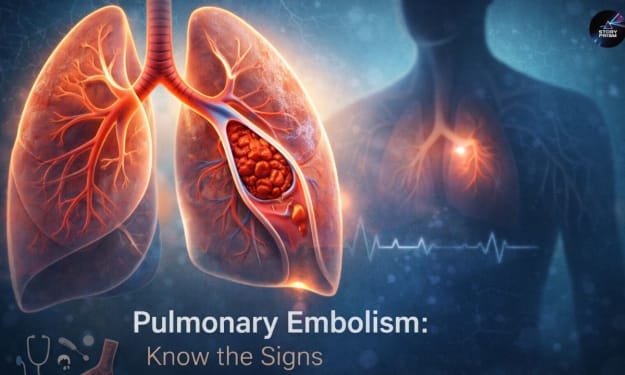
Pulmonary Embolism: Symptoms, Causes, Treatment, and Prevention of a Silent Killer
Introduction Pulmonary embolism (PE) is a serious, potentially life-threatening condition that occurs when a blood clot blocks one or more arteries in the lungs. It is one of the most critical emergencies in cardiovascular health, ranking just after heart attacks and strokes in terms of morbidity and mortality. PE often originates from deep vein thrombosis (DVT), a blood clot in the veins of the legs or pelvis, that travels through the bloodstream to the lungs. Understanding the risk factors, early symptoms, diagnostic methods, treatment options, and preventive strategies is essential to improving outcomes and saving lives.
By Story Prism2 days ago in Longevity
VITAMINS THAT KEEP FEMALES ALWAYS TEENAGER
Vitamins Required for Healthy Skin and Hair Growth Healthy skin and strong, lustrous hair are not achieved by external care alone. While creams, oils, and shampoos help protect and nourish from the outside, true beauty begins from within. Vitamins play a crucial role in maintaining skin elasticity, preventing premature aging, supporting hair growth, and reducing hair fall. A deficiency in essential vitamins often reflects quickly through dull skin, acne, pigmentation, brittle hair, and excessive hair loss.
By Ibrahim Shah 5 days ago in Longevity



Comments
There are no comments for this story
Be the first to respond and start the conversation.