
Gunmen Raid Village in Northern Nigeria, Killing at Least 30 People and Abducting Others
A fresh wave of violence underscores Nigeria’s deepening security crisis as rural communities remain trapped between armed groups and limited state protection

StartNorthern Nigeria has once again been shaken by violence after gunmen raided a rural village, killing at least 30 people and abducting several others in a late-night attack that has left survivors traumatized and communities fearful of what may come next. The assault, carried out by heavily armed attackers on motorcycles, highlights the worsening insecurity gripping large parts of the country’s north and the persistent vulnerability of rural populations.
According to local residents and community leaders, the attackers stormed the village under cover of darkness, firing indiscriminately and setting homes ablaze. Many villagers were caught unprepared, asleep in their homes as gunfire echoed through the area. Those who attempted to flee were pursued, while others were forced to watch as relatives and neighbors were killed.
By morning, the scale of the devastation became clear. Bodies lay scattered across the village, homes were reduced to ashes, and families searched desperately for loved ones believed to have been abducted. While official casualty figures are still being verified, local sources report that at least 30 people were killed, with dozens more injured or missing.
A Pattern of Violence
This latest attack is not an isolated incident. Northern Nigeria has experienced years of violence linked to armed banditry, militant extremism, and communal conflict. Criminal groups, often referred to locally as bandits, have increasingly targeted villages for raids involving killings, kidnappings, and livestock theft. These groups operate across vast, hard-to-police territories, exploiting weak security presence and difficult terrain.
Kidnappings for ransom have become a grim feature of life in many northern states. Abducted villagers are often held in forest hideouts while families struggle to raise money for their release. In some cases, victims are never returned, fueling fear and mistrust within affected communities.
Residents say the gunmen involved in this attack appeared well organized and heavily armed, suggesting links to the broader network of criminal gangs operating across the region. The use of motorcycles, a common tactic, allows attackers to strike quickly and disappear before security forces can respond.
Impact on Civilians
For civilians, the consequences are devastating. Survivors describe scenes of chaos and helplessness as families were torn apart. Women and children are often the most affected, either losing breadwinners or being taken hostage themselves. Entire villages have been forced to flee, abandoning farms and livelihoods in search of safety.
Displacement has placed additional pressure on neighboring communities already struggling with poverty and limited resources. Schools have closed, healthcare access has been disrupted, and food insecurity is worsening as farmers fear returning to their fields.
Local leaders warn that without urgent intervention, the cycle of violence will continue to escalate. “People are living in constant fear,” one community elder said. “We do not know when they will come again, and we feel forgotten.”
Government Response and Challenges
Nigerian authorities have condemned the attack and pledged to bring those responsible to justice. Security forces have reportedly been deployed to the area, and investigations are underway. However, many residents remain skeptical, citing past promises that failed to bring lasting security.
The Nigerian government faces significant challenges in addressing violence in the north. Security forces are stretched thin, dealing simultaneously with insurgency in the northeast, banditry in the northwest, and communal clashes in other regions. Poor infrastructure, limited intelligence, and accusations of corruption further complicate efforts.
Analysts argue that military action alone is unlikely to resolve the crisis. Addressing the root causes of insecurity—such as poverty, unemployment, weak governance, and the proliferation of small arms—is essential for long-term stability.
A Regionalconsideration
The violence in northern Nigeria also has broader regional implications. Insecurity threatens cross-border trade, fuels displacement into neighboring countries, and undermines economic development across West Africa. Humanitarian organizations warn that continued instability could lead to a larger crisis if left unchecked.
International partners have expressed concern and offered support, but lasting solutions depend largely on coordinated domestic efforts. Strengthening local policing, investing in rural development, and rebuilding trust between communities and authorities are often cited as critical steps forward.
Lives Caught in the Middle
For now, the focus remains on the victims. Families are burying their dead, searching for the abducted, and trying to rebuild amid uncertainty. Community members have called for increased security patrols and better early-warning systems to prevent future attacks.
As northern Nigeria mourns yet another tragedy, the raid serves as a stark reminder of the human cost of ongoing insecurity. Until meaningful action is taken to protect vulnerable communities, villages like this one will remain on the front lines of a conflict that shows no sign of ending. writing...
About the Creator
Keep reading
More stories from Ayesha Lashari and writers in The Swamp and other communities.
Swiss Open Criminal Case Against Managers of Ski Resort Bar After Deadly Fire
Swiss authorities have opened a criminal investigation into the managers of a ski resort bar after a deadly fire claimed the lives of several people and injured many more. The fire, which occurred in the early hours of the morning, has shocked the local community and drawn national attention to the safety practices at recreational venues, particularly those that serve alcohol.
By Ayesha Lashari2 months ago in The Swamp
Why Black History Matters in America?
The United States of America is celebrating their 250th anniversary in 2026. I'm proud to be an American and as someone who was born here, I wouldn't imagine myself living anywhere else. This is a country where opportunities are possible. Where anyone can be successful in anything they desire to do. Equality, community, and togetherness are the backbones of what America is and should be about. However, we have an administration who wants to erase and disregard those who have made positive, meaningful impacts in our country, specifically Black figures, such as Martin Luther King, Jr., Rosa Parks, and Maya Angelou. President Trump and his administration have been constantly complaining and fighting against what they call the "Woke agenda". They use this excuse as a distraction from other issues they refuse to address, such as the high cost of living, climate change, and inflation. That equality is dividing America, when in reality, it's bringing us together. Being woke is not tied to a specific political party. No matter where you stand on the political spectrum, you can still care about other people and their plights. Compassion and empathy for others isn't tied to a political party, either. We were taught as children to treat others the way we want to be treated and not judge others because they're different from us. Caring about others isn't a personal attack on your beliefs. It doesn't make you any less of a person. People who are easily offended over African American figures, past or present, or anything related to it, are grasping at straws. Current and future generations need to know who people like Harriet Tubman and Shirley Chisholm were, especially in the classroom. Black History is part of American History. It should be recognized, not hidden or forgotten. Besides, you can't shield children from everything, just because your feelings are easily hurt.
By Mark Wesley Pritchard 17 days ago in The Swamp
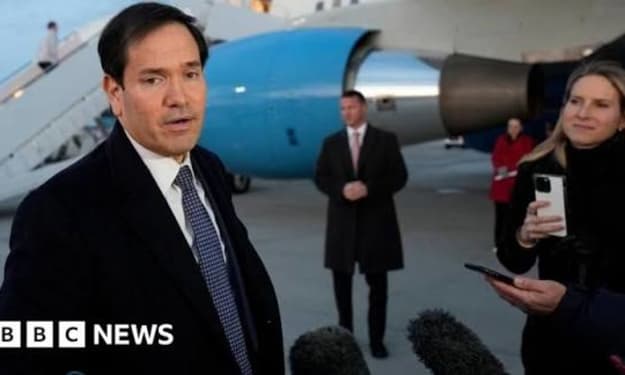
Rubio Warns Europe of New Era in Geopolitics Ahead of Major Munich Speech
U.S. Senator Marco Rubio has warned European leaders that the world is entering a new and more dangerous era of geopolitics, marked by shifting alliances, intensifying great-power competition, and growing instability. His remarks come ahead of a highly anticipated speech at the Munich Security Conference, one of the world’s most influential gatherings of political and security leaders. In comments released before his address, Rubio said that Europe and the United States must prepare for a future defined less by cooperation and more by rivalry among major powers, particularly involving China, Russia, and regional actors seeking to challenge the Western-led international order. “We are no longer living in the post–Cold War moment,” Rubio said. “We are entering a period where power politics is returning, and democracies must be prepared to defend not only their interests but their values.” A Changing Global Landscape Rubio’s warning reflects growing concern in Washington that global politics is undergoing a fundamental transformation. Conflicts in Ukraine and the Middle East, rising tensions in the Indo-Pacific, and the spread of advanced military technologies have reshaped strategic thinking across NATO and the European Union. According to Rubio, Europe can no longer assume that peace and stability will be guaranteed through diplomacy alone. He argued that defense spending, military readiness, and technological innovation must become central priorities for Western nations. “The idea that economic interdependence alone would prevent conflict has proven wrong,” he said. “Authoritarian states are using trade, energy, and technology as tools of coercion.” His message is expected to resonate strongly in Munich, where leaders from more than 40 countries will discuss security threats ranging from cyber warfare and artificial intelligence to energy security and climate-related risks. Focus on Russia and China A central theme of Rubio’s upcoming speech is expected to be the twin challenges posed by Russia and China. He has consistently described Russia’s war in Ukraine as a defining conflict for Europe’s future and warned that failure to deter Moscow could embolden other powers. Rubio is also expected to urge European governments to reduce their economic dependence on China, particularly in strategic sectors such as telecommunications, rare earth minerals, and advanced manufacturing. “Europe must decide whether it wants strategic autonomy or strategic vulnerability,” Rubio said. “You cannot rely on authoritarian regimes for the foundations of your economy and security.” His comments come as several European countries reassess their trade and investment policies with Beijing, amid fears of supply chain disruption and political pressure. Pressure on NATO Unity Rubio’s remarks also highlight concerns over unity within NATO. While the alliance has expanded and strengthened its eastern defenses since the Ukraine war, divisions remain over burden-sharing and long-term strategy. He warned that internal disagreements could weaken Europe’s ability to respond to future crises. “Adversaries are watching for cracks in our unity,” Rubio said. “They believe democracies are too divided and too slow to act. We must prove them wrong.” The senator is expected to call for closer U.S.–European cooperation on defense production, intelligence sharing, and joint military exercises, arguing that fragmented responses would only benefit rival powers. Europe’s Role in a New Era European officials attending the Munich conference are likely to view Rubio’s speech as both a challenge and a reassurance. On one hand, his message underscores the seriousness of the threats facing Europe. On the other, it signals continued American engagement in European security at a time when questions persist about the future direction of U.S. foreign policy. Several European diplomats have privately acknowledged that the geopolitical environment has changed more rapidly than anticipated. One senior EU official said that Rubio’s warning reflects “a broader recognition that the old assumptions about stability no longer apply.” The conference is expected to include discussions on strengthening Europe’s defense industry, protecting critical infrastructure, and coordinating responses to hybrid threats such as disinformation campaigns and cyberattacks. A Broader Political Signal Rubio’s appearance in Munich also carries political significance at home. As a prominent voice on foreign policy in the U.S. Senate, he has positioned himself as a leading advocate for a tougher stance on authoritarian powers and for renewed leadership among democratic allies. His speech is likely to be seen as part of a broader effort to shape Western strategy for the coming decade, emphasizing deterrence, resilience, and unity. Analysts say his warning should not be interpreted as pessimism but as a call to action. “This is about preparing Europe and the United States for a world where competition is the norm,” said one transatlantic security expert. “Rubio is urging leaders to face reality and adapt.” Looking Ahead As Rubio takes the stage in Munich, his message will test how ready European governments are to confront a harsher geopolitical climate. Whether his call leads to concrete policy shifts remains to be seen, but his warning underscores a growing consensus that the global order is entering a period of profound change. For Europe, the challenge will be to translate rhetoric into long-term strategy — ensuring that security, economic independence, and democratic values remain at the center of its response to a rapidly evolving world.
By Fiaz Ahmed 6 days ago in The Swamp
Where there's Art there's Heart
Here's a stupid thing: I adore art, but I start to panic whenever I step into a gallery. In the one place I should be at my contented best - surrounded by walls teeming with creative expression - I fall apart. What ought to be an enriching experience, tacitly designed to facilitate the exploration of human empathy and perspective, is for me an overwhelming purgatory of anxiety that compresses me to the point I cannot breathe. At the same time, I experience a sense of extraction, as though my head is being prized open to create a hole so big my sanity could evaporate. Somewhere between these two opposing forces of vice and vortex, I feel myself dissolving in a stream of panic that makes me want to cry; and I feel so daft feeling this way, that all I want to do is run for the hills.
By Caroline Jane2 days ago in Humans



Comments
There are no comments for this story
Be the first to respond and start the conversation.