
Jesse Jackson was supposed to be the first Black President
Before Obama, There was Jesse Jackson. He supposed to the first Black President.

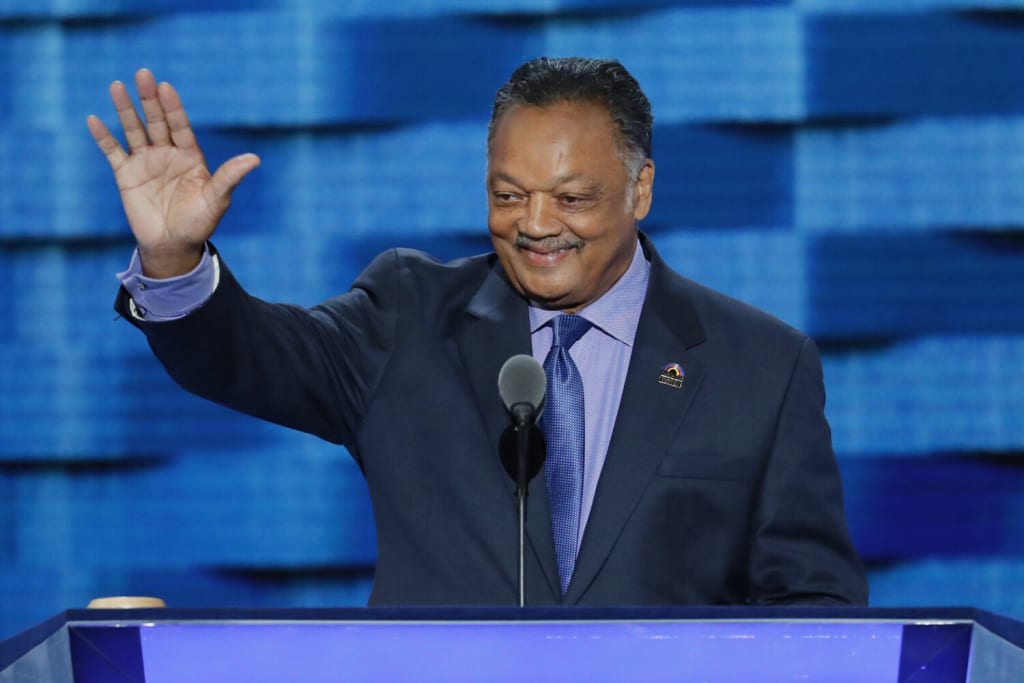
Before Barack Obama became the first Black president, there was Reverend Jesse Jackson. Rev. Jesse Jackson was running for president in 1984 and 1988. Though he didn't win presidency, Jackson continues with his political activism and fighting for equality. In the light of Reverend Jesse Jackson's passing let's look back how Jackson became a political activist and a former presidential candidate.
Born Jesse Louis Burns on October 8, 1941, in Greenville, South Carolina to his parents: Helen Burns and Noah Louis Robinson. Burns was a teenager when she had Jesse while his father was married. A year after Jesse's birth, his mother married Charles Henry Jackson, a post-office maintenance worker who later adopted him. As a child, Jesse Jackson was taunted by other children about his out‑of‑wedlock birth, and he said these experiences helped motivate him to succeed. Living under Jim Crow segregation laws, he was taught to go to the back of the bus and to use separate water fountains practices he accepted until the Montgomery bus boycott of 1955. He attended a racially segregated school, Sterling High School in Greenville, where he was elected student class president, finished 10th in his class, and earned letters in baseball, football, and basketball.
While in college, Jackson played quarterback and was elected student body president. He became active in local civil-rights protests against segregated libraries, theaters, and restaurants. He graduated with a B.S. degree in sociology in 1964, then attended the Chicago Theological Seminary on a scholarship. He left the seminary in 1966, three classes short of earning his master's degree, to focus full-time on the civil rights movement. He was ordained a minister in 1968 and was awarded a Master of Divinity degree by Chicago Theological Seminary in 2000, based on his previously earned credits and his subsequent work and life experience. In 1965, he went to Selma, Alabama, to march with Dr. Martin Luther King, Jr., eventually becoming a worker in King's Southern Christian Leadership Conference (SCLC). In 1966, he moved his young family to Chicago, where he did graduate work at the Chicago Theological Seminary. Jackson never finished his studies but was later ordained by the minister of a Chicago church.
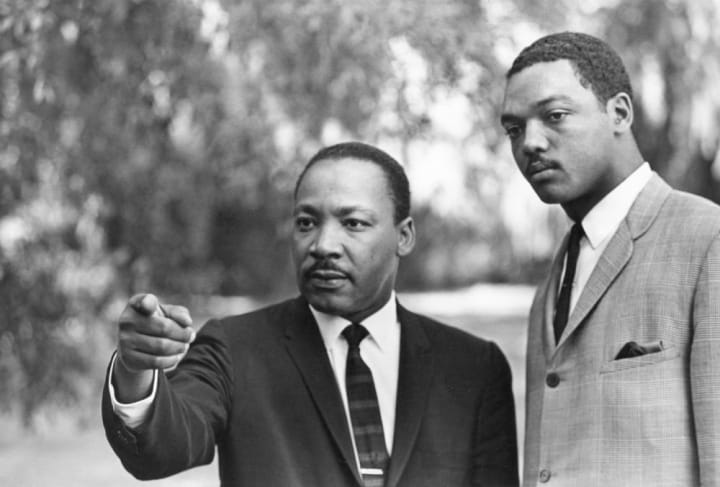
While King, at first, was enamored with the brashness of the young leader, not everyone in the organization felt the same way. Many felt that Jackson acted too independently, and eventually King came to tire of him as well. Just five days before his assassination, King stormed out of a meeting after Jackson had repeatedly interrupted him. Jackson traveled with King to Memphis, where King was assassinated on April 4, 1968, while standing on the balcony of his hotel room. Jackson, who was in a room one floor below King's, later told reporters he was the last to talk to Dr. King he claimed, in his arms until he died. The events, as Jackson described them, immediately set off a wave of anger among others who were at the scene and claimed Jackson had overstated his presence at King's shooting for his own gain.
Jackson was eventually suspended by the SCLC. He formally resigned from the organization in 1971. The same year Jackson left the SCLC, he founded Operation PUSH (People United to Save Humanity). Jackson created the organization, based in Chicago, in order to advocate Black self-help and in a sense let it serve as his political pulpit. In 1984, Jackson established the National Rainbow Coalition, whose mission was to establish equal rights for African Americans, women, and LGBTQ people. The two organizations merged in 1996 to form the Rainbow PUSH Coalition.
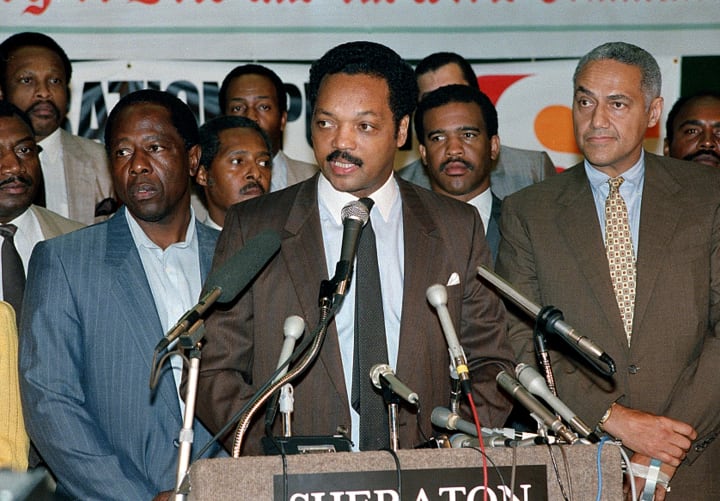
In the late 1970s, he began traveling around the world to mediate or spotlight problems and disputes. He visited South Africa in 1979 and spoke out against the country's apartheid policies, and later traveled to the Middle East to throw his support behind the creation of a Palestinian state. He also got behind democratic efforts in the small island nation of Haiti. In 1984, when Jackson launched his first Democratic presidential campaign, many in the political establishment treated it as symbolic. A protest candidacy. A statement run. The assumption was that a Black man could rally Black voters but not build a viable national coalition. Jackson proved that assumption wrong.
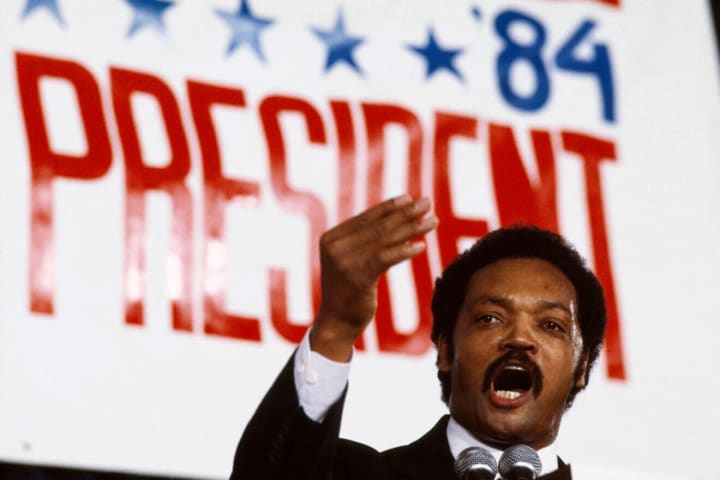
But the campaign also sparked some controversy when, in a January 1984 interview with a Washington Post reporter, Jackson referred to Jews as “Hymies” and to New York City as “Hymietown.” Protests erupted, and Jackson apologized for the remarks one month later. In 1988, Jackson made a second presidential run, this time finishing second in the Democratic primaries to Massachusetts Governor Michael Dukakis, winning more than 7 million votes.
Jackson's candidacy divided support among black politicians, and even prominent African Americans such as Coretta Scott King who supported his right to run, refrained from endorsing him due to their belief he would not win the nomination. Among black office-holders, Jackson received the support of former Mayor of Atlanta Maynard Jackson, and Mayor of Newark Kenneth A. Gibson. Jackson entered the race after most prominent Democrats including Senator Gary Hart, and former Vice President Walter Mondale. In December, he was endorsed by National Baptist Convention, USA, Inc. chairman T. J. Jemison, and lost the endorsement of the Alabama Democratic Conference, the largest black political organization in Alabama, to Mondale.
In January, Jackson participated in the first Democratic debate in Hanover, New Hampshire. Although Jackson campaign issues coordinator Frank Watkins said the campaign did not "have to spend but a moment's time on how to utilize TV, because he understands that better than any of the other candidates and most of their media advisers", his performance was criticized for being "either wrong or uninformed". Neither Jackson or Senator Fritz Hollings campaigned prolifically in Iowa ahead of the Iowa caucuses which Mondale won. Jackson took part in the February 24 League of Women Voters-sponsored debate and The New York Times wrote that Jackson "provided the most dramatic exchange of the 90-minute program when Barbara Walters, the ABC News interviewer who was the moderator, asked him if he had made anti-Semitic statements, including referring to Jews as 'Hymies.'" Hart defended Jackson as having "no derogatory feelings in his soul"; Jackson won the New Hampshire primary. Jackson did not seek the presidency again, but in 1990 he was elected as the District of Columbia's shadow senator, serving one term during the Bush and Clinton administrations. Although initially critical of President Bill Clinton, he later became a supporter. Jackson hosted Both Sides with Jesse Jackson on CNN from 1992 to 2000. In 2008, Jackson supported then Senator Barack Obama running for president until Obama won his presidency leaving Jackson in tears.
Though Jackson did not become president. But he made it harder for anyone to say a Black man could not.
Hope to keep the Coalition Alive
Rest in Power Reverend Jackson.
Sources
YouTube
Bet.com
Biography.com
About the Creator
Gladys W. Muturi
Hello, My name is Gladys W. Muturi. I am an Actress, Writer, Filmmaker, Producer, and Mother of 1.
Instagram: @gladys_muturi95
Facebook: facebook.com/gladystheactress
YouTube: @gladys_muturi
Keep reading
More stories from Gladys W. Muturi and writers in The Swamp and other communities.
I'm Not Surprised with Nicki Minaj
Nicki Minaj has turned into MAGA Barbie and I am not surprised since I had never been a fan of Nicki, I did liked her music, and I never really liked Nicki since the 2010s. Honestly, during the 2010s era, I was a teen in high school, all teens were obsessing with Young Money artists like Lil Wayne, Drake, Lil Twist, Birdman, and then there was Nicki Minaj, the Barbie wig wearing bimbo wearing wack ass fashion wannabe Lady Gaga even though she admires and respects her. Recently, Rapper Nicki Minaj made a surprise appearance at the Turning Point USA AmericaFest summit invited by Erika Kirk, the widow of Charlie Kirk and the new leader of Turning Point. At the event, Maga Minaj was speaking for her administration and upmost respect for President Trump. Minaj was calling the current Vice President J.D. Vance an "assassin" in a cringey way like why say that in front of a widow whose husband got assassinated. Her remarks led to significant fan backlash, and as of Wednesday, her Instagram account now reads: “Sorry, this page isn’t available.” A number of followers unfollowed the supposed Queen of Rap after showing support for Trump. Barbz fans were mixed with emotions about Nicki's support. Honestly, it didn't surprise me that Ms. Minaj is showing support for Trump. Here are reasons why...
By Gladys W. Muturi16 days ago in The Swamp
Why Black History Matters in America?
The United States of America is celebrating their 250th anniversary in 2026. I'm proud to be an American and as someone who was born here, I wouldn't imagine myself living anywhere else. This is a country where opportunities are possible. Where anyone can be successful in anything they desire to do. Equality, community, and togetherness are the backbones of what America is and should be about. However, we have an administration who wants to erase and disregard those who have made positive, meaningful impacts in our country, specifically Black figures, such as Martin Luther King, Jr., Rosa Parks, and Maya Angelou. President Trump and his administration have been constantly complaining and fighting against what they call the "Woke agenda". They use this excuse as a distraction from other issues they refuse to address, such as the high cost of living, climate change, and inflation. That equality is dividing America, when in reality, it's bringing us together. Being woke is not tied to a specific political party. No matter where you stand on the political spectrum, you can still care about other people and their plights. Compassion and empathy for others isn't tied to a political party, either. We were taught as children to treat others the way we want to be treated and not judge others because they're different from us. Caring about others isn't a personal attack on your beliefs. It doesn't make you any less of a person. People who are easily offended over African American figures, past or present, or anything related to it, are grasping at straws. Current and future generations need to know who people like Harriet Tubman and Shirley Chisholm were, especially in the classroom. Black History is part of American History. It should be recognized, not hidden or forgotten. Besides, you can't shield children from everything, just because your feelings are easily hurt.
By Mark Wesley Pritchard 17 days ago in The Swamp
Two Pakistani Nationals Indicted in U.S. Over Alleged $10 Million Healthcare Fraud Scheme
Two Pakistani nationals have been indicted in the United States for their alleged involvement in a $10 million healthcare fraud scheme, according to an announcement by the United States Department of Justice. Federal authorities claim the accused orchestrated a complex billing operation that targeted Medicare and private insurance providers, resulting in millions of dollars in fraudulent reimbursements.
By Ayesha Lashari6 days ago in The Swamp
Where there's Art there's Heart
Here's a stupid thing: I adore art, but I start to panic whenever I step into a gallery. In the one place I should be at my contented best - surrounded by walls teeming with creative expression - I fall apart. What ought to be an enriching experience, tacitly designed to facilitate the exploration of human empathy and perspective, is for me an overwhelming purgatory of anxiety that compresses me to the point I cannot breathe. At the same time, I experience a sense of extraction, as though my head is being prized open to create a hole so big my sanity could evaporate. Somewhere between these two opposing forces of vice and vortex, I feel myself dissolving in a stream of panic that makes me want to cry; and I feel so daft feeling this way, that all I want to do is run for the hills.
By Caroline Jane2 days ago in Humans




Comments
There are no comments for this story
Be the first to respond and start the conversation.