
Mexican Drug Lord Killing Sparks Revenge Attacks; Cars and Businesses Set Ablaze, Highways Blocked
Retaliatory cartel violence in Mexico leaves streets blocked, businesses burned, and residents fearful following the killing of a prominent drug lord.

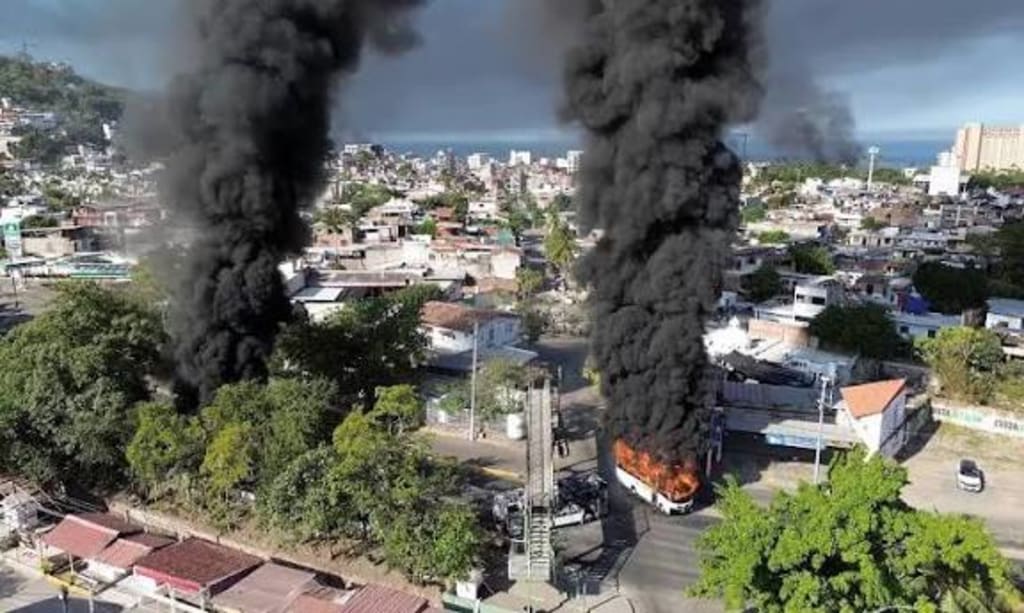
A violent wave of retaliatory attacks has swept across multiple towns in Mexico following the killing of a high-profile drug lord, leaving residents fearful and authorities scrambling to restore order. The murder, carried out in the early hours last week, appears to have triggered coordinated revenge assaults by rival cartel factions, with cars torched, businesses set on fire, and major highways blocked.
The victim, whose name has been withheld for security reasons, was a leading figure in one of Mexico’s largest criminal organizations operating in northern and central regions. His death has reignited tensions between rival groups already vying for territorial control over lucrative smuggling routes and drug markets.
Chaos on the Streets
Eyewitnesses report seeing masked individuals setting vehicles ablaze along major thoroughfares, forcing motorists to abandon their cars and flee. In some cases, commercial establishments, including grocery stores and gas stations, were targeted, leaving property damaged and residents temporarily stranded.
Highways connecting key urban centers were blocked with burning barricades, delaying emergency services and disrupting the movement of goods. Local authorities confirmed that multiple attempts to clear the roads were met with resistance, and in some areas, police officers had to retreat under threat of armed confrontation.
Residents described a terrifying scene. “We could hear explosions and gunfire all night,” said one witness in Mexico’s northern state. “People were shouting, running, and hiding. It felt like the city had completely disappeared.”
Law Enforcement Response
Mexican security forces deployed reinforcements in affected areas, including federal police and military units, to contain the violence. Helicopters patrolled the skies, while checkpoints were set up along strategic highways to prevent further attacks. Officials emphasized that restoring public safety is a top priority, but acknowledged the difficulty of confronting highly organized and heavily armed groups.
“The situation is extremely volatile,” said a government spokesperson. “We urge residents to remain indoors and report any suspicious activity. Coordination between federal, state, and local authorities is ongoing.”
Impact on Civilians
The retaliatory attacks have caused widespread disruption for civilians. Schools were closed in some towns, businesses suspended operations, and local transport services were halted. In addition to property damage, residents report heightened anxiety and fear for personal safety, particularly in neighborhoods located near known cartel territories.
Hospitals in affected regions have remained open but report an influx of individuals with minor injuries from stampedes, burns, and smoke inhalation. While no official death toll has been released beyond the initial cartel killing, emergency services are preparing for the possibility of further casualties if the violence escalates.
Criminal Dynamics
Experts note that such episodes of retribution are common in the Mexican cartel landscape, where power vacuums created by the killing of a leader often provoke swift retaliation. “These are not random acts,” said a Latin American security analyst. “They are strategic moves intended to send a message, intimidate rivals, and assert dominance over contested territories.”
Analysts also point to the broader implications for public safety and governance. The cyclical nature of cartel violence undermines trust in law enforcement and highlights the persistent challenge of controlling organized crime in regions where state presence is limited.
Government Measures
The federal government has announced plans to increase intelligence operations, enhance surveillance of key transport routes, and implement emergency response protocols for civilians. Officials have also called on community leaders to cooperate with authorities in reporting suspicious activity and to discourage participation in violent reprisals.
At the same time, local mayors have emphasized the need for long-term solutions, including social programs and economic initiatives aimed at reducing the influence of criminal networks in vulnerable communities.
Conclusion
The killing of a high-profile drug lord has sparked a wave of violent retaliation across Mexico, illustrating the fragility of security in regions dominated by organized crime. As authorities work to contain the attacks, residents remain caught in the crossfire, highlighting the ongoing struggle to maintain law and order in the face of entrenched cartel violence.
About the Creator
Fiaz Ahmed
I am Fiaz Ahmed. I am a passionate writer. I love covering trending topics and breaking news. With a sharp eye for what’s happening around the world, and crafts timely and engaging stories that keep readers informed and updated.
Keep reading
More stories from Fiaz Ahmed and writers in The Swamp and other communities.
Life or Death Over Yemen: How Two F-16 Pilots Survived a Houthi SAM Ambush
In the skies over northern Yemen, two F-16 pilots faced the nightmare scenario that every combat aviator dreads: a sudden surface-to-air missile (SAM) attack. The incident, which took place during a coalition strike mission, highlights both the dangers of modern asymmetric warfare and the extraordinary skill required to survive in hostile airspace dominated by mobile, well-hidden air-defense systems. The pilots, part of a multinational air operation supporting coalition objectives, were tasked with a precision strike against insurgent positions linked to the Houthi movement. Intelligence had identified high-value targets, but the threat of SAMs in the region is notoriously difficult to predict. Yemen’s mountainous terrain provides insurgents with natural cover, and they have increasingly relied on portable, radar-guided missile systems to challenge coalition air superiority. A Sudden Threat According to sources familiar with the mission, the pilots were flying at medium altitude when radar warning receivers triggered multiple alerts. “The SAM launch indicators came up instantly,” said one official. “They had only seconds to react.” The first missile, a radar-guided surface-to-air system, was detected by the F-16’s onboard warning sensors. The pilots executed evasive maneuvers at breakneck speed, using the jet’s afterburners, flares, and sharp banking turns to confuse the missile’s tracking system. “It’s a test of both training and instinct,” said a retired fighter pilot familiar with the aircraft. “Every move must be precise. Hesitation can be fatal.” Teamwork Under Fire The survival of the two pilots was a direct result of coordinated teamwork. Flying in close formation, they alternated between offensive maneuvers and defensive positioning, ensuring that each aircraft could monitor the other’s blind spots. Their wingman maintained visual contact while the lead pilot executed high-G turns to evade the incoming missile. This level of coordination reflects years of rigorous training, often simulated in high-intensity combat drills. “You rehearse these scenarios countless times,” the retired pilot explained. “But there’s nothing like real fire to test your mettle.” Countermeasures and Modern Technology F-16s are equipped with advanced electronic countermeasures designed to disrupt enemy targeting systems. During the ambush, the pilots deployed infrared flares to decoy heat-seeking missiles and electronic jamming to interfere with radar-guided projectiles. These tools are critical in survival, especially against the portable, manned SAM systems increasingly used by non-state actors. “The jet itself gives you options, but it’s the pilot’s skill that makes the difference,” noted a defense analyst. “Technology can only go so far if the operator hesitates.” Returning to Base After several tense minutes, the pilots successfully evaded all incoming threats and regrouped at a safer altitude. Damage inspections revealed no critical hits, and the jets returned to base intact. The mission underscored both the persistent threat environment in Yemen and the ability of well-trained aircrews to operate under extreme pressure. “The debrief focused on lessons learned,” said a coalition spokesperson. “Situational awareness, real-time intelligence, and decisive action were key. These are not hypothetical skills—they save lives.” Strategic Implications The incident also highlights the evolving nature of air warfare. Insurgent groups are increasingly sophisticated, blending traditional guerrilla tactics with modern missile systems. Coalition forces must adapt constantly, emphasizing pilot training, electronic warfare, and intelligence gathering to maintain air superiority. Military analysts note that small-scale SAM ambushes, while not capable of turning the tide of a conflict, pose a persistent threat to manned aircraft and can have a psychological impact on aircrews. Courage Above the Clouds The survival of the two F-16 pilots serves as a testament to courage, training, and the enduring danger of combat missions in contested airspace. Their actions remind the global military community that even in an era of drones and precision weapons, the human element remains decisive. As one official summarized, “It’s about preparation, teamwork, and the split-second decisions that keep pilots alive. In the end, it’s life or death—and these two made it back.”
By Fiaz Ahmed about 19 hours ago in The Swamp
A Gathering of Evil Bosses
“I’m the queen of chin jutting while I smooth my hair, attacking, insulting, and deflecting to protect my appointer.” “Oh, please, Blondi, my hair is curled, highlighted, and longer than yours. I feature television commercials telling immigrants that we will give them a free plane ride home, and if they voluntarily turn themselves in, they will be allowed to legally apply for re-entry. It runs everywhere, and I look good in it! You can’t compete because of your blond hair. Mine is nicer, and my lips are prettier than yours.”
By Andrea Corwin 5 days ago in The Swamp
ANZ Sees Gold Hitting $5,800 an Ounce in the Second Quarter
Gold’s historic ascent may be far from over. In a bold new outlook, ANZ has projected that bullion could surge to $5,800 per ounce in the second quarter, reinforcing the growing belief among major financial institutions that the precious metal is entering a new structural bull market.
By Sadaqat Ali6 days ago in The Swamp
Magic
Note from the Author: I want to let you know that this is an unusual story, and it has been written purely from whatever is in my unconscious mind, because before I start writing, I get into a flow state that reaches my unconsciousness. I also write in my subconscious mind, which is like a mid-flow state between the conscious and unconscious mind.
By Denise Larkina day ago in Fiction




Comments
There are no comments for this story
Be the first to respond and start the conversation.