
Navalny Was Poisoned With Frog Toxin, European Governments Say
New forensic tests point to rare poison as tensions rise between Russia and Europe

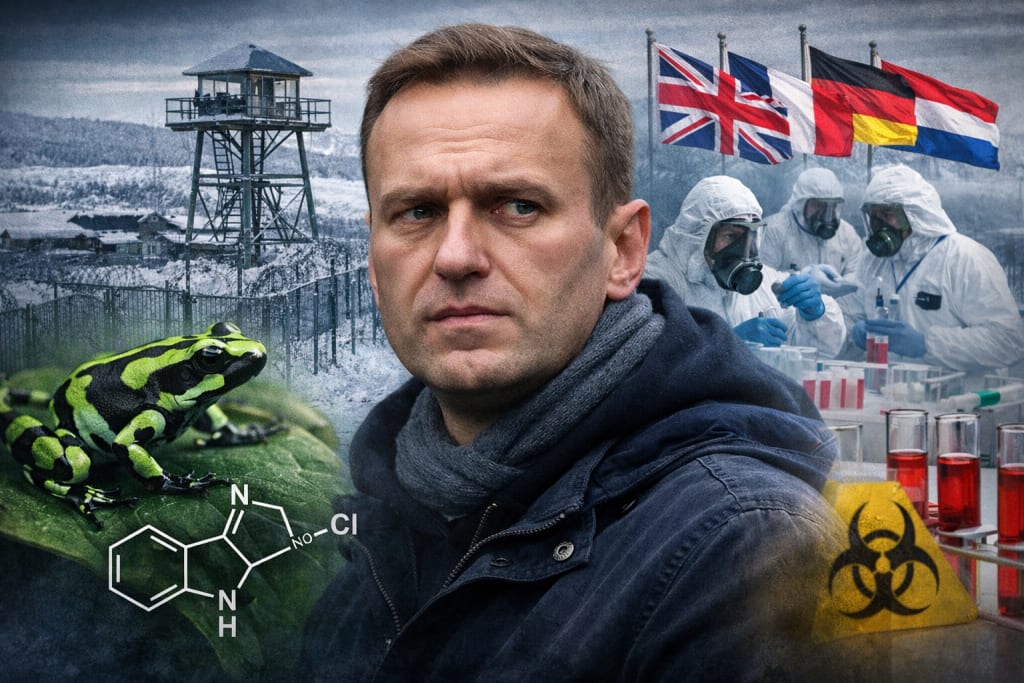
European governments say that Russian opposition leader Alexei Navalny was killed with a rare poison taken from a frog toxin. The claim comes after new laboratory tests were done on samples from his body. Leaders from the United Kingdom, France, Germany, Sweden, and the Netherlands say the evidence shows he was poisoned with a substance called epibatidine. This chemical is found in certain poison dart frogs from South America.
Navalny died on February 16, 2024, in a remote Arctic prison colony in Russia. At the time, Russian authorities said he died of natural causes. However, many Western leaders questioned that explanation. Now, two years later, European officials say scientific tests prove he was poisoned.
Alexei Navalny was one of the strongest critics of Russian President Vladimir Putin. For years, he led anti-corruption investigations and organized protests across Russia. He was arrested many times. In 2020, he was poisoned with a nerve agent known as Novichok but survived after receiving treatment in Germany. When he returned to Russia in 2021, he was arrested again and later sentenced to a long prison term.
His death in prison shocked the world. Many world leaders blamed the Kremlin immediately, even before the new test results were released. Navalny’s supporters believed he was killed because of his political views and his growing influence.
According to European officials, the new tests found traces of epibatidine in Navalny’s body. Epibatidine is a powerful neurotoxin. It attacks the nervous system and can cause breathing to stop. Even a very small amount can be deadly. The toxin was first discovered in poison dart frogs found in Ecuador and other parts of South America. Scientists say it is much stronger than morphine.
European governments say this toxin does not occur naturally in Russia. They argue that it would have required advanced knowledge and resources to obtain and use such a substance. In a joint statement, the five countries said Russia had the “means, motive, and opportunity” to poison Navalny.
The governments also said they plan to report the findings to the Organization for the Prohibition of Chemical Weapons (OPCW). The OPCW is an international body that works to prevent the use of chemical weapons. If the claim is confirmed, it could be seen as a serious violation of international law.
Russia has denied the accusations. Russian officials say there is no proof that Navalny was poisoned. They continue to insist that he died of natural causes. The Kremlin has called the European claims politically motivated.
Navalny’s widow, Yulia Navalnaya, welcomed the new findings. She has long said that her husband was murdered. After the European announcement, she said the truth is finally coming out. She promised to continue fighting for justice and for a democratic Russia.
The case has increased tensions between Russia and Western countries. Relations were already strained because of the war in Ukraine and previous sanctions. Now, European leaders are discussing possible new sanctions against Russia. Some officials say stronger action is needed to hold those responsible accountable.
This is not the first time Russian authorities have been accused of using poison against critics. In 2018, former Russian spy Sergei Skripal and his daughter were poisoned in the United Kingdom with a nerve agent. In 2006, Alexander Litvinenko died in London after being poisoned with radioactive polonium-210. In both cases, Western governments blamed Russia. Moscow denied involvement.
The alleged use of epibatidine is unusual. Most known political poisonings linked to Russia involved nerve agents or radioactive substances. Using a frog toxin would be rare and difficult to trace. Experts say it could have been chosen to avoid detection.
Scientists explain that epibatidine works by affecting receptors in the nervous system. It can cause seizures, paralysis, and respiratory failure. Because it acts quickly and powerfully, it can be fatal before medical help arrives. However, it is not commonly used outside of research settings.
The announcement from European governments raises many questions. How was the toxin obtained? How was it given to Navalny inside a high-security prison? Who ordered the poisoning? These questions may take years to answer.
Human rights groups say Navalny’s death shows the dangers faced by political opponents in Russia. They are calling for an independent international investigation. Some activists argue that justice will not be possible without political change in Russia
At the same time, the situation is complex. Proving responsibility in international cases is difficult. Political tensions can make investigations more challenging. Russia is unlikely to cooperate with Western-led inquiries. This could limit access to evidence and witnesses.
The case also has a strong emotional impact. Navalny was seen by many as a symbol of hope for democratic reform in Russia. His decision to return to Russia after surviving the 2020 poisoning made him a powerful figure. Supporters say he knew the risks but chose to stand by his beliefs.
His death has inspired protests among Russian communities abroad. Memorials were held in several European cities. Many people see him as a symbol of resistance against corruption and authoritarian rule.
For Europe, the announcement is about more than one individual. It raises concerns about the use of chemical substances for political purposes. If confirmed, it would challenge international agreements designed to prevent chemical weapons.
The coming months may bring more diplomatic pressure and possible sanctions. European leaders say they will continue to push for accountability. Russia says the accusations are part of a campaign to damage its reputation.
In the end, the truth may depend on international cooperation and further scientific review. What is clear is that Navalny’s death continues to shape global politics. It has deepened divisions between Russia and the West and strengthened calls for justice.
The story of Alexei Navalny is one of courage, controversy, and conflict. Now, with new claims about a rare frog toxin, it has entered another chapter. Whether the world will see clear answers remains uncertain. But the impact of his life and death continues to be felt around the globe.
About the Creator
sehzeen fatima
Sehzeeen Fatima is a writer with a Master’s in Science who shares inspiring stories about sports, life, and people. She writes in simple, clear language to connect with readers and spark meaningful thought.
Keep reading
More stories from sehzeen fatima and writers in The Swamp and other communities.
Australia Urges Calm After Violent Clashes in Sydney
Australia is a country that values peace, safety, and the right to protest. But in early February 2026, a major event caused serious conflict in Sydney, one of Australia’s largest cities. Thousands of people came together to protest, and clashes broke out between demonstrators and police. The government has now urged everyone to stay calm and to avoid violence. This article explains what happened, why it happened, and what leaders in Australia are saying in simple English.
By sehzeen fatima6 days ago in The Swamp
Why Black History Matters in America?
The United States of America is celebrating their 250th anniversary in 2026. I'm proud to be an American and as someone who was born here, I wouldn't imagine myself living anywhere else. This is a country where opportunities are possible. Where anyone can be successful in anything they desire to do. Equality, community, and togetherness are the backbones of what America is and should be about. However, we have an administration who wants to erase and disregard those who have made positive, meaningful impacts in our country, specifically Black figures, such as Martin Luther King, Jr., Rosa Parks, and Maya Angelou. President Trump and his administration have been constantly complaining and fighting against what they call the "Woke agenda". They use this excuse as a distraction from other issues they refuse to address, such as the high cost of living, climate change, and inflation. That equality is dividing America, when in reality, it's bringing us together. Being woke is not tied to a specific political party. No matter where you stand on the political spectrum, you can still care about other people and their plights. Compassion and empathy for others isn't tied to a political party, either. We were taught as children to treat others the way we want to be treated and not judge others because they're different from us. Caring about others isn't a personal attack on your beliefs. It doesn't make you any less of a person. People who are easily offended over African American figures, past or present, or anything related to it, are grasping at straws. Current and future generations need to know who people like Harriet Tubman and Shirley Chisholm were, especially in the classroom. Black History is part of American History. It should be recognized, not hidden or forgotten. Besides, you can't shield children from everything, just because your feelings are easily hurt.
By Mark Wesley Pritchard 15 days ago in The Swamp
US Slips to Its Lowest-Ever Rank in Global Corruption Index
The United States has fallen to its lowest position ever in a prominent global corruption index, marking a significant moment for a country long viewed as a benchmark for democratic governance and institutional accountability. The drop has sparked debate among policymakers, watchdog organizations, and citizens alike about the health of American democracy and the integrity of its public institutions.
By Aqib Hussain5 days ago in The Swamp
Super Bowl LX Recap: A Team Called Hawks
Sixty. The Super Bowl turned 60! Still amazes me that this was the sixtieth Super Bowl played in NFL history. It seems like yesterday that I watched Super Bowl XXVII, the first SB I ever watched. The QB who won Super Bowl XXVII has since called a few SBs, and will call next year's game, but that's another story. Super Bowl LX took place at Levi's Stadium in Santa Clara, California, the home stadium of the San Francisco 49ers. However, it was one of their division foes who represented the NFC, as the Seattle Seahawks faced off against the New England Patriots.
By Clyde E. Dawkins7 days ago in Unbalanced



Comments
There are no comments for this story
Be the first to respond and start the conversation.