
Rubio Delivers MAGA’s Foreign Policy Doctrine in Munich
A new vision of American power, national interest, and global leadership takes center stage on Europe’s biggest security stage.

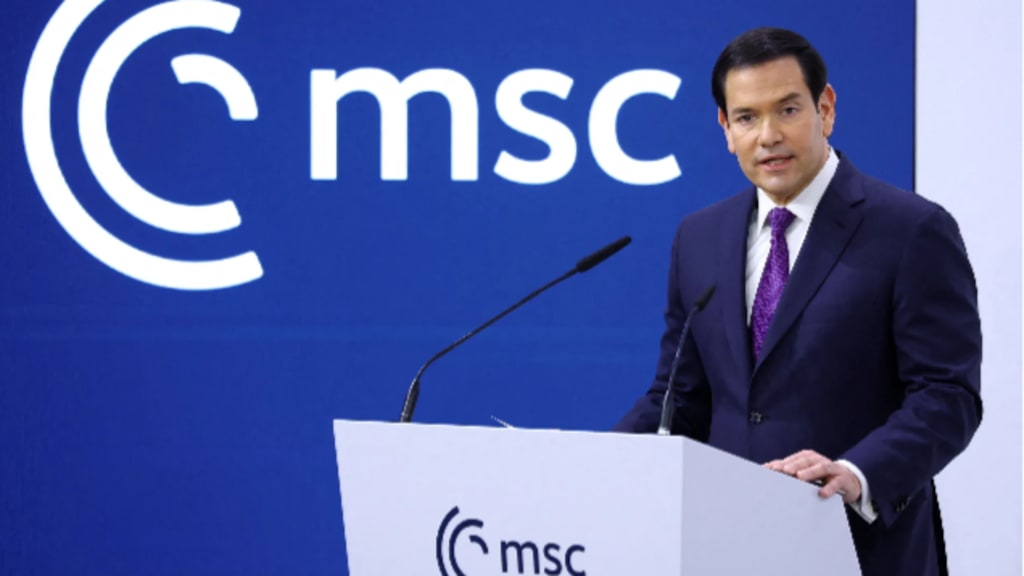
When Marco Rubio stepped onto the international stage at the Munich Security Conference, his speech signaled more than a routine policy address. It was a declaration of what the “Make America Great Again” (MAGA) movement believes U.S. foreign policy should look like in a rapidly changing world.
Rubio’s remarks outlined a doctrine rooted in realism, nationalism, and skepticism toward traditional global institutions. His message was direct: American foreign policy should serve American citizens first, not abstract ideals or endless overseas commitments.
For an audience accustomed to hearing speeches about multilateralism, shared values, and collective security, Rubio’s presentation stood out as a sharp ideological contrast.
A Shift From Globalism to National Interest
Rubio framed MAGA’s foreign policy doctrine around one central idea: the United States must prioritize its own security, economy, and borders before trying to manage the world.
He argued that past administrations had stretched American power too thin by engaging in costly wars, supporting international institutions that failed to deliver results, and allowing rivals like China and Russia to gain strategic advantages.
Instead of spreading democracy by force, Rubio suggested that the U.S. should:
Protect its sovereignty
Secure its supply chains
Strengthen its military
Confront adversaries directly when American interests are threatened
This approach reflects a broader MAGA worldview that questions whether alliances and global organizations always benefit the United States.
Rubio did not call for isolationism, but he made it clear that cooperation must be transactional and based on concrete benefits rather than moral obligation.
China and the New Strategic Rivalry
A major focus of Rubio’s speech was China. He described Beijing as the most serious long-term threat to American power and global stability.
According to Rubio, China has used decades of economic engagement with the West to strengthen its military and political influence while undermining democratic systems. He accused China of exploiting international trade rules and using technology to expand surveillance and control.
Rubio argued that MAGA foreign policy would take a harder line on China by:
Limiting dependence on Chinese manufacturing
Restricting sensitive technology transfers
Strengthening U.S. industrial capacity
Supporting allies facing Chinese pressure
Rather than seeking accommodation, Rubio presented competition as unavoidable. In his view, the world is entering an era of great-power rivalry where strength, not diplomacy alone, will determine outcomes.
Europe and NATO: A New Kind of Partnership
Rubio also addressed America’s relationship with Europe and NATO, stressing that alliances must be fair and balanced.
He repeated a familiar MAGA criticism: European nations benefit from U.S. security guarantees while spending too little on their own defense. Rubio called for allies to increase military budgets and take greater responsibility for regional security.
Instead of the U.S. acting as the world’s permanent protector, he promoted a model where:
Allies carry more of the burden
The U.S. intervenes selectively
Defense commitments are conditional on reciprocity
This message resonated with some conservatives who believe American taxpayers should not subsidize foreign security indefinitely. However, it also raised concerns among European leaders who fear weakening unity at a time of rising threats from Russia and instability in Eastern Europe.
Ukraine and the Limits of Intervention
Rubio’s doctrine emphasized caution about long-term military involvement abroad. While he did not reject support for Ukraine outright, he questioned whether open-ended aid without a clear strategy serves American interests.
He suggested that diplomacy and negotiated settlements should be considered alongside military assistance. This reflects a broader MAGA argument that U.S. resources should be focused at home rather than funding prolonged conflicts overseas.
Critics argue that such a stance risks emboldening authoritarian powers. Supporters counter that endless intervention drains America’s economy and distracts from domestic priorities such as border security, inflation, and infrastructure.
Values vs. Power Politics
One of the most striking elements of Rubio’s speech was its tone. Instead of framing U.S. foreign policy as a moral mission, he spoke in terms of competition, leverage, and national advantage.
Traditional U.S. diplomacy often emphasizes:
Human rights
Democracy promotion
International law
Rubio’s MAGA doctrine places greater emphasis on:
Strength
Deterrence
Economic independence
Strategic self-interest
This shift reflects a belief that values alone cannot protect a nation in an increasingly dangerous world. In Rubio’s words, peace comes from power, not promises.
Reactions and Global Implications
The response to Rubio’s speech was mixed. Some attendees saw it as a necessary wake-up call, arguing that the world has changed and U.S. policy must adapt. Others viewed it as a retreat from the cooperative leadership role America has played since World War II.
European analysts warned that a purely transactional approach could weaken trust between allies. Asian observers noted that a tougher stance on China could escalate tensions in the Indo-Pacific.
Yet for MAGA supporters, Rubio’s speech was a long-overdue articulation of their worldview on the global stage.
A Doctrine for a New Era
Rubio’s appearance in Munich was not just symbolic—it was strategic. By presenting MAGA foreign policy to an international audience, he made it clear that this vision is not confined to domestic politics. It is meant to guide America’s role in the world.
The doctrine he outlined can be summarized simply: America should engage with the world, but on its own terms.
As global competition intensifies and traditional alliances are tested, Rubio’s message highlights a growing divide in how Americans see their nation’s future. Should the U.S. continue acting as a global leader bound by shared values, or become a power focused first on its own survival and prosperity?
The answer may shape international politics for decades to come.
Final Thought
Rubio’s Munich speech revealed more than policy positions—it revealed a philosophical shift. MAGA’s foreign policy doctrine rejects idealism in favor of realism, replaces universal missions with national priorities, and redefines leadership as strength rather than sacrifice.
Whether this approach brings stability or deeper division remains uncertain. What is clear, however, is that the world is listening closely—and preparing for an America that may soon look very different on the global stage.
About the Creator
Sajida Sikandar
Hi, I’m Sajida Sikandar, a passionate blogger with 3 years of experience in crafting engaging and insightful content. Join me as I share my thoughts, stories, and ideas on a variety of topics that matter to you.
Keep reading
More stories from Sajida Sikandar and writers in The Swamp and other communities.
China Is the Real Threat, Taiwan Says in Rebuke to Munich Speech
The world’s attention turned sharply toward East Asia following a dramatic exchange of words between China and Taiwan after the recent Munich Security Conference. What began as a speech meant to promote China’s vision of global order quickly turned into a flashpoint of geopolitical tension when Taiwan responded with a bold accusation: China is the real threat to regional and international security.
By Sajida Sikandarabout 11 hours ago in The Swamp
Why Black History Matters in America?
The United States of America is celebrating their 250th anniversary in 2026. I'm proud to be an American and as someone who was born here, I wouldn't imagine myself living anywhere else. This is a country where opportunities are possible. Where anyone can be successful in anything they desire to do. Equality, community, and togetherness are the backbones of what America is and should be about. However, we have an administration who wants to erase and disregard those who have made positive, meaningful impacts in our country, specifically Black figures, such as Martin Luther King, Jr., Rosa Parks, and Maya Angelou. President Trump and his administration have been constantly complaining and fighting against what they call the "Woke agenda". They use this excuse as a distraction from other issues they refuse to address, such as the high cost of living, climate change, and inflation. That equality is dividing America, when in reality, it's bringing us together. Being woke is not tied to a specific political party. No matter where you stand on the political spectrum, you can still care about other people and their plights. Compassion and empathy for others isn't tied to a political party, either. We were taught as children to treat others the way we want to be treated and not judge others because they're different from us. Caring about others isn't a personal attack on your beliefs. It doesn't make you any less of a person. People who are easily offended over African American figures, past or present, or anything related to it, are grasping at straws. Current and future generations need to know who people like Harriet Tubman and Shirley Chisholm were, especially in the classroom. Black History is part of American History. It should be recognized, not hidden or forgotten. Besides, you can't shield children from everything, just because your feelings are easily hurt.
By Mark Wesley Pritchard 14 days ago in The Swamp
Scottish Labour Leader Anas Sarwar Expected to Call for Prime Minister to Resign
Scottish Labour leader Anas Sarwar is expected to call for the Prime Minister to resign, intensifying political pressure on the UK government amid mounting criticism over leadership and accountability. The move comes as opposition parties seek to capitalize on public dissatisfaction and renewed scrutiny of Westminster following a series of controversies that have weakened confidence in the Prime Minister’s authority. Sources close to Scottish Labour say Sarwar will use an upcoming speech to argue that the Prime Minister has lost the trust of the public and can no longer effectively lead the country. His remarks are expected to echo wider concerns raised by Labour figures across the UK, who have accused the government of failing to address key issues such as the cost-of-living crisis, public services, and political integrity. Growing Political Pressure Sarwar has previously positioned Scottish Labour as a party focused on stability and reform, contrasting his leadership with what he describes as “chaos and drift” at Westminster. In recent weeks, he has sharpened his tone, signaling that the time has come for decisive political change. “The country deserves leadership that restores confidence and puts people first,” Sarwar is expected to say, according to party insiders. “When a Prime Minister loses the trust of Parliament and the public, resignation becomes a matter of responsibility, not politics.” The anticipated call adds to a chorus of opposition voices demanding accountability, with senior Labour figures in London also questioning the Prime Minister’s ability to govern effectively. The Scottish National Party (SNP) and Liberal Democrats have similarly urged the government to explain its handling of recent crises. Impact in Scotland In Scotland, Sarwar’s stance is also seen as part of a broader effort to reassert Scottish Labour’s relevance ahead of future elections. Polling has suggested shifting political dynamics, with Labour seeking to challenge the SNP’s dominance while presenting itself as a credible alternative both in Holyrood and Westminster. Political analysts note that Sarwar’s call for resignation could resonate with voters frustrated by political turmoil at the UK level. “Scottish Labour is trying to show that it is willing to take a firm stand on leadership and standards,” said Dr. Fiona McKenzie, a political scientist at the University of Edinburgh. “This is about drawing a clear line between what Sarwar says is responsible government and what he characterizes as failure at Westminster.” However, some critics argue that the move risks being seen as opportunistic rather than constructive, particularly at a time when economic and social challenges remain acute. Government Response Downing Street has dismissed opposition calls for resignation, insisting that the Prime Minister retains the confidence of his party and is focused on delivering policies aimed at economic growth and national stability. A government spokesperson said the administration would not be distracted by what it described as “political grandstanding.” “The Prime Minister is committed to serving the British people and addressing the challenges facing the country,” the spokesperson said. “We remain focused on delivering results rather than engaging in political theatre.” Conservative Party officials have also rallied behind the Prime Minister, emphasizing the importance of unity and warning that further leadership disputes could undermine confidence in the UK’s political system. Broader Political Context Sarwar’s expected intervention comes at a time when trust in political institutions is under strain. A series of scandals and policy reversals has fueled public skepticism, while opposition parties have seized the moment to demand reforms and leadership change. Within Labour, the message has been carefully coordinated to present a united front across the UK. While Sarwar speaks for the party in Scotland, his stance aligns with broader Labour calls for higher standards in public office and renewed accountability at the top of government. Observers say the pressure on the Prime Minister is unlikely to ease in the coming weeks, especially if further criticism emerges from within Parliament or among senior political figures. What Happens Next Whether Sarwar’s call will have a tangible impact remains uncertain. While opposition demands for resignation can influence public debate, the decision ultimately rests with the Prime Minister and their party. Still, the intervention underscores the growing sense of political instability and the deepening divide between the government and its critics. As Sarwar prepares to make his statement, the spotlight will once again fall on Westminster leadership and the question of whether the Prime Minister can survive the latest wave of opposition pressure. For Scottish Labour, the move represents both a challenge to the government and a strategic effort to define its role in shaping the future of UK politics.
By Fiaz Ahmed 7 days ago in The Swamp
Nancy Guthrie: Is a miracle still possible after close to two weeks?
Close to two weeks since Nancy Guthrie's abduction As of February 12, 2026, Nancy Guthrie remains classified as missing for 12 days, but there is no official confirmation that she is deceased. Blood matching Guthrie’s DNA was found on her front porch, indicating she likely suffered an injury during the abduction.
By Cheryl E Preston3 days ago in Geeks



Comments
There are no comments for this story
Be the first to respond and start the conversation.