
Scientists Celebrate Longest Solar Eclipse of the Century While Religious Leaders Call It a Dark Omen That Should Keep Children Indoors
A rare celestial event sparks wonder in laboratories and fear in communities, highlighting the clash between science and superstition.

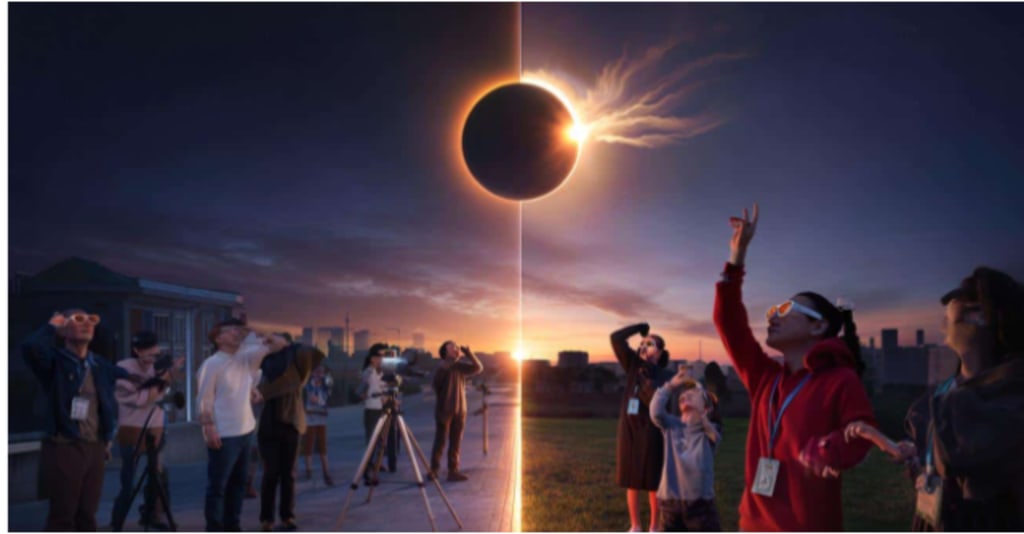
The world witnessed one of the most extraordinary astronomical events of modern times today — the longest solar eclipse of the century. Across continents, skies darkened for several minutes as the Moon perfectly aligned with the Sun, creating a breathtaking spectacle that captivated scientists, photographers, and stargazers alike.
For astronomers, the eclipse was a moment of triumph — a once-in-a-lifetime opportunity to study the Sun’s outer atmosphere, test instruments, and deepen humanity’s understanding of the cosmos. But in stark contrast, several religious leaders and traditional communities viewed the same phenomenon with fear, calling it a dark omen and urging families to keep children indoors to avoid what they described as harmful spiritual and physical effects.
This striking divide between scientific celebration and religious caution has once again ignited debate over how society interprets natural events in the modern age.
A Celestial Marvel for Science
Scientists around the world had prepared for months to observe the eclipse. Research teams from universities and space agencies set up telescopes, high-resolution cameras, and sensors along the eclipse’s path of totality.
Experts from NASA described the eclipse as a “golden opportunity” to study the Sun’s corona — the mysterious outer layer of the solar atmosphere that is normally hidden by intense sunlight.
During totality, when the Moon completely blocked the Sun, temperatures dropped, winds shifted, and animals reportedly behaved as if night had fallen. For researchers, these changes provided valuable data on how sudden darkness affects Earth’s atmosphere and ecosystems.
“This eclipse allows us to analyze solar flares, magnetic fields, and radiation patterns with greater clarity,” said one astrophysicist involved in the observations. “Events like this help us understand how solar activity influences satellites, communication systems, and even climate behavior.”
Millions of people gathered in open fields, rooftops, and observatories wearing protective eclipse glasses. Social media was flooded with photos and videos showing a glowing ring of light around the Moon — a phenomenon known as the “ring of fire.”
For many, it was a moment of awe and unity, reminding humanity of its shared place in the universe.
Religious Warnings and Fear
While scientists celebrated, some religious leaders delivered a very different message.
In several regions, clerics and spiritual figures warned followers that the eclipse was a sign of negative cosmic energy. Parents were advised to keep children indoors, avoid eating during the eclipse, and stay away from windows or open spaces.
“These events disturb the balance of nature,” one religious leader stated in a televised sermon. “Children are especially vulnerable to harmful forces during such times.”
Temples and prayer centers reported increased attendance, as people sought protection through rituals and prayers. In some communities, pregnant women were instructed not to step outside, and households covered mirrors and windows as a precaution.
Though these beliefs are deeply rooted in tradition, health officials emphasized that there is no scientific evidence linking solar eclipses to illness, bad luck, or spiritual danger.
The Clash Between Science and Superstition
This eclipse has once again highlighted the long-standing tension between scientific reasoning and cultural belief systems.
On one side are astronomers who see the eclipse as a predictable result of orbital mechanics — a precise alignment between the Earth, Moon, and Sun. On the other side are communities that interpret the event through religious texts and folklore, viewing darkness in daylight as an unsettling disruption of divine order.
Sociologists note that fear surrounding eclipses is not new. Ancient civilizations once believed eclipses were caused by dragons swallowing the Sun or angry gods sending warnings. Even today, despite technological progress, those narratives persist in many parts of the world.
“Science explains what happens in the sky, but belief systems explain what it means to people,” said a cultural researcher. “When those meanings clash, fear often spreads faster than facts.”
Impact on Daily Life
In several cities, schools reported lower attendance as parents kept children at home. Street markets closed temporarily, and outdoor events were postponed.
Hospitals also saw an increase in anxious patients seeking reassurance about the eclipse’s effects. Doctors and scientists went on radio and television programs to explain that watching the eclipse safely with proper eye protection posed no health risk.
Public health departments distributed leaflets stating:
Solar eclipses do not cause disease
Children are not physically harmed by eclipse exposure
Only direct viewing of the Sun without protection can damage eyesight
Despite these efforts, misinformation circulated rapidly on social media, with posts claiming that the eclipse could weaken immunity or bring misfortune.
A Teaching Moment for Science Education
Many educators saw the event as a powerful learning opportunity.
Schools and universities organized live streams of the eclipse, explaining the science behind it in simple terms. Teachers encouraged students to observe the event safely and ask questions about space, gravity, and light.
“This is the perfect time to inspire curiosity,” said a science teacher who hosted an eclipse-watching session. “Instead of fear, children should feel wonder.”
Some religious scholars also tried to bridge the divide by reminding followers that natural phenomena can be appreciated without abandoning faith. They argued that science and spirituality need not be enemies.
Global Reactions
Internationally, the eclipse was treated as a celebration. Parks filled with families, scientists hosted public talks, and news channels ran live coverage of the Moon’s slow movement across the Sun.
Astronomy clubs described the eclipse as “historic,” noting that such a long period of totality will not occur again for decades. For many observers, it was a reminder of how small human conflicts seem when compared to the vastness of space.
Yet in places where fear dominated, the same event became a symbol of anxiety rather than wonder.
Conclusion
The longest solar eclipse of the century has done more than darken the sky — it has illuminated a deep divide in how humanity interprets the universe.
To scientists, it was a triumph of knowledge and preparation. To some religious leaders, it was a warning sign that demanded caution and isolation, especially for children.
This contrast reveals a larger challenge: how to promote scientific understanding without dismissing cultural traditions. As the Moon moved away and daylight returned, the eclipse left behind not just stunning images, but an urgent reminder that education, communication, and critical thinking are essential in an age where fear can spread as quickly as light disappears.
In the end, the eclipse proved that while the Sun and Moon may align only rarely, society must work harder to align reason with belief — so that future wonders of the sky are met with curiosity rather than concern
About the Creator
Sajida Sikandar
Hi, I’m Sajida Sikandar, a passionate blogger with 3 years of experience in crafting engaging and insightful content. Join me as I share my thoughts, stories, and ideas on a variety of topics that matter to you.
Keep reading
More stories from Sajida Sikandar and writers in The Swamp and other communities.
Second Round of US–Iran Nuclear Talks to Be Held Today
Today marks a crucial moment in international diplomacy as the United States and Iran begin the second round of indirect nuclear negotiations in Geneva, Switzerland. The talks aim to revive dialogue over Iran’s nuclear program and reduce growing tensions that have strained relations between Tehran and Washington for years.
By Sajida Sikandarabout 8 hours ago in The Swamp
Why Black History Matters in America?
The United States of America is celebrating their 250th anniversary in 2026. I'm proud to be an American and as someone who was born here, I wouldn't imagine myself living anywhere else. This is a country where opportunities are possible. Where anyone can be successful in anything they desire to do. Equality, community, and togetherness are the backbones of what America is and should be about. However, we have an administration who wants to erase and disregard those who have made positive, meaningful impacts in our country, specifically Black figures, such as Martin Luther King, Jr., Rosa Parks, and Maya Angelou. President Trump and his administration have been constantly complaining and fighting against what they call the "Woke agenda". They use this excuse as a distraction from other issues they refuse to address, such as the high cost of living, climate change, and inflation. That equality is dividing America, when in reality, it's bringing us together. Being woke is not tied to a specific political party. No matter where you stand on the political spectrum, you can still care about other people and their plights. Compassion and empathy for others isn't tied to a political party, either. We were taught as children to treat others the way we want to be treated and not judge others because they're different from us. Caring about others isn't a personal attack on your beliefs. It doesn't make you any less of a person. People who are easily offended over African American figures, past or present, or anything related to it, are grasping at straws. Current and future generations need to know who people like Harriet Tubman and Shirley Chisholm were, especially in the classroom. Black History is part of American History. It should be recognized, not hidden or forgotten. Besides, you can't shield children from everything, just because your feelings are easily hurt.
By Mark Wesley Pritchard 15 days ago in The Swamp




Comments
There are no comments for this story
Be the first to respond and start the conversation.