
The Supreme Court’s Declaration of Independence
High court asserts its authority over politics, reshaping the balance of power in Washington


The U.S. Supreme Court has issued a series of recent rulings that many legal scholars describe as a modern “declaration of independence” from political pressure, signaling a firm assertion of judicial authority at a moment of intense polarization in the United States.
In decisions touching on executive power, regulatory authority, and constitutional interpretation, the Court has increasingly positioned itself as an institution unwilling to bend to shifting political winds. While supporters praise the move as a defense of constitutional balance, critics warn that the justices are reshaping the boundaries between the judiciary, Congress, and the presidency in ways that could permanently alter American governance.
A Turning Point in Judicial Authority
At the heart of the Court’s recent posture is its insistence that constitutional questions belong squarely within the judiciary’s domain, regardless of political consequences. Several high-profile rulings have curtailed the reach of federal agencies and limited the discretion of the executive branch, reinforcing the idea that unelected judges, not political leaders, are the final arbiters of constitutional meaning.
Legal analysts say this marks a departure from decades of judicial restraint, during which the Court often deferred to Congress or regulatory bodies on complex policy matters. The shift reflects a belief among a majority of justices that democratic accountability must be balanced against strict constitutional limits, even if that produces controversial outcomes.
“This is the Court reminding the nation that it is not a subsidiary of the political branches,” said one constitutional law professor. “It is asserting its independence in unmistakable terms.”
Political Reactions
The response from Washington has been swift and divided. Lawmakers from both parties have accused the Court of either overreach or timidity, depending on the issue at hand. Progressive leaders argue that the justices are rolling back protections on voting rights and environmental regulation, while conservatives counter that the Court is finally restoring the Constitution’s original structure.
The White House has expressed respect for judicial independence but has also raised concerns about the practical consequences of certain rulings, particularly those affecting healthcare, climate policy, and federal oversight.
Behind the scenes, congressional aides say lawmakers are exploring legislative strategies to counter or clarify some of the Court’s decisions, setting the stage for an institutional standoff between branches of government.
Public Trust and Institutional Legitimacy
Public confidence in the Supreme Court has declined in recent years, driven in part by perceptions that the Court has become too political. Opinion polls show trust in the institution near historic lows, even as the Court insists it is acting purely on legal principle rather than ideology.
Chief Justice John Roberts has repeatedly emphasized the importance of preserving the Court’s legitimacy by demonstrating neutrality and respect for precedent. Yet critics argue that recent rulings suggest a willingness to overturn long-standing doctrines, raising questions about stability in constitutional law.
Supporters, however, contend that the Court is doing exactly what the framers intended: checking the power of elected officials and safeguarding the Constitution against temporary majorities.
Constitutional Implications
The phrase “declaration of independence” has gained traction among commentators who see the Court’s actions as redefining the separation of powers. By narrowing the authority of administrative agencies and emphasizing judicial review, the Court is effectively reclaiming influence that had shifted toward the executive branch over the last half-century.
This recalibration could have far-reaching consequences. Regulatory systems governing finance, environmental protection, labor, and public health may now face higher legal hurdles. States, too, may find greater room to challenge federal authority, reshaping the balance between national and local power.
A Court at the Center of American Politics
Ironically, the Court’s effort to assert independence has placed it squarely at the center of political debate. Every major decision is now scrutinized not only for legal reasoning but for its political impact.
Some historians compare the current moment to the New Deal era, when the Court’s resistance to federal programs sparked intense conflict with President Franklin D. Roosevelt. Others argue that today’s divisions are even sharper, fueled by social media and partisan media ecosystems that amplify every ruling into a national controversy.
Looking Ahead
Whether the Supreme Court’s assertiveness strengthens or weakens democracy remains an open question. Its defenders say the institution is restoring constitutional discipline and protecting liberty. Its critics fear that unelected judges are shaping policy without accountability.
What is clear is that the Court has entered a new phase in its relationship with the political branches—one defined by independence, confrontation, and profound influence over the nation’s future. In doing so, it has made a statement not unlike the one issued in 1776: that its authority does not flow from politics, but from principle.
About the Creator
Fiaz Ahmed
I am Fiaz Ahmed. I am a passionate writer. I love covering trending topics and breaking news. With a sharp eye for what’s happening around the world, and crafts timely and engaging stories that keep readers informed and updated.
Keep reading
More stories from Fiaz Ahmed and writers in The Swamp and other communities.
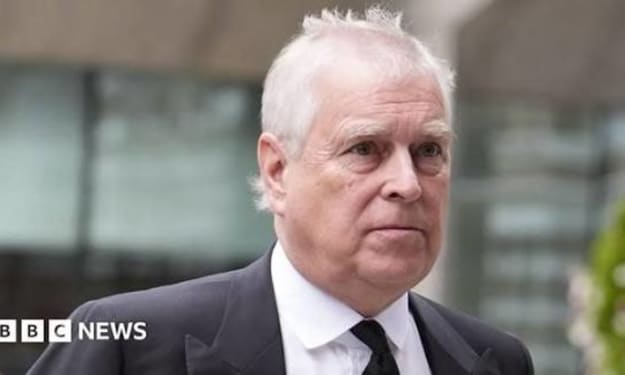
Government Considers Removing Prince Andrew from Royal Line of Succession
The UK government is reportedly exploring the possibility of removing Prince Andrew from the line of succession to the British throne. The move comes amid sustained scrutiny over his legal issues and public controversies, raising questions about the monarchy’s public image, accountability, and the potential implications for royal protocol. Background Prince Andrew, the Duke of York, has been embroiled in multiple controversies that have undermined his public standing. While he stepped back from official royal duties in recent years, his position in the line of succession has remained unchanged. The government review indicates that officials are examining whether legislative or procedural measures could formally alter his status in the royal hierarchy. Historically, removing a royal from the succession is rare and legally complex. The Succession to the Crown Act 2013 sets out rules governing succession, including conditions related to marriage, religion, and other statutory requirements. While no recent precedent exists for removal due to conduct, historical examples show that heirs have been bypassed or excluded for political, religious, or personal reasons. Government Deliberations Sources within Whitehall suggest that officials are considering multiple pathways, including voluntary renunciation, formal legislative amendments, or a hybrid approach combining procedural and symbolic measures. Legal advisors have reportedly been engaged to assess the feasibility, risks, and constitutional ramifications of such an action. A senior government adviser told confidential sources: “The matter is highly sensitive. We are considering all legal avenues while being mindful of public perception, parliamentary requirements, and the broader stability of the monarchy.” Public Opinion and Political Pressure Public sentiment appears to favor some form of action. Surveys indicate that a majority of citizens believe royals implicated in serious legal or ethical controversies should not retain their place in the line of succession. Advocacy groups and media commentators have argued that failing to act could erode public trust in the monarchy and its relevance in modern Britain. Members of Parliament from multiple parties have reportedly raised questions regarding Prince Andrew’s status, emphasizing accountability, transparency, and ethical governance. Some lawmakers suggest that formal removal could demonstrate that the monarchy adheres to contemporary standards of responsibility. Legal and Constitutional Challenges Legal experts caution that removing a royal from succession is complicated. Any formal change would require parliamentary approval and possibly coordination with other Commonwealth realms that recognize the British monarch as head of state. Challenges include ensuring compliance with existing statutes, addressing succession rights of other family members, and avoiding potential legal disputes. Even if successfully implemented, such a move could set a precedent for scrutiny of other royals’ conduct, raising questions about how personal behavior intersects with hereditary rights. Potential Outcomes Officials are reportedly considering a range of outcomes, from voluntary abdication of succession rights by Prince Andrew to formal legislative action. Timing and communication of any decision are expected to be carefully managed to minimize disruption to the royal household and public confidence. Observers suggest that the decision could influence the monarchy’s public image significantly, either reinforcing standards of accountability or exposing institutional vulnerabilities. The government is likely to weigh both symbolic and practical effects before taking action. Looking Ahead As deliberations continue, attention is focused on legal feasibility, constitutional precedent, and public perception. For the monarchy, the outcome could redefine expectations of responsibility and conduct for members of the royal family, highlighting tensions between tradition, public accountability, and modern governance standards.
By Fiaz Ahmed about 18 hours ago in The Swamp
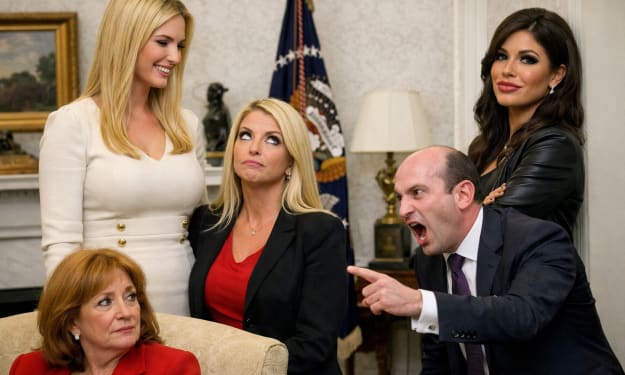
A Gathering of Evil Bosses
“I’m the queen of chin jutting while I smooth my hair, attacking, insulting, and deflecting to protect my appointer.” “Oh, please, Blondi, my hair is curled, highlighted, and longer than yours. I feature television commercials telling immigrants that we will give them a free plane ride home, and if they voluntarily turn themselves in, they will be allowed to legally apply for re-entry. It runs everywhere, and I look good in it! You can’t compete because of your blond hair. Mine is nicer, and my lips are prettier than yours.”
By Andrea Corwin 3 days ago in The Swamp
Craft Over Catharsis Challenge Winners
Craft Over Catharsis? What the hell does that even mean? The phrase came out of a curation meeting as a genuine question. We had been noticing that many challenge entries, across prompts, naturally gravitate toward trauma, grief, and personal reckoning. That makes sense. Writing is often cathartic. It's one of the ways we process what we've lived through.
By Vocal Curation Team3 days ago in Resources


Comments
There are no comments for this story
Be the first to respond and start the conversation.