
Global Pharmaceutical Packaging Market Size and Forecast 2025–2033: Securing the Future of Modern Medicine
With rising drug demand, biologics, and smart packaging innovations, the pharmaceutical packaging industry is set to nearly double in value by 2033.

Introduction: Packaging as the Backbone of Modern Pharmaceuticals
In the global healthcare ecosystem, pharmaceutical packaging plays a far more critical role than simply containing medicines. It is the first line of defense for drug safety, stability, and integrity. From protecting sensitive biologics to ensuring accurate dosing and preventing counterfeiting, packaging has become a strategic pillar of the pharmaceutical value chain.
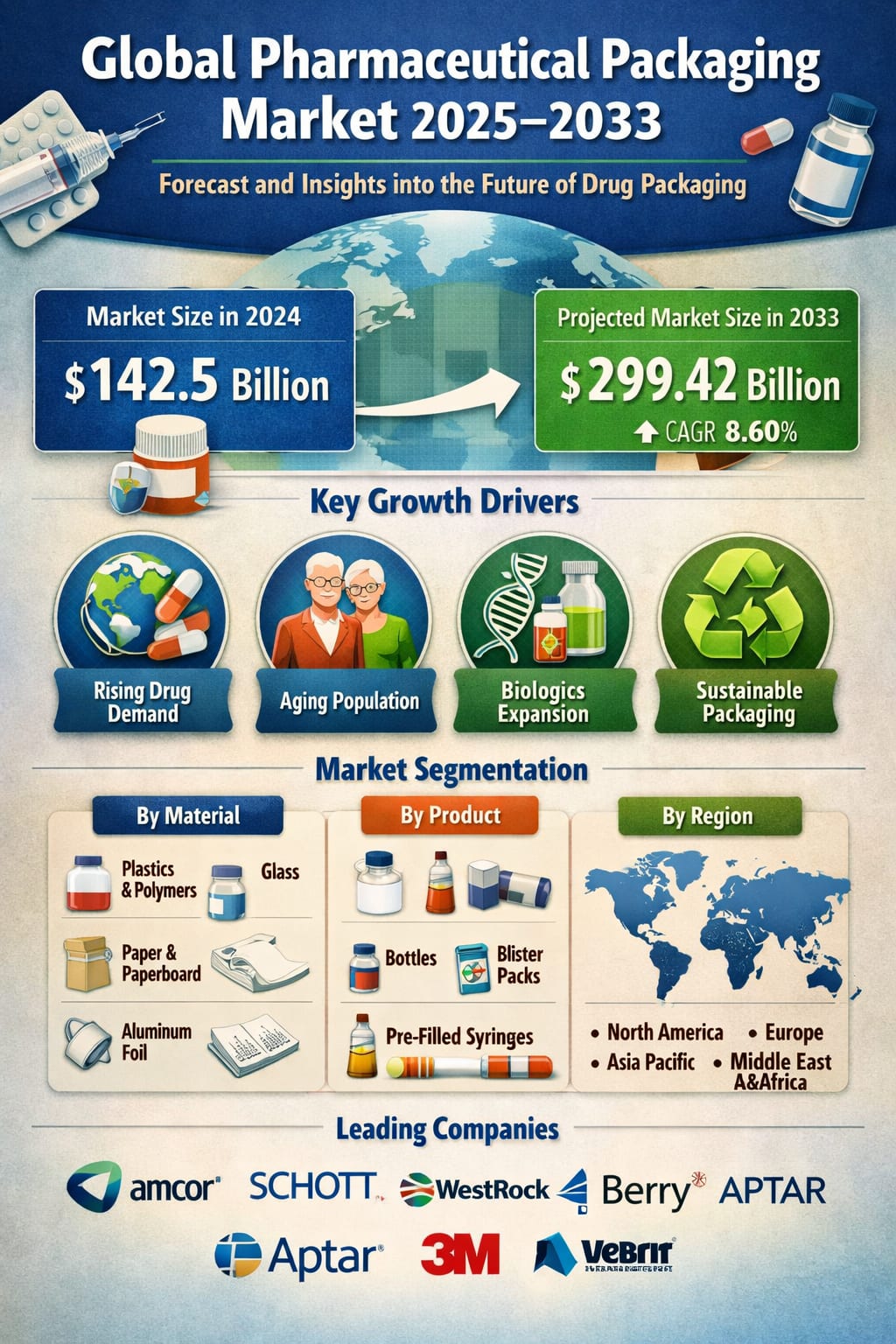
According to Renub Research’s latest industry analysis, the Global Pharmaceutical Packaging Market is expected to reach US$ 299.42 billion by 2033, up from US$ 142.5 billion in 2024, growing at a robust CAGR of 8.60% from 2025 to 2033. This impressive growth trajectory reflects not only rising global drug consumption but also rapid innovation in packaging materials, formats, and technologies.
As healthcare systems expand, populations age, and chronic diseases become more prevalent, the demand for safe, efficient, and intelligent pharmaceutical packaging is accelerating worldwide.
Pharmaceutical Packaging Market Overview
Pharmaceutical packaging refers to the process and materials used to enclose, protect, store, and distribute medicines. Common formats include blister packs, bottles, vials, ampoules, pre-filled syringes, inhalers, and pouches. The core objectives of pharmaceutical packaging are to:
Protect drugs from contamination, moisture, light, and oxygen
Prevent tampering and counterfeiting
Ensure accurate labeling and traceability
Improve patient safety, compliance, and convenience
Modern pharmaceutical packaging must comply with strict regulatory standards related to labeling, serialization, child resistance, and tamper evidence. At the same time, the industry is embracing smart packaging, eco-friendly materials, and user-centric designs to meet evolving healthcare and sustainability goals.
Packaging is no longer a passive component—it is now an active enabler of drug efficacy, patient adherence, and supply chain security.
Market Outlook: Strong Growth Through 2033
The global pharmaceutical packaging market’s projected rise from US$ 142.5 billion in 2024 to US$ 299.42 billion by 2033 highlights the scale of transformation underway. Growth is being driven by several converging trends:
Increasing global demand for pharmaceuticals
Rapid expansion of biologics and specialty drugs
Aging populations and rising chronic disease burden
Stricter regulatory requirements for safety and traceability
Innovation in materials, smart packaging, and sustainable solutions
Expanding healthcare access in emerging economies
Together, these factors are reshaping packaging from a cost center into a value-adding, innovation-driven segment of the pharmaceutical industry.
Key Growth Drivers
1. Increasing Global Drug Demand
One of the most powerful drivers of the pharmaceutical packaging market is the surging global demand for medicines. Population growth, improved healthcare access, and greater health awareness are boosting pharmaceutical consumption across both developed and emerging markets.
Chronic conditions such as diabetes, cardiovascular diseases, cancer, and respiratory disorders require long-term medication use, further increasing the volume of drugs produced and distributed. As pharmaceutical output rises, so does the need for secure, durable, and high-performance packaging to maintain product integrity throughout the supply chain.
Innovation in packaging materials is helping meet this demand. For instance, advanced blister packaging solutions using high-barrier materials are extending shelf life and protecting drugs from environmental damage, ensuring safety and efficacy on a global scale.
2. Aging Population and Healthcare Needs
The world’s population is aging rapidly, particularly in developed economies. Older adults typically require more medications due to age-related conditions such as arthritis, neurological disorders, cardiovascular diseases, and metabolic illnesses.
This demographic shift is significantly increasing the consumption of both prescription and over-the-counter drugs, directly boosting demand for pharmaceutical packaging. Moreover, elderly patients often require easy-to-open, clearly labeled, and compliance-friendly packaging, driving innovation in ergonomic and user-centric designs.
As a result, the aging population is not only expanding the market size but also influencing the design, functionality, and accessibility of pharmaceutical packaging solutions.
3. Technological Innovations in Packaging
Technology is transforming pharmaceutical packaging at an unprecedented pace. Smart packaging solutions using QR codes, RFID tags, and sensors are improving:
Drug traceability and anti-counterfeiting measures
Real-time tracking across supply chains
Patient engagement and adherence monitoring
In parallel, advanced drug delivery packaging such as pre-filled syringes, auto-injectors, and unit-dose blister packs is improving dosing accuracy, convenience, and safety.
Sustainability is another major innovation driver. Companies are increasingly developing recyclable, lightweight, and eco-friendly materials to reduce environmental impact while maintaining high performance standards. New material combinations and designs are helping balance regulatory compliance, patient safety, and environmental responsibility.
Challenges Facing the Market
1. Strict Regulatory Compliance
Pharmaceutical packaging operates under some of the world’s most stringent regulatory frameworks. Authorities such as the FDA, EMA, and other global regulators impose strict requirements related to:
Labeling accuracy
Serialization and traceability
Tamper-evidence and child resistance
Material compatibility and safety
Keeping up with evolving regulations requires continuous investment in technology, quality control, and documentation. Non-compliance can result in product recalls, financial penalties, and reputational damage. For multinational pharmaceutical companies, ensuring consistent global compliance adds further complexity and cost.
2. Complexity of Biologics and Specialty Drugs
Biologics and specialty drugs represent one of the fastest-growing segments of the pharmaceutical industry—but they also pose major packaging challenges. These products are highly sensitive to temperature, light, and humidity, often requiring cold-chain storage and specialized containers such as vials, pre-filled syringes, or auto-injectors.
Packaging must ensure sterility, prevent contamination, and maintain stability throughout transportation and storage. These strict requirements increase production costs and limit the range of suitable packaging materials and formats, making this a technically demanding and capital-intensive segment of the market.
Regional Market Insights
United States Pharmaceutical Packaging Market
The United States remains one of the largest and most advanced pharmaceutical packaging markets in the world. Growth is driven by:
High pharmaceutical production volumes
Strict regulatory standards
Strong demand for child-resistant and tamper-evident packaging
Rapid adoption of smart and sustainable packaging technologies
With continued innovation and a strong focus on patient safety, the U.S. market is well positioned for long-term expansion and technological leadership in pharmaceutical packaging.
Germany Pharmaceutical Packaging Market
Germany’s pharmaceutical packaging industry is shaped by innovation, sustainability, and regulatory compliance. The country’s strong emphasis on environmentally responsible manufacturing is driving investment in advanced materials and recyclable packaging solutions.
Sustainability-focused innovations, such as fully recyclable or mono-material packaging structures, are influencing not only the German market but also broader European packaging trends. Germany continues to serve as a key hub for high-quality, technologically advanced pharmaceutical packaging solutions.
India Pharmaceutical Packaging Market
India’s pharmaceutical packaging market is growing rapidly, supported by the country’s expanding role as a global pharmaceutical manufacturing and export hub. Rising demand for cost-effective, high-quality, and compliant packaging solutions is fueling investment and innovation.
With increasing exports of generics, vaccines, and specialty drugs, India’s packaging industry is focusing on improving quality standards, automation, and sustainability. Strategic investments and partnerships are further strengthening the country’s position in the global pharmaceutical packaging value chain.
Saudi Arabia Pharmaceutical Packaging Market
Saudi Arabia’s pharmaceutical packaging market is benefiting from growing healthcare investment, expanding domestic pharmaceutical production, and stronger regulatory emphasis on safety and sustainability.
The region is increasingly adopting modern packaging solutions that improve supply chain efficiency, patient compliance, and product stability. As healthcare infrastructure continues to develop, demand for advanced and environmentally responsible pharmaceutical packaging is expected to rise steadily.
Market Segmentation
By Material
Plastics & Polymers
Paper & Paperboard
Glass
Aluminum Foil
Others
By Product
Bottles
Caps & Closures
Pre-Filled Syringes
Vials & Ampoules
Jars & Canisters
Blister Packs
Pre-Filled Inhalers
Cartridges
Bags & Pouches
Others
By Region and Country
North America: United States, Canada
Europe: France, Germany, Italy, Spain, United Kingdom, Belgium, Netherlands, Turkey
Asia Pacific: China, Japan, India, Australia, South Korea, Thailand, Malaysia, Indonesia, New Zealand
Latin America: Brazil, Mexico, Argentina
Middle East & Africa: South Africa, United Arab Emirates, Saudi Arabia
Competitive Landscape
The global pharmaceutical packaging market is highly competitive, with leading players focusing on innovation, sustainability, and strategic expansion. Companies are analyzed across five key dimensions:
Company Overview
Key Persons
Recent Developments & Strategies
SWOT Analysis
Sales Analysis
Key Players Include:
Amcor PLC
3M Company
Schott AG
WestRock Company
Berry Global Group Inc.
McKesson Corporation
AptarGroup Inc.
Klockner Pentaplast Group
CCL Industries Inc.
FlexiTuff International Ltd
These companies are investing heavily in smart packaging, sustainable materials, and high-performance solutions to meet evolving regulatory and market demands.
Future Outlook: Packaging as a Strategic Healthcare Enabler
Looking ahead to 2033, pharmaceutical packaging will continue to evolve from a supporting function into a strategic enabler of healthcare delivery. Smart technologies, sustainable materials, and patient-centric designs will define the next generation of packaging solutions.
With the market expected to nearly double in value over the forecast period, opportunities will be strongest in biologics, specialty drugs, emerging markets, and environmentally responsible packaging innovations.
Final Thoughts
The global pharmaceutical packaging market is entering a golden era of growth and innovation. Driven by rising drug demand, aging populations, technological advancements, and stricter safety standards, the industry is set to expand from US$ 142.5 billion in 2024 to US$ 299.42 billion by 2033.
As healthcare becomes more complex and more global, packaging will play an increasingly vital role in ensuring safety, efficiency, sustainability, and patient trust. For pharmaceutical companies, packaging innovators, and investors alike, the coming decade represents a powerful opportunity to reshape how medicines are protected, delivered, and experienced worldwide.
About the Creator
Tom Shane
Tom Shane is a content writer specializing in SEO-driven blogs, product descriptions, and thought leadership. He crafts engaging, research-backed content that connects with audiences and drives results.
North America Silicone Market Size and Forecast 2025–2033
North America Silicone Market Outlook The North America Silicone Market is entering a phase of steady and resilient growth, supported by expanding applications across construction, healthcare, electronics, transportation, and personal care industries. According to Renub Research, the market is expected to grow from US$ 5.94 billion in 2024 to US$ 9.22 billion by 2033, registering a compound annual growth rate (CAGR) of 5.00% from 2025 to 2033.
By shibansh kumar6 days ago in Trader
Heart Pump Device Market Size and Forecast 2025–2033
The global healthcare landscape is undergoing a transformative shift as cardiovascular diseases (CVDs) continue to pose a formidable challenge. Against this backdrop, the Heart Pump Device Market is emerging as a critical lifeline for millions of patients worldwide.
By shibansh kumar2 days ago in Trader
Think for Me
"How do you calculate the circumference of a circle? Submit your answer when ready." [Pause] "Excellent! Every student was able to call up the answer electronically very quickly. If I, as a robot had feelings, I would express pride. You may break for lunch. Return to this cyber room in 45 minutes."
By Julie Lacksonen7 days ago in Humans


Comments
There are no comments for this story
Be the first to respond and start the conversation.