Holianyk Ihor
Bio
Stories (450)
Filter by community
Cosmic Spin Masters: The Stars That Rotate So Fast They Flatten Themselves
When most of us picture a star, we imagine a flawless glowing sphere—something smooth, round, and uniform. But the universe, as usual, loves to surprise us. Some stars defy this classic picture entirely. They spin so rapidly that their shape becomes distorted, stretched, and dramatically flattened. These celestial whirlers are some of the most intriguing objects astronomers have ever observed, and they challenge our understanding of what a star can be.
By Holianyk Ihor3 months ago in Futurism
Cosmic Bridges: The Hidden Gravitational Highways Linking Galaxies
When we look up at the night sky, galaxies appear as isolated islands scattered through an endless, silent ocean. But modern astrophysics paints a very different picture. Rather than drifting alone, galaxies are woven into a vast interconnected structure held together by invisible forces. This structure is threaded with what scientists sometimes call “cosmic bridges” — gravitational channels that link galaxies across unimaginable distances.
By Holianyk Ihor3 months ago in Futurism
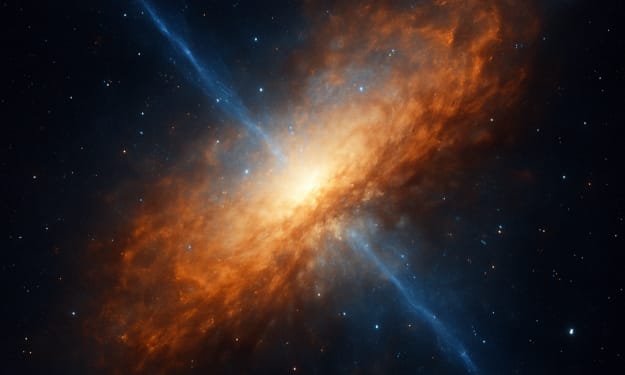
The Giant Accretion Rings of Black Holes: Cosmic Structures Thousands of Light-Years Across
When most people picture a black hole, they imagine a dark, compact monster devouring anything that strays too close. That image isn’t wrong, but it’s also far from complete. Modern astronomy has revealed that some black holes aren’t just surrounded by small disks of hot gas—they are embedded within enormous cosmic structures called accretion rings, stretching across thousands of light-years. These colossal rings challenge our understanding of how galaxies evolve, how black holes feed, and how matter behaves under extreme gravitational forces.
By Holianyk Ihor3 months ago in Futurism
If the Sun Turned Into a Black Hole, Earth Would Still Orbit It — Here’s the Mind-Bending Reason Why
When most people hear the words “black hole”, they imagine a cosmic monster: a gravitational vacuum cleaner devouring everything in its path. So at first glance, the idea that Earth could calmly keep orbiting the Sun if it suddenly collapsed into a black hole sounds impossible — almost like a trick question from an astronomy class.
By Holianyk Ihor3 months ago in Futurism
Runaway Stars: The Cosmic Sprinters Racing Out of the Milky Way at 2,000 km/s
When we look up at the night sky, the stars seem eternal and unmoving. We imagine them as quiet beacons, frozen in place. But in reality, every one of them is hurtling through space at incredible speeds. Most stars drift along at a calm and predictable pace—maybe a few dozen or a few hundred kilometers per second. Fast by human standards, but nothing extraordinary by galactic ones.
By Holianyk Ihor3 months ago in Futurism
Are There “Cosmic Spheres” of Antimatter?
Possible Relics of Ancient Universal Processes Antimatter is one of the most fascinating substances in the universe. It flashes into existence in violent cosmic events, vanishes the moment it touches ordinary matter, and leaves behind nothing but pure energy. Scientists chase its traces using the world’s most sensitive instruments. But a bold idea has been circulating in astrophysics: what if the universe still hides large objects made of antimatter—stable structures formed in the earliest moments after the Big Bang?
By Holianyk Ihor3 months ago in Futurism
The Space Garden on the ISS: How Astronauts Grow Lettuce and Microgreens in Orbit
When most people imagine life aboard the International Space Station (ISS), they picture floating astronauts, futuristic experiments, and breathtaking views of Earth rising over the curve of the planet. What they don’t usually picture is a garden. Yet hundreds of miles above us, orbiting at nearly 28,000 kilometers per hour, astronauts tend to a small but remarkable “space greenhouse” where they grow fresh lettuce and nutrient-packed microgreens.
By Holianyk Ihor3 months ago in Futurism
Japan’s Wooden Satellites: How Engineers Are Reinventing Space Technology With Timber
When you picture a satellite orbiting Earth, you probably imagine something metallic and high-tech—aluminum panels, titanium frames, maybe a few carbon-fiber components. The very last material you’d expect to see floating 400 kilometers above Earth is… wood.
By Holianyk Ihor3 months ago in Futurism
Worlds With Three Suns: The Strange and Stunning Reality of Triple-Star Planets
Most of us grow up imagining a solar system as something simple and orderly: a single star with a neat family of planets circling around it. Our own Sun reinforces that picture. But the universe rarely sticks to simple patterns. Among the billions of stars in the Milky Way, there exist far more complex arrangements — including triple-star systems. And what’s even more astonishing is that some of these systems are home to planets that orbit all three stars at once.
By Holianyk Ihor3 months ago in Futurism
NASA’s Psyche Mission Is Headed Toward a Metal World Worth $10,000 Quadrillion
In October 2023, NASA launched one of its most intriguing deep-space missions yet — Psyche, a robotic explorer on a years-long journey to a mysterious metallic asteroid unlike anything humanity has ever visited. This strange object, named 16 Psyche, isn’t valuable because it hides alien technology or secret energy sources, but because it appears to be made largely of metal. Not just any metal — we’re talking about iron, nickel, and potentially precious metals that, on Earth, form the backbone of modern industry.
By Holianyk Ihor3 months ago in Futurism
When the Universe was one second Old: The Birth of the First Hydrogen Atoms
Imagine a cosmic stopwatch starting at the very instant the Universe burst into existence. It clicks once—one second has passed. Just a single heartbeat. That moment is so short that most of us wouldn’t even notice it. But on the scale of the cosmos, one second after the Big Bang marks a profound turning point. It’s the moment when the foundations of all future matter—including stars, planets, and eventually us—began to solidify.
By Holianyk Ihor3 months ago in Futurism
Phoenix A: The Brightest Known Galaxy — A Cosmic Beacon Shining Trillions of Suns
In the vast, silent darkness of the universe, brilliance is rare. Stars flicker, nebulae glow, quasars blaze — yet only a handful of cosmic giants truly challenge our imagination. Among them stands Phoenix A, the brightest galaxy humans have ever discovered. Its light outshines the Sun not by millions or billions, but by trillions of times. It is a cosmic lighthouse whose glow reaches across billions of years of space and time.
By Holianyk Ihor3 months ago in Futurism