Holianyk Ihor
Bio
Stories (450)
Filter by community
When the Universe Was One Second Old: The Birth of the First Hydrogen Atoms
Imagine a cosmic stopwatch starting at the very instant the Universe burst into existence. It clicks once—one second has passed. Just a single heartbeat. That moment is so short that most of us wouldn’t even notice it. But on the scale of the cosmos, one second after the Big Bang marks a profound turning point. It’s the moment when the foundations of all future matter—including stars, planets, and eventually us—began to solidify.
By Holianyk Ihor3 months ago in Futurism
Why Astronauts Lose Up to One Liter of Fluid Per Day in Orbit
When astronauts leave Earth, their bodies begin to change almost immediately. Bones weaken, muscles shrink, and even the sense of taste can shift. But one of the most surprising effects of spaceflight happens within the first few days in orbit: astronauts start losing up to one liter of bodily fluid per day.
By Holianyk Ihor3 months ago in Futurism
Why Astronauts Lose Up to One Liter of Fluid per Day in Orbit — And What It Means for the Future of Space Travel
When humans leave Earth, they don’t just float — their bodies fundamentally change. Bones weaken, muscles shrink, vision shifts, tastes change… but one of the most dramatic transformations happens almost immediately: astronauts start losing up to one liter of bodily fluid per day. Not because they sweat more or because the spacecraft is too dry, but because microgravity tricks the body into believing it has too much liquid.
By Holianyk Ihor3 months ago in Education
Astronauts Drink Water Recycled from Sweat and Breath — And It’s Not as Weird as You Think
When most people imagine life in space, they picture astronauts floating gracefully in zero gravity, conducting futuristic experiments, or gazing out at the blue curve of Earth. What rarely comes to mind is one of the most vital — and surprisingly complicated — aspects of living beyond our planet: water.
By Holianyk Ihor3 months ago in Futurism
The Milky Way Has Already “Devoured” Several Smaller Satellite Galaxies
When we look up at the night sky, the Milky Way appears calm and ethereal—an elegant misty band stretching across the darkness. But behind this peaceful appearance lies a dramatic and sometimes violent cosmic history. Our galaxy is not a quiet spectator of the universe. In reality, the Milky Way has spent billions of years growing by tearing apart and absorbing smaller galaxies that stray too close.
By Holianyk Ihor3 months ago in Futurism
Binary Asteroids: The Cosmic Dance of Twin Worlds
When most people think of an asteroid, they picture a lonely, rugged rock drifting through the solar system—silent, solitary, and self-contained. But space, as it often does, surprises us. Not all asteroids travel alone. Some of them form remarkable partnerships: binary asteroid systems, or what you might call asteroid twins, orbiting around a shared center of mass. These systems behave like miniature versions of binary stars, engaging in an endless gravitational dance that can last billions of years.
By Holianyk Ihor3 months ago in Futurism
Where Space Really Begins: The Kármán Line at 100 Kilometers
If you ask a child where space begins, you’ll probably get an answer like “above the clouds” or “where the stars are.” Adults may point vaguely upward and say something about satellites or rockets. But in reality, there is no physical border where Earth suddenly ends and space begins. Our atmosphere slowly fades into darkness, thinning layer by layer until it becomes indistinguishable from the vacuum of space.
By Holianyk Ihor3 months ago in Education
Earth’s Mysterious “Third Radiation Belt”: What NASA’s Van Allen Probes Really Discovered
When NASA launched the twin Van Allen Probes in 2012, scientists expected to study something familiar — the two well-known belts of charged particles surrounding Earth, first discovered in 1958. These “Van Allen radiation belts” had been mapped, modeled, and largely understood.
By Holianyk Ihor3 months ago in Futurism
Earth: The Only Planet That Breathes, Moves, and Holds Liquid Water
When we gaze up at the night sky — a vast ocean of stars scattered across the darkness — it’s easy to forget how special our home planet really is. Among billions of worlds orbiting distant suns, Earth stands alone. It’s the only known planet that combines two astonishing traits: active plate tectonics and liquid water flowing freely on its surface.
By Holianyk Ihor3 months ago in Futurism
Laika: The Stray Dog Who Became the First Space Explorer
A Little Dog, a Giant Leap for Science On November 3, 1957, a small stray dog from the streets of Moscow made history. Her name was Laika, and she became the first living creature to orbit the Earth. While humans had long dreamed of touching the stars, it was this humble dog who first crossed the boundary between our planet and the vast unknown.
By Holianyk Ihor3 months ago in Futurism
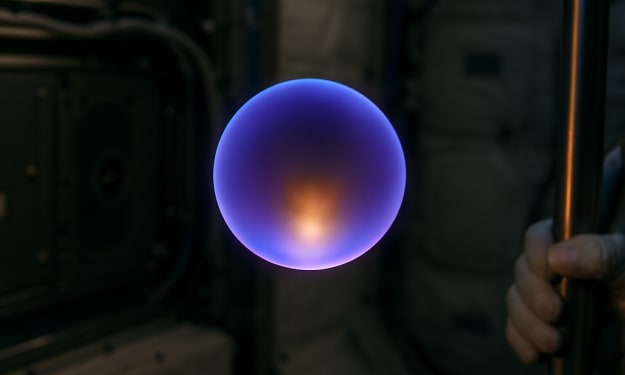
The Curious Case of Space Fire: Why Flames Turn Spherical in Zero Gravity
When you picture a flame, you probably imagine a flickering teardrop stretching upward — the warm glow of a candle or the orange tongues of a campfire dancing toward the sky. But take that same flame into space, and something extraordinary happens: it stops stretching. Instead of a flickering tongue, it becomes a floating, glowing sphere, calm and ghostly blue.
By Holianyk Ihor3 months ago in Futurism
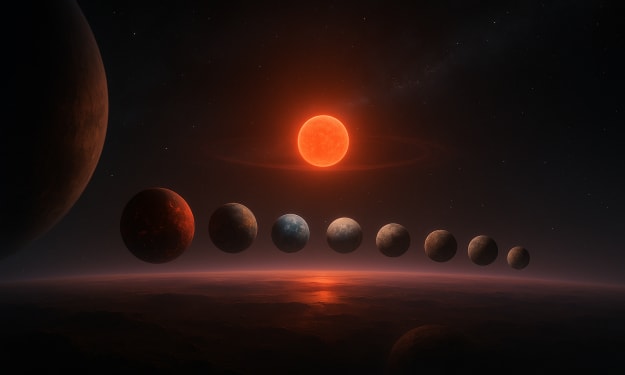
TRAPPIST-1: Seven Worlds Around a Tiny Star — and Three Could Be Alive
When astronomers announced in 2017 that a faint red star just 40 light-years away hosts seven Earth-sized planets, the news shook the world of science. For the first time, we had discovered an entire system of rocky worlds that might resemble our own. The name of that modest little star — TRAPPIST-1 — soon became synonymous with the search for life beyond Earth.
By Holianyk Ihor3 months ago in Futurism