future
Exploring the future of science today, while looking back on the achievements from yesterday. Science fiction is science future.
The Cities of Tomorrow: Living in a World Run by Robots
In the rapidly evolving landscape of urban development, robotics and artificial intelligence (AI) are no longer confined to laboratories or sci-fi movies. Today, they are poised to reshape the way we live, work, and interact within our cities. As we stand on the brink of this technological revolution, understanding the implications of robot-run urban environments is critical for both policymakers and citizens.
By muhammed salmanabout 6 hours ago in Futurism
The "Wow!" Signal: The 72 seconds in 1977 when space finally spoke back.
The red ink bled into the grain of the fan-fold paper like a fresh wound. It was August 1977, but the air inside the control room of the "Big Ear" observatory in Ohio smelled of stale percolated coffee and the sharp, metallic tang of an overheated mainframe. Jerry Ehman didn't shout. He didn't gasp. He simply sat there, his eyes fixed on a vertical column of characters that shouldn't have existed.
By The Chaos Cabinetabout 6 hours ago in Futurism
Materials That Only Work in Space: When the Universe Becomes the Laboratory
For most of human history, materials science has been constrained by Earth itself. Gravity shapes how crystals grow, air corrodes exposed surfaces, moisture seeps into polymers, and temperature changes happen gradually. But beyond Earth’s atmosphere lies an environment so extreme—and so different—that entirely new classes of materials can exist. Some of them do not merely perform better in space; they only function in space.
By Holianyk Ihorabout 10 hours ago in Futurism
Europe SEO Market Size and Forecast 2026–2034. AI-Generated.
Introduction The Europe Search Engine Optimization (SEO) market is entering a decisive growth phase as businesses across industries prioritize organic visibility and long-term digital performance. According to Renub Research, the Europe SEO Market is expected to expand from US$ 19.02 Billion in 2025 to US$ 43.66 Billion by 2034, registering a strong CAGR of 9.67% during the forecast period 2026–2034.
By Sakshi Sharmaabout 13 hours ago in Futurism
What Happens If a Black Hole Enters Our Solar System
The universe is full of cosmic horrors that make even the most imaginative science fiction seem tame, and black holes rank among the most terrifying. These gravitational monsters, regions of spacetime where gravity is so intense that not even light can escape, have captured human imagination for decades. But what would actually happen if one of these cosmic predators wandered into our neighborhood?
By Holianyk Ihor2 days ago in Futurism
CAN’T MAKE THIS POOP UP
ABOUT THIS PROJECT This is a rendering of pent up feelings of 2026. Into technology, and adapted to the progress. Seriously, we have at our finger tips online, and live in a future my Grandma Carrie Soleta would say, "Oh, my!"This is a little comedy realistic true story written in a format to produce a fun explanation of emerging technology and change in the 21st century.
By Vicki Lawana Trusselli 2 days ago in Futurism
Brazil vs Mexico vs Argentina: Which Country Leads the Latin America AI Market?
The global race for technological dominance is not just happening in Silicon Valley or Beijing; it is rapidly reshaping the economic landscape of Latin America. As businesses shift from experimental pilots to full-scale deployment, the Latin America AI market has become a fierce three-horse race. The primary contenders include Brazil, the undisputed volume leader; Mexico, the industrial manufacturing hub; and Argentina, the region’s resilient talent factory.
By Joey Moore2 days ago in Futurism
Europe In Vitro Diagnostics: ROI Analysis for Healthcare Investors (2026 Edition). AI-Generated.
In a global economy defined by volatility, the European healthcare sector remains a fortress of stability for institutional and private investors. As capital markets navigate the uncertainties of 2026, the Europe in vitro diagnostics market has emerged as a critical "defensive growth" asset class. It offers a unique blend of technological innovation and recession-proof demand.
By Joey Moore3 days ago in Futurism
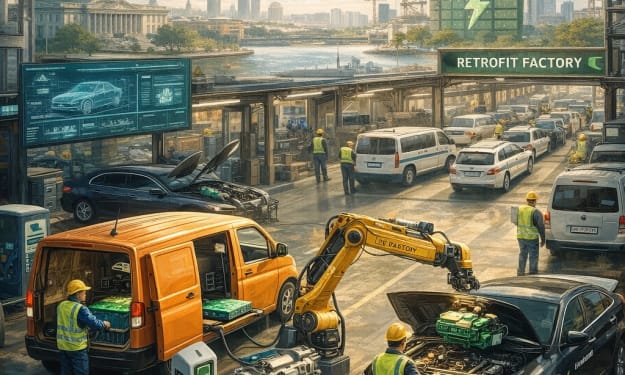
Electrifying the Existing Fleet
Electrifying the Existing Fleet: National Retrofitting as an Industrial and Climate Strategy Abstract The large-scale electrification of used internal combustion engine vehicles through retrofitting has emerged as a contested but increasingly plausible strategy within circular economy and climate policy frameworks. Rather than relying exclusively on the production of new electric vehicles, national-scale conversion programmes propose extending the life of existing vehicle fleets, particularly for government and commercial use. This article analyses the environmental rationale, economic viability, industrial constraints, policy landscape, and consumer adoption challenges associated with used-car electrification. Drawing on European case studies, cost comparisons, and current incentives, it argues that retrofitting is not a universal substitute for new electric vehicles but represents a strategically efficient solution for specific use cases, especially urban fleets operating on predictable routes.
By Peter Ayolov4 days ago in Futurism