
Do Not Go Gentle
The Truth Behind Robin Williams's Death

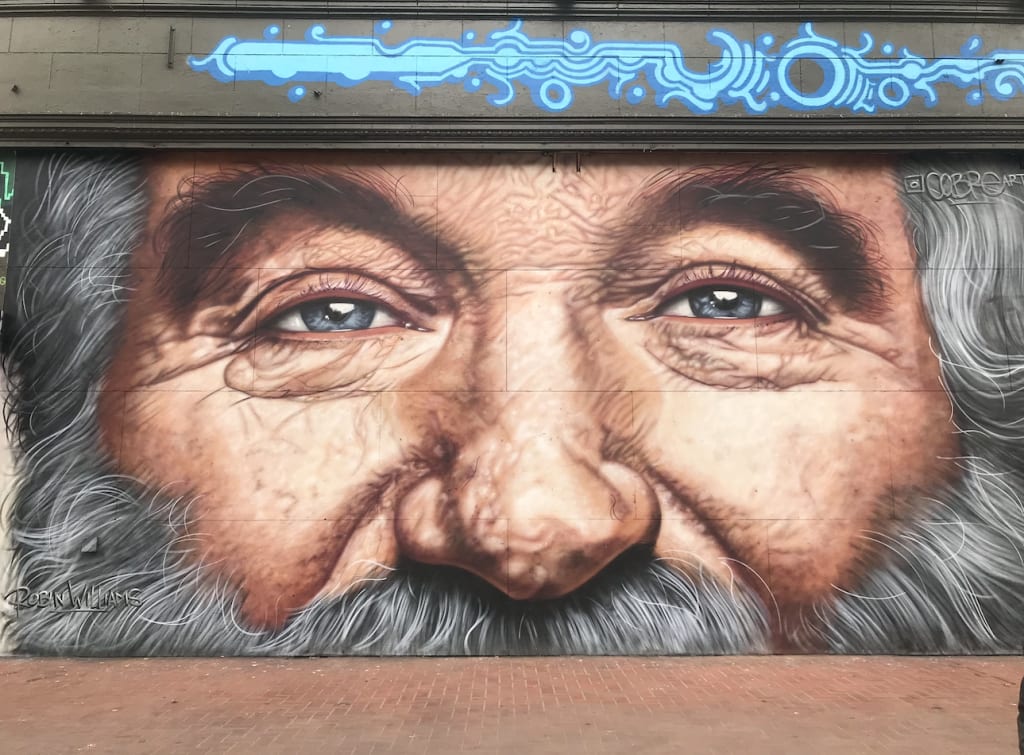
"Do not go gentle into that good night (. . .) Rage, rage against the dying of the light." - Dylan Thomas
I was in the kitchen of a B&B in Ireland when I heard that Robin Williams had died. The news was such a tragic shock to me- Robin had been a part of many beloved pieces of entertainment from my years growing up in the 90’s and early 00's. He was an institution, known in the public for both his incredible comic talent and his unique kindness in his pursuits like entertaining troops overseas or sitting by the hospital beds of young people inspiring them to go on. For my three younger siblings and I, it felt a little like hearing someone we'd known and loved in our childhood had died.
I don't normally have that strong a reaction when a celebrity dies, no matter how beloved. But Robin Williams's death stuck with me. When I heard it was a suicide it felt even more personal as someone who also dealt with depression. If someone like Robin Williams could be taken down in his prime by this malignant monster, what chance did I have? It gave me a sense of foreboding on a personal level. Everywhere the news spouted truisms about the darkness that could be lurking behind the face of comedy and the fact that we never really know what someone is going through from looking at their outward image. Awareness of mental illness was stressed for a time as it is when such things happen, and then the world of the public collapsed back to its regular rhythms.
It was a whole six years later in 2020 that I came upon a documentary film called Robin's Wish. It depicted Robin Williams's struggle with something called Lewy Body Dementia, a condition I'd never heard of in my life.
Lewy bodies are abnormal deposits of alpha-synuclein protein in the brain that cause cognitive and physical decline at a rapid, progressive pace. Upon Robin's autopsy, it was found that he had one of the worst, late-stage cases of this disease that medical professionals had ever seen. One even said that he was amazed that at the end of his life, Robin could even walk or move at all.
When he was living, Robin was not able to get a diagnosis for what he was dealing with, which only added to his distress. The documentary follows the observations from Robin's wife Susan Williams, and a few of his closest friends who were around him most as he became sicker and more reclusive. When consumed together they create the tragic story of a brilliant, kind man fighting an impossible battle with a faceless foe. What follows are several of the most common symptoms and signs of Lewy Body Dementia and the ways in which they manifested- from their onset around two years before his death.
Confusion and Increased Anxiety: probably one of the first signs Susan can remember of her husband not acting like himself was when he started to become hesitant to take the stage to do stand-up at a place they frequented down the street. As a comic, Robin had always seemed to draw from a well of endless material and the sudden lack of self-confidence was strange. As time went on, it became more pronounced: when on the set of Night at the Museum 3, director Shawn Levy related how Robin would often seem confused and express frustration and anxiety at forgetting his lines. He would seem uncharacteristically insecure and ask if he'd produced anything usable or if his material sucked. At one point he even called his wife from set having a full-blown panic attack.
Sleep Problems: Robin was often exhausted during the day but developed insomnia at night. On occasions when he slept he would thrash or speak out loud as if physically enacting his dreams. Eventually, due to this, he and Susan started sleeping in separate rooms.
Paranoia and Delusions: Susan described how Robin would go through 'delusional looping' when this got especially bad. One night he had the idea out of nowhere that a friend of his was going to die that night and she stayed up and talked him down about it for hours while he tried to text the friend and wanted to go to his house when no one answered (it was maybe 2 am so the friend was likely asleep). At other times, he would grow suspicious of their relationship and follow her around the house, questioning her loyalty. These patterns seemed to operate on a fluctuating basis, so when he became more lucid he would feel bad or embarrassed about his behavior. It tended, like in many other dementia conditions, to get worse at night.
Visual Perception Issues & Hallucinations: Robin was said to stand and stare for long periods of time as the disease advanced. It's not clear whether he had hallucinations, though this is apparently a very common symptom of LBD. In general he seemed to be very private and unwilling to burden others with the extent of what he was going through.
Memory Problems: forgetting of lines turned into more immediate memory issues. A friend recalled going on a bike ride with Robin , in which he asked him the same question multiple times 30 seconds apart.
Parkinsonian Physical Symptoms: This included muscle stiffness, a shuffling gait and tremors. It was the presence of these symptoms that caused Robin to receive a misdiagnosis of Parkinson's at the onset. He was never satisfied with this conclusion and apparently asked if they were sure he didn't have Alzheimer's or maybe Schizophrenia. In my opinion this shows just how aware of his decline he was and how disruptive his mental symptoms were getting.
These symptoms got more extreme and harder to manage at a more rapid clip about a year before Robin ultimately decided to end his life. At that point, the disease had robbed him of the ability to execute most of the things he liked to do. And the worst part was that he died with no conclusive diagnosis. I can't imagine how afraid I would be in his place of what was happening to me. I might have thought I was simply 'going crazy' and that it was all in my head.
This story was so impactful to me and I'm surprised to this day that most people I've told about it had no idea. Many people I hear reminisce about Robin Williams' work and genius still seem to tout the depression narrative and nothing else. It feels like a disservice to him to attribute the way things turned out to depression or addiction, two foes Robin was well acquainted with and had battled and come out on the other side. The toxicology report revealed that he was drug-free. While he was almost certainly depressed at the time of death, given the circumstances it seems like it was just another symptom of the problem rather than the cause.
One of Robin's friends said he felt the media "painted Robin as the sad clown" and this is still the narrative I see most. The truth was that before LBD wreaked havoc on him he was quoted as saying he was living his best life, that he had 'finally gotten it right.' He'd met his wife in 2011 (they'd bonded as recovered addicts and lived in Marin County with a close-knit neighborhood of friends.) As Susan stated point-blank in the documentary, "He did not die from depression." In fact, he'd fought depression in the past and come out the other side. His foe this time was far more insidious and resistant to any kind of cure. And he did not go down without a fight- to the end he was going to regular therapy, practicing meditations and brain exercises he was prescribed. Like the medical pros said, it was impressive that Robin had been able to maintain the level of functionality he did considering how far the disease had progressed.
I think it's important to share Robin's story not only to correct the record on this tragic piece of recent history, but to raise awareness of how many other people live with this illness, many of whom are also misdiagnosed and struggling. Suicide is unfortunately common among sufferers. In the end, I think that that’s probably something Robin Williams, who spent his life and work being such a light for others, would have wanted.
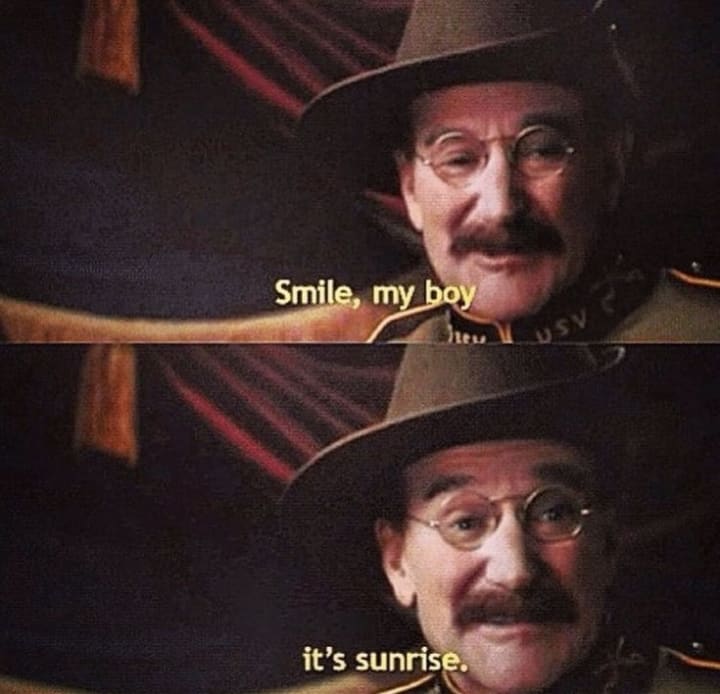
Source: you can currently watch Robin’s Wish here for free
About the Creator
Keep reading
More stories from Raistlin Allen and writers in History and other communities.
Dominus
I was a gladiator when you found me. I was living in close quarters day after day, smelling the stink of others' unwashed bodies- fighting them for space. Each day we were sent out to struggle for our lives while the nobility watched. We glistened with the fear-sweat of adrenaline as the cheers rolled over us from on high. Our pain was their pleasure. But I don't think it was ever yours. You'd known too much of pain to take pleasure in anyone else’s.
By Raistlin Allen11 months ago in History
Empire in Ashes
In late summer of the year 476, the Western Roman Empire was already a shadow of its former self, but its final hours still carried the weight of a thousand years of power. Rome no longer ruled the Mediterranean world; its emperors were puppets, its armies filled with foreign mercenaries, its treasury nearly empty. In Ravenna, the imperial capital, the teenage emperor Romulus Augustulus waited behind palace walls while events moved beyond his control. Real authority rested with Orestes, his father and commander of the army, who had seized power only a year earlier. But the soldiers who kept the empire standing had grown restless. They were foederati—Germanic troops who fought for Rome in exchange for land—and they now demanded what had long been promised. When Orestes refused, their leader, a seasoned warrior named Odoacer, turned against him. Within days, Odoacer’s forces marched across northern Italy, crushing resistance with alarming ease. Orestes was captured near Piacenza and executed, and the road to Ravenna lay open. As the final seventy-two hours began, Ravenna was tense but strangely quiet. The once-mighty empire had no legions left to defend its emperor, only thin walls and fading prestige. Odoacer’s army surrounded the city, not with the fury of a sack, but with the confidence of inevitability. Inside the palace, Romulus Augustulus—named after Rome’s legendary founder and its first emperor—stood as a tragic symbol of decline. He was young, inexperienced, and powerless, ruling an empire that existed more in memory than in reality. There was no dramatic last stand, no desperate counterattack. Negotiations replaced battles, and survival replaced pride. When Odoacer entered Ravenna, he did not burn it. He deposed the boy emperor peacefully, an act that was both merciful and final. Romulus was spared, granted a pension, and sent into exile, likely to live out his life in obscurity while history moved on without him. In the final hours, the symbols of empire were quietly dismantled. The imperial regalia—the crown, the purple robes, the insignia of supreme authority—were gathered and prepared for a journey east. Odoacer made a calculated decision that marked the true end of Western Roman rule: he did not name a new emperor. Instead, he sent the imperial insignia to Constantinople, acknowledging the Eastern Roman Emperor, Zeno, as the sole ruler of the Roman world. The message was clear and unprecedented. The West no longer needed its own emperor. What had once been the heart of a global empire was now a kingdom ruled by a barbarian king in Roman clothing. As the seventy-two hours closed, no single moment announced the fall. There were no collapsing walls or burning palaces, only the quiet disappearance of an institution that had shaped Europe, North Africa, and the Mediterranean for centuries. The Roman Senate still existed. Roman laws were still enforced. Cities still stood. But the idea of a Western Roman Emperor—an unbroken line stretching back to Augustus—was gone. The world did not end in 476, but it undeniably changed. Power fragmented, trade routes weakened, and Western Europe slowly entered a new era of competing kingdoms and shifting identities. Rome, once the ruler of the known world, became a memory, a symbol, and eventually a legend. The final seventy-two hours of the Western Roman Empire were not marked by chaos, but by quiet acceptance. Its fall was not a sudden collapse, but the last breath of a long decline. Yet even in ashes, Rome endured. Its language, laws, architecture, and ideas survived its emperors, shaping civilizations long after the crown was laid down. The empire died not with a roar, but with a whisper—leaving behind a legacy that still defines the modern world.
By Talhamuhammada day ago in History
A Love Forboding
The chipped stone slope caused unbearable footing. I slid, skirting on my heels. I cast my shield, relinquishing my guard to stay upright. Left with my double-edge and a prayer to the maker, I skated toward my objective. The earthly stubble gave way to solid ground. I found myself restored, a trail of dust in my wake.
By James U. Rizzi5 days ago in Fiction


Comments
There are no comments for this story
Be the first to respond and start the conversation.